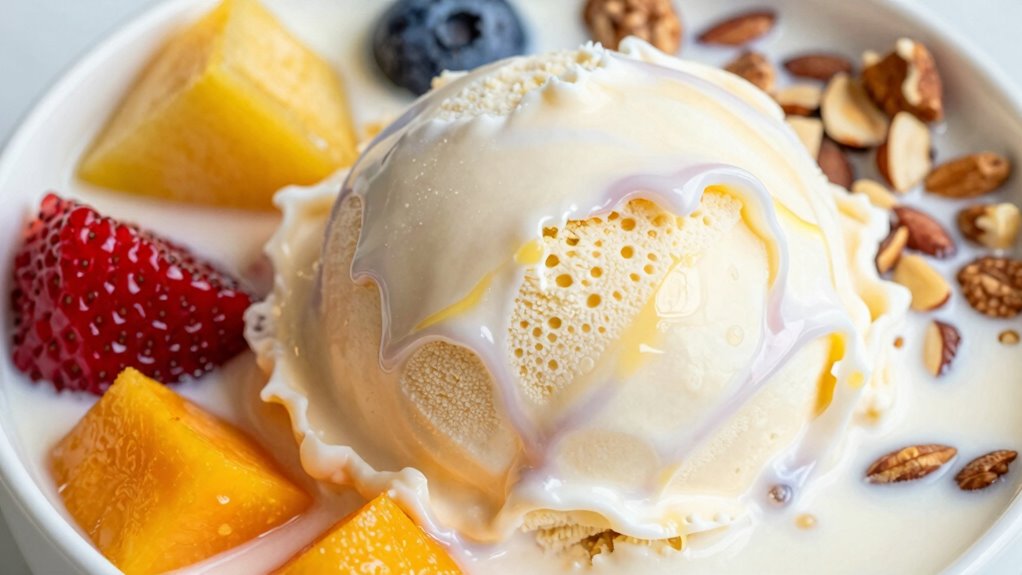
Dairy-free ice cream often separates because plant-based ingredients and stabilizers struggle to keep everything evenly blended during freezing and storage. Insufficient fat, improper emulsifiers, or weak stabilizers can cause ice crystals to grow and fats to separate, resulting in a grainy or oily texture. Temperature fluctuations and repeated thawing also break down the emulsion, making separation worse. To understand how to prevent this, learn more about ingredient roles and best storage practices.

Get baking supplies delivered free with Prime
- Fast, free delivery on millions of items
- Prime Video, Amazon Music and more included
- Member-only deals all year
Key Takeaways
- Insufficient fat content can lead to poor emulsification and separation during freezing and storage.
- Lack of stabilizers or improper usage allows ice crystals to grow, causing separation and grainy textures.
- Temperature fluctuations during storage or serving disrupt emulsion stability, resulting in separation.
- Overfreezing or repeated freeze-thaw cycles damage the structure, leading to separation and dryness.
- Poor-quality ingredients or improper mixing can weaken emulsions, increasing the risk of separation over time.
dairy-free ice cream stabilizers
As an affiliate, we earn on qualifying purchases.
As an affiliate, we earn on qualifying purchases.
What Makes Up Dairy-Free Ice Cream?
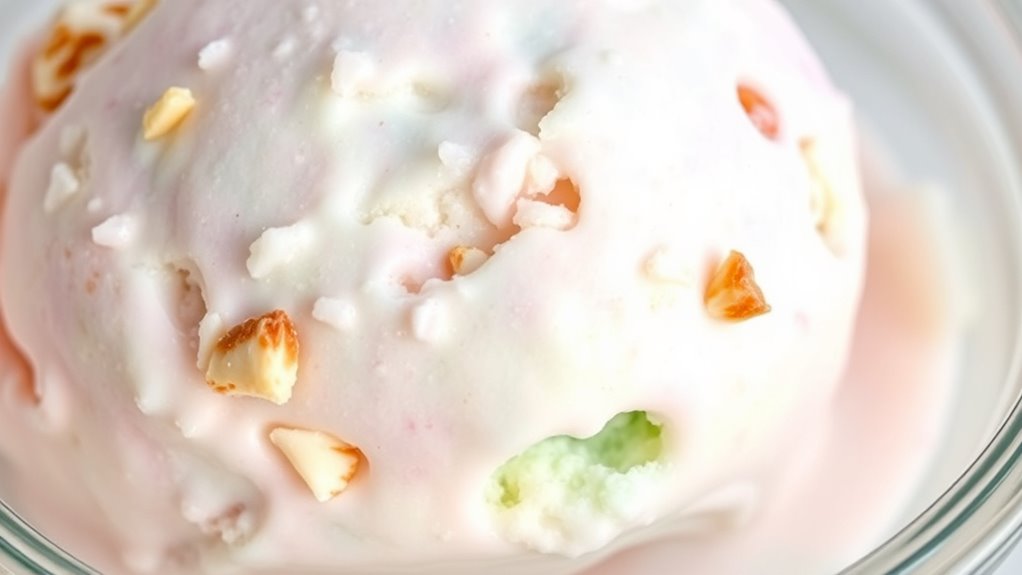
Dairy-free ice cream relies on plant-based ingredients instead of traditional dairy milk and cream. You’ll often find alternative milk options like almond, coconut, soy, or cashew milk forming the base. These provide the creamy texture and rich flavor that mimic dairy ice cream. Flavor additives are key to creating variety; natural ingredients like fruit purees, cocoa, vanilla, or even spices enhance taste. Some recipes include thickening agents such as coconut oil or plant-based gums to improve consistency. Sweeteners like agave, maple syrup, or coconut sugar balance the flavors. Overall, dairy-free ice cream combines these plant-based liquids with flavor additives to deliver a satisfying, dairy-free treat. The choice of alternative milk and flavor additives directly influences the final product’s taste and appeal. Additionally, understanding how the ingredients interact can help in achieving the desired texture and consistency in your homemade versions, especially when considering emulsification techniques to blend ingredients smoothly. Incorporating stabilizers and thickeners can further enhance the mouthfeel and prevent separation during storage.
plant-based ice cream emulsifiers
As an affiliate, we earn on qualifying purchases.
As an affiliate, we earn on qualifying purchases.
How Ingredients Influence Dairy-Free Ice Cream Texture
Your choice of fat influences how creamy and smooth your dairy-free ice cream feels, with higher fat levels providing richness. Stabilizers help prevent ice crystals from forming, giving your ice cream a better texture. Understanding how these ingredients work together lets you craft a more satisfying frozen treat. Additionally, incorporating natural ingredients can enhance both flavor and texture without compromising the health benefits of a dairy-free option. Recognizing the role of ingredient interactions can further optimize your ice cream’s consistency and overall quality. Moreover, selecting appropriate stabilizers can significantly improve the final product’s mouthfeel and stability over time, especially when combined with quality assurance practices to monitor consistency.
Fat Content Impact
The fat content in dairy-free ice cream plays a crucial role in determining its texture and mouthfeel. Higher fat levels help prevent issues like fat separation and the formation of a greasy cream layer. To understand this better:
- Low-fat options tend to be more prone to fat separation, making the ice cream less smooth.
- Adequate fat creates a creamy, rich texture that melts nicely in your mouth.
- Fat stabilizes the mixture, reducing the likelihood of a greasy or oily layer forming.
- Balancing fat content is key—too little causes separation, while too much can lead to an overly dense consistency.
- The fat content also influences how well the ice cream holds its shape during storage and serving. Incorporating the right balance of emulsifiers and stabilizers can further improve texture and prevent separation.
Adjusting fat levels carefully ensures a smoother, more stable ice cream experience without undesirable separation or a greasy cream layer.
Stabilizers and Texture
Stabilizers play a key role in shaping the texture of dairy-free ice cream by preventing ice crystal growth and ensuring a smooth, creamy consistency. Natural thickeners like guar gum, xanthan gum, and agar help achieve this by binding water and adding body to the mixture. These stabilizers also work as flavor enhancers, making every spoonful richer and more satisfying. They improve mouthfeel and prevent the ice cream from becoming icy or grainy. When choosing stabilizers, look for those derived from natural sources to keep your ice cream clean-label and healthy. Proper use of these ingredients helps maintain the desired texture, even after freezing and storage. Additionally, understanding the water-binding properties of stabilizers allows for better control over the final product’s consistency. Recognizing the interactions between stabilizers and other ingredients can further improve the overall quality of your dairy-free ice cream. Using stabilizers that are compatible with a variety of dietary preferences ensures that your dairy-free ice cream appeals to a broader audience. Incorporating knowledge of ingredient interactions can also help optimize the formulation for both taste and texture. Moreover, selecting stabilizers with natural origins can enhance the health profile of your ice cream. In essence, stabilizers are fundamental for creating a dairy-free ice cream that’s smooth, creamy, and enjoyable from the first scoop to the last.
vegan ice cream freezer storage containers
As an affiliate, we earn on qualifying purchases.
As an affiliate, we earn on qualifying purchases.
How Emulsifiers and Stabilizers Keep Ice Cream Smooth
Emulsifiers help blend fats and liquids smoothly, preventing separation and ensuring a creamy texture. Stabilizers add thickness and trap air, which keeps your ice cream soft and scoopable. Together, they work to maintain the ideal smoothness in dairy-free ice cream. Additionally, UV lamps for resin crafting can be used to cure certain additives in the recipe, enhancing texture and consistency. These processing techniques ensure the final product remains uniform and appealing, especially when incorporating electric power generation methods to control production conditions. Understanding the role of food additive safety is also important to ensure the ingredients used are suitable for consumption and do not compromise health.
Role of Emulsifiers
Emulsifiers play a crucial role in maintaining the smooth, creamy texture of dairy-free ice cream. They work by stabilizing fat and water mixtures, preventing separation. There are different emulsifier types, each with unique functions:
- Lecithin helps blend oils and liquids smoothly.
- Gums like xanthan stabilize the mixture and improve texture.
- Mono- and diglycerides aid in dispersing fats evenly.
- Carrageenan adds viscosity and prevents ice crystallization. Their main functions include reducing surface tension, creating a stable emulsion, and improving mouthfeel. Without emulsifiers, dairy-free ice cream can become grainy or separate, compromising quality. Understanding emulsifier functions is essential for perfecting dairy-free recipes. Proper selection and use of emulsifiers can also influence the overall product stability, ensuring a consistent and enjoyable ice cream experience from first scoop to last. Additionally, choosing the right emulsifiers can help optimize texture and flavor for a better consumer experience. Moreover, emulsifiers contribute to product shelf life, helping maintain quality during storage and transportation.
Furthermore, the correct emulsifier combination can enhance the appearance of the final product, making it more appealing to consumers.
Function of Stabilizers
To keep dairy-free ice cream smooth and creamy, stabilizers work by preventing ice crystals from forming and reducing texture issues. They interfere with the gelation process, ensuring a uniform structure. Stabilizers also enhance ingredient interactions, helping ingredients blend seamlessly and maintain consistency. Think of stabilizers as the backbone that supports the ice cream’s smooth texture. They slow down ice crystal growth, which keeps the ice cream scoopable longer. Here’s how stabilizers work:
| Stabilizer Type | Function |
|---|---|
| Guar Gum | Binds water, prevents ice crystal growth |
| Xanthan Gum | Improves viscosity, stabilizes texture |
| Carrageenan | Interacts with proteins, thickens |
| Agar | Gelation, enhances structure |
| Locust Bean Gum | Synergizes with other stabilizers |
These ingredients ensure your dairy-free treat stays luscious and smooth. Understanding stabilizer functions helps in selecting the right ingredients for optimal texture, especially when considering texture preservation techniques used in dairy-free ice cream production.
natural ice cream thickening agents
As an affiliate, we earn on qualifying purchases.
As an affiliate, we earn on qualifying purchases.
How Temperature and Storage Impact Ice Cream Quality

Temperature and storage conditions play a crucial role in maintaining the quality of dairy-free ice cream. Proper temperature stability guarantees your ice cream stays smooth and prevents unwanted separation. Poor storage conditions can cause ice crystals to form, leading to gritty texture or melting. To keep your ice cream at its best, consider these tips:
- Store your ice cream at a consistent temperature, ideally around -20°C.
- Avoid frequent temperature fluctuations, which can compromise texture.
- Use airtight containers to prevent moisture and flavor transfer.
- Keep ice cream away from the freezer door, where temperatures fluctuate most.
How Freezing and Thawing Cycles Affect Texture
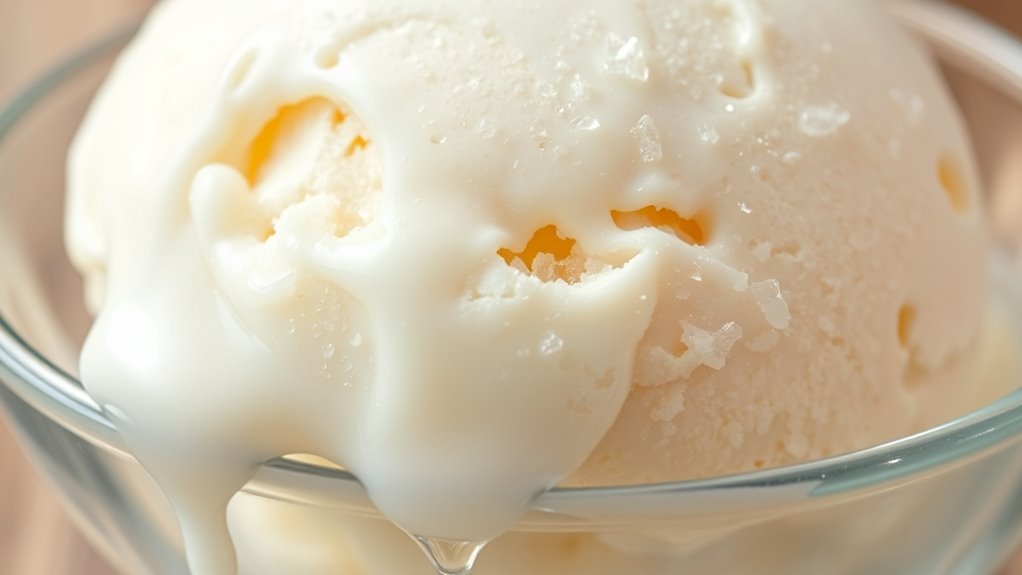
Frequent freezing and thawing cycles can profoundly damage the texture of dairy-free ice cream. Each cycle causes ice crystals to grow larger, leading to a grainy or icy consistency due to freezing effects. When ice cream thaws, the structure collapses as the melted water separates from the fat and stabilizers. Thawing challenges arise because repeated temperature changes prevent the mixture from maintaining a smooth, uniform texture. These fluctuations weaken the emulsion, causing ice crystals to merge and create a gritty, uneven mouthfeel. Additionally, moisture loss during thawing can result in ice cream becoming overly dry or crumbly. To preserve your dairy-free ice cream’s texture, avoid unnecessary freeze-thaw cycles and keep it stored at a consistent temperature.
How to Scoop and Serve Dairy-Free Ice Cream Perfectly
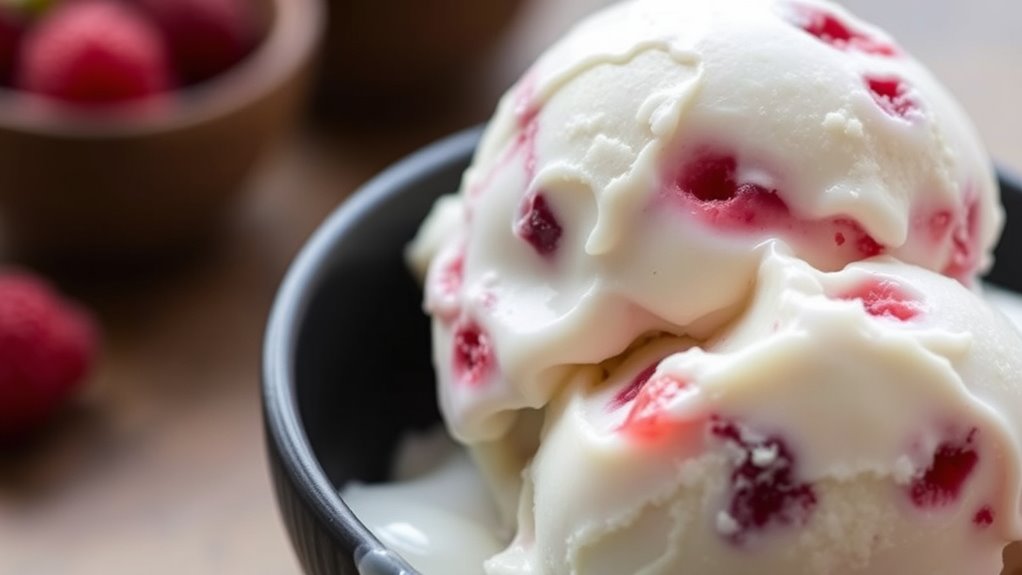
Handling dairy-free ice cream carefully is key to maintaining its smooth texture when serving. To scoop and serve it perfectly, start by letting it sit at the right serving temperature—about 10-15 minutes out of the freezer. This softens it just enough for easy scooping. Next, follow these tips:
For smooth serving, soften dairy-free ice cream 10-15 minutes before scooping.
- Use a warmed scoop or dip it in hot water before scooping to make the process smoother.
- Avoid pressing too hard; gentle, steady pressure preserves the ice cream’s consistency.
- Add your favorite dairy free flavoring after scooping to enhance taste without affecting texture.
- Serve immediately to prevent melting or separation, especially in warmer environments.
How Choosing Quality Ingredients Reduces Separation
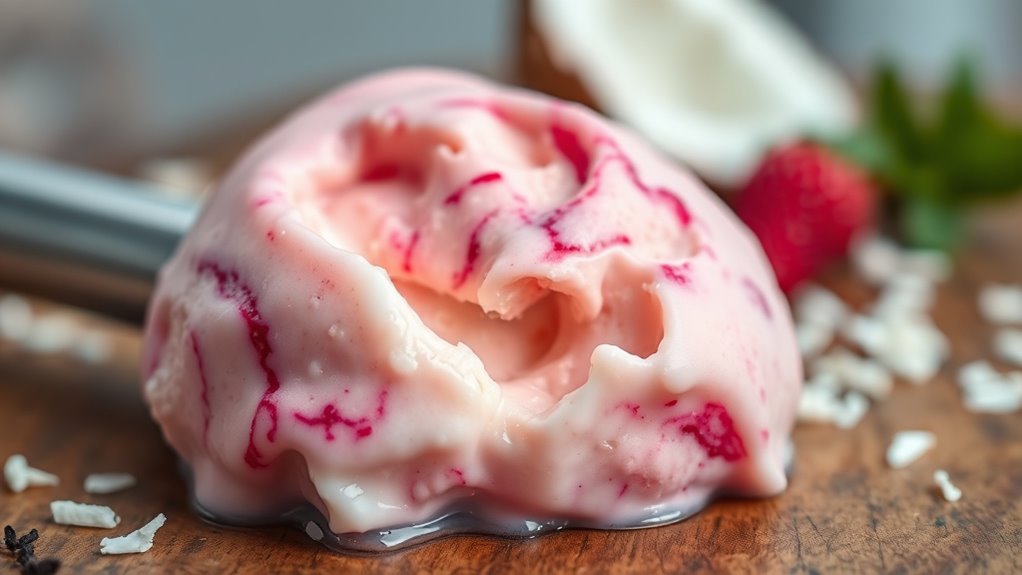
Choosing high-quality ingredients is essential because they have better natural stabilizers and emulsifiers that help maintain the ice cream’s creamy texture. When you select premium ingredients, you reduce the need for artificial flavors, which can cause separation, and instead rely on natural sweeteners that blend smoothly. Quality nuts, fruits, and plant-based fats provide a more stable base, minimizing separation over time.
| Ingredient Type | Benefits | Examples |
|---|---|---|
| Natural Sweeteners | Improve texture, reduce separation | Maple syrup, agave nectar |
| Emulsifiers | Keep fats and liquids well integrated | Lecithin, fruit purees |
| Stabilizers | Prevent ice crystal formation, separation | Agar, guar gum |
Frequently Asked Questions
Can Homemade Dairy-Free Ice Cream Prevent Separation Effectively?
Yes, homemade dairy-free ice cream can prevent separation effectively. You can use homemade techniques like churning thoroughly and incorporating ingredient tweaks such as adding stabilizers like xanthan gum or cornstarch. These methods help create a smoother, more cohesive texture by preventing ice crystal formation and separation. Regular stirring during freezing also keeps the mixture uniform, ensuring your dairy-free ice cream stays creamy and well-blended.
Are There Specific Brands That Resist Separation Better?
Brands like So Delicious and Ben & Jerry’s stand out for their superior stability, thanks to careful ingredient formulation. While many dairy-free options face separation, these brands use stabilizers and emulsifiers that keep their ice cream smooth and creamy longer. You’ll find that their focus on brand stability minimizes separation, making them a reliable choice if you want dairy-free ice cream that stays well-mixed and irresistibly creamy.
How Does Adding Sugar Influence Separation in Dairy-Free Ice Cream?
Adding sugar to dairy-free ice cream helps reduce separation by preventing sugar crystallization, which can cause ice crystals to form and make the texture gritty. Sugar also enhances flavor, making your ice cream more enjoyable. However, too much sugar can promote separation if it leads to uneven freezing, so balance it carefully. Overall, a moderate amount improves texture and flavor while minimizing the risk of separation.
Does the Type of Plant-Based Milk Impact Separation Issues?
Yes, the type of plant-based milk impacts separation issues because different plant-based alternatives have varied milk compositions. For example, coconut milk is high in fat, which helps keep the mixture stable, while almond milk is lower in fat and more prone to separation. You should consider the milk’s protein and fat content, as these influence how well your dairy-free ice cream stays smooth and creamy without separating.
Can Storage Containers Affect the Separation of Dairy-Free Ice Cream?
Sure, your fancy glass container probably won’t help your dairy-free ice cream stay smooth, but a flimsy plastic one might. The container material and size matter because they influence temperature and air exposure, which can worsen separation. Bigger containers might leave more air, causing ice crystals, while smaller ones keep things colder and more stable. So, choose wisely to keep your ice cream creamy and delicious.
Conclusion
Think of your dairy-free ice cream as a delicate garden. When you nurture it with quality ingredients, proper storage, and gentle handling, it blooms into a smooth, delightful treat. But neglect or sudden changes can cause it to separate, like a garden overrun by weeds. By tending carefully, you guarantee your ice cream remains a beautiful, harmonious experience—proof that patience and care turn simple ingredients into something truly special.
Halloween Picks
halloween
As an affiliate, we earn on qualifying purchases.