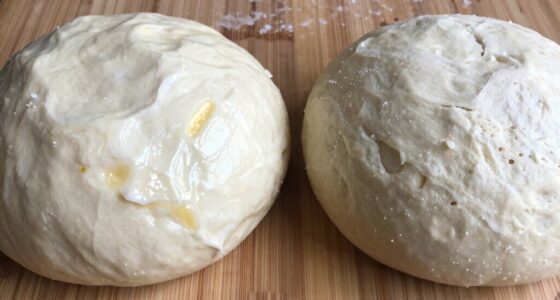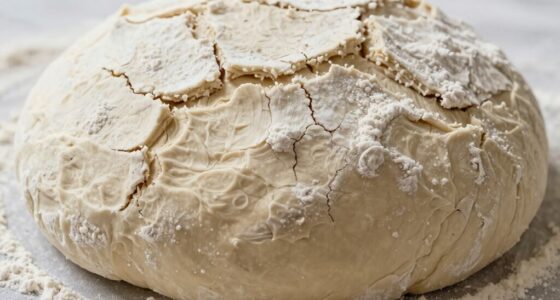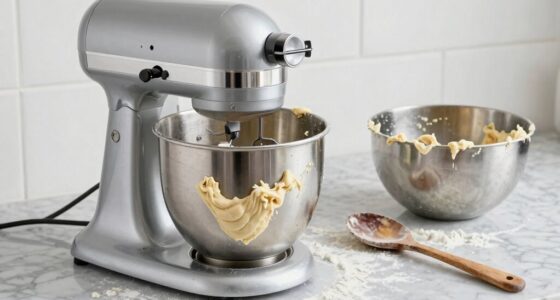

When thinking about batch size in home mixing, focus on your project’s needs and accuracy. Small batches are great for testing and tweaking, but they require precise measurements and careful tools to avoid errors. Large batches save time but need well-calibrated equipment to guarantee consistency. Balancing your batch size with these factors helps you achieve the best results while minimizing waste. Keep exploring to learn how to optimize your approach for perfect mixes every time.
Key Takeaways
- Match batch size to your project scope, balancing testing needs and full-scale production.
- Use precise measurement tools, especially for small batches, to ensure ingredient accuracy.
- Regularly calibrate equipment to maintain consistency across larger batches.
- Start with small batches to refine techniques before scaling up to larger quantities.
- Prioritize measurement accuracy and equipment calibration to prevent errors and waste.
Have you ever wondered how the size of your mixing batch affects your home projects? The key lies in understanding how batch size influences ingredient accuracy and equipment calibration. When you’re working on small batches, it can be tempting to eyeball measurements or rush through mixing, but that can lead to inaccuracies that compromise your entire project. Larger batches demand more precise measurement and calibration to ensure consistency and quality.
Smaller batches need precise measurements; larger ones require careful equipment calibration for consistent, quality results.
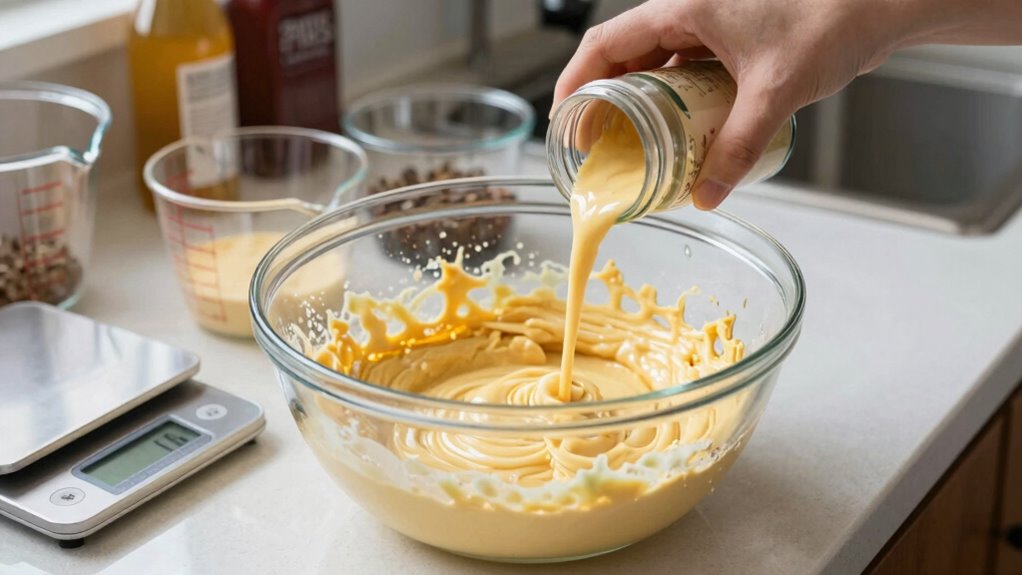
If your batch is too small, even a slight mismeasurement can throw off the entire mixture. For example, adding a pinch more of an ingredient or misreading your measuring tools can significantly impact the final result. To avoid this, you should pay close attention to ingredient accuracy, using precise tools like digital scales or graduated cups. When working with small quantities, double-check your measurements to ensure they’re exact. This attention to measurement accuracy helps your mixture maintain the consistency needed for a professional finish. Additionally, understanding batch size can help you optimize your workflow and reduce errors. Recognizing the importance of equipment calibration ensures that your tools are providing accurate results, especially when working with larger quantities. Proper calibration also extends the lifespan of your tools and maintains their reliability over time. Regularly calibrating your equipment can prevent unexpected issues during your projects and save you time in the long run.
On the other hand, bigger batches might seem easier to work with because you’re pouring everything into a large container, but they come with their own challenges. Equipment calibration becomes critical here. If your mixing tools, such as scales or mixers, aren’t properly calibrated, larger batches can turn into a mess of uneven textures or inconsistent ingredients distribution. Regular calibration of your equipment guarantees that you’re adding the right amounts and blending everything thoroughly. For instance, if your mixer is off by even a small percentage, the entire batch could turn out differently than expected, wasting time and materials.
Thinking about batch size also means considering your workspace and project scope. Small batches are ideal for testing new recipes or colors, allowing you to make adjustments without wasting too much material. Larger batches suit bigger projects, but only if you’re confident in your measurements and calibration. It’s wise to start small, perfect your process, then scale up once you’re sure your measurements are precise and your equipment is properly calibrated. Developing proper measurement techniques can significantly improve your overall results and efficiency.
In essence, the best way to think about batch size in home mixing is to balance your project needs with the importance of accuracy and calibration. Never underestimate the impact of small measurement errors or uncalibrated equipment—these can derail your project’s success. By paying close attention to these factors, you’ll improve your consistency, reduce waste, and get better results every time. Whether you’re mixing a small batch for a touch-up or a large one for a major project, precision remains your best tool for success.

Etekcity Digital Food Kitchen Scale, Grams and Oz for Weight Loss, Baking and Cooking, 0.05oz/1g Precise Graduation,5 Weight Units, IPX6 Waterproof, USB Rechargeable,304 Stainless Steel-Silver, 22lb
𝗠𝗮𝘅 𝗖𝗮𝗽𝗮𝗰𝗶𝘁𝘆: Weigh objects as heavy as 22 lb/10 kg and as light as 2 g in increments…
As an affiliate, we earn on qualifying purchases.
As an affiliate, we earn on qualifying purchases.
Frequently Asked Questions
How Does Batch Size Affect Mixing Time?
Your batch size directly impacts mixing time because larger batches take longer to blend thoroughly. If you choose a batch size that exceeds your equipment capacity, it can lead to uneven ingredients consistency and longer mixing times. Conversely, smaller batches mix quickly, ensuring uniformity and preventing strain on your equipment. Finding the right balance helps you achieve efficient mixing while maintaining consistent ingredient quality.
What Materials Are Best for Small Batch Mixing?
For small batch mixing, choose materials like high-quality plastics or stainless steel, which offer excellent durability and resist chemical reactions. Guarantee your containers are compatible with the materials you’re mixing to prevent contamination or damage. Durable materials help your tools last longer, while compatible containers make cleanup easier and preserve the integrity of your mixture. Opting for these materials simplifies your process and ensures consistent, high-quality results.
Can Batch Size Impact the Quality of the Final Product?
Sure, your batch size can totally make or break your masterpiece. If you go too big, ingredients might lose consistency, like a bad hair day for your mixture. Equipment limitations also come into play—small blenders can’t handle massive batches, leading to uneven textures. So, keep your batch size just right; it’s the secret to that perfect, consistent final product, without overloading your gear or sacrificing quality.
How Do I Scale Batch Size for Larger Projects?
To scale batch size for larger projects, you need to maintain color consistency and ingredient proportion. Double or triple your recipe carefully, measuring ingredients precisely to guarantee uniformity. Use larger mixing equipment if necessary, and mix thoroughly to avoid uneven distribution. Keep track of measurements, and test small batches first to confirm the color and texture stay consistent before scaling up fully.
Are There Safety Concerns With Different Batch Sizes?
Yes, safety concerns vary with batch size because larger batches require robust safety protocols and compatible equipment. Always guarantee your safety gear, like gloves and masks, is suitable for the volume you’re mixing. Check that your equipment can handle the batch size to prevent spills or malfunctions. Following proper safety protocols and verifying equipment compatibility helps minimize risks, ensuring a safe and successful mixing process regardless of batch size.

Hamilton Beach 6-Speed Electric Hand Mixer with Whisk, Traditional Beaters, Snap-On Storage Case, 250 Watts, White
NO MORE LOST BEATERS: The snap-on storage case that comes with the Hamilton Beach hand mixer neatly holds…
As an affiliate, we earn on qualifying purchases.
As an affiliate, we earn on qualifying purchases.
Conclusion
Think of batch size in home mixing like a recipe’s perfect balance—too small, and you might run out before you’re done; too large, and cleanup becomes a mountain. Finding that sweet spot guarantees your project flows smoothly, saving time and effort. Remember, it’s about working smart, not hard. When you strike the right balance, your mixing process becomes a well-choreographed dance rather than a chaotic scramble. Happy mixing!
![[Pack of 100] 10oz Disposable Graduated Measuring Cups for Mixing - Measurements in mL and Oz - Multipurpose Reusable Cups for Paint, Epoxy Resin, Stain, Liquid Mixing Cups](https://m.media-amazon.com/images/I/51VQiLium5L._SL500_.jpg)
[Pack of 100] 10oz Disposable Graduated Measuring Cups for Mixing – Measurements in mL and Oz – Multipurpose Reusable Cups for Paint, Epoxy Resin, Stain, Liquid Mixing Cups
BANG FOR YOUR BUCK – Includes 100 10oz PET Mixing Cups (measurement lines to 7.5 oz, holds 10oz…
As an affiliate, we earn on qualifying purchases.
As an affiliate, we earn on qualifying purchases.

ANGSO-AUTO ADAS Calibration Dynamic Acc Positioning Tool for Planar Unit, Angle Leveling Tool ADAS Calibration Tool for Car Use
The Car Radar Angle Leveling Tool is designed to be powered by 2* AAA 1.5 V batteries (Please…
As an affiliate, we earn on qualifying purchases.
As an affiliate, we earn on qualifying purchases.