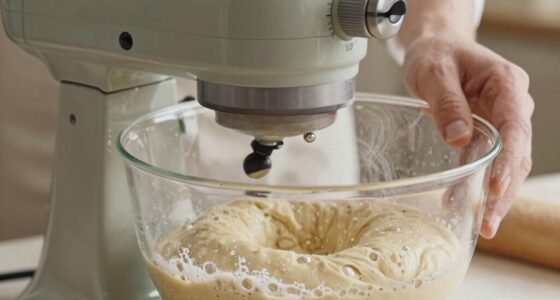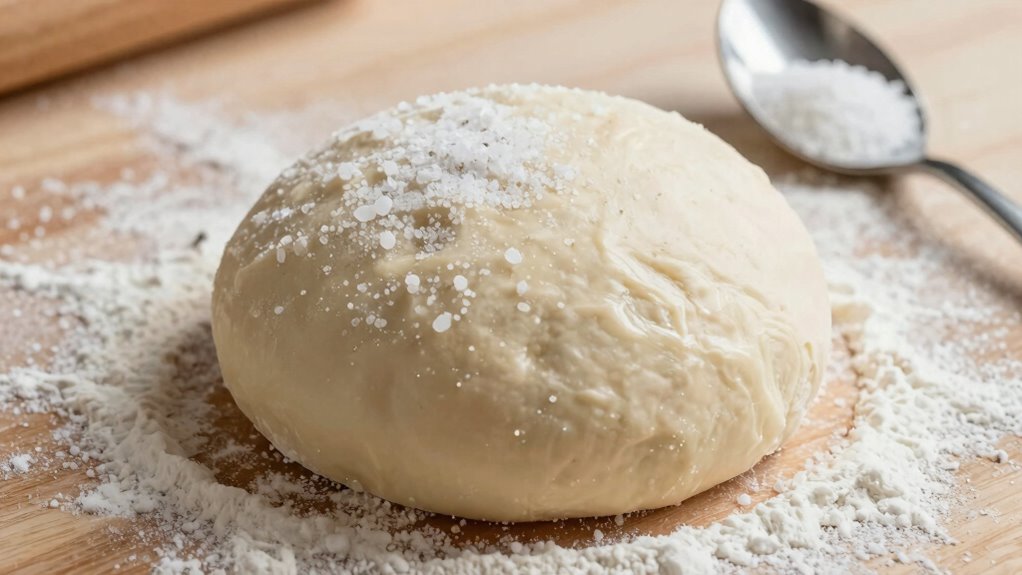

Salt timing affects dough feel more than you might expect because adding it early tightens the gluten, making the dough firmer, less sticky, and easier to handle. Late salt results in softer, stickier dough that’s harder to shape. This change impacts hydration, elasticity, and how the dough responds during kneading and shaping. Understanding these effects helps you control your dough’s texture and performance—if you keep exploring, you’ll discover even more ways salt timing influences your baking.
Key Takeaways
- Early salt tightens gluten, resulting in firmer, more cohesive dough that feels less sticky and easier to handle.
- Late salt leads to softer, stickier dough due to delayed gluten strengthening, affecting kneading and shaping.
- Salt moderates yeast activity, influencing fermentation speed and dough elasticity, thus altering dough feel.
- Proper salt timing enhances gluten development and hydration, directly impacting dough’s resilience and stretchiness.
- Variations in salt addition timing cause noticeable differences in dough texture, handling, and final bread structure.
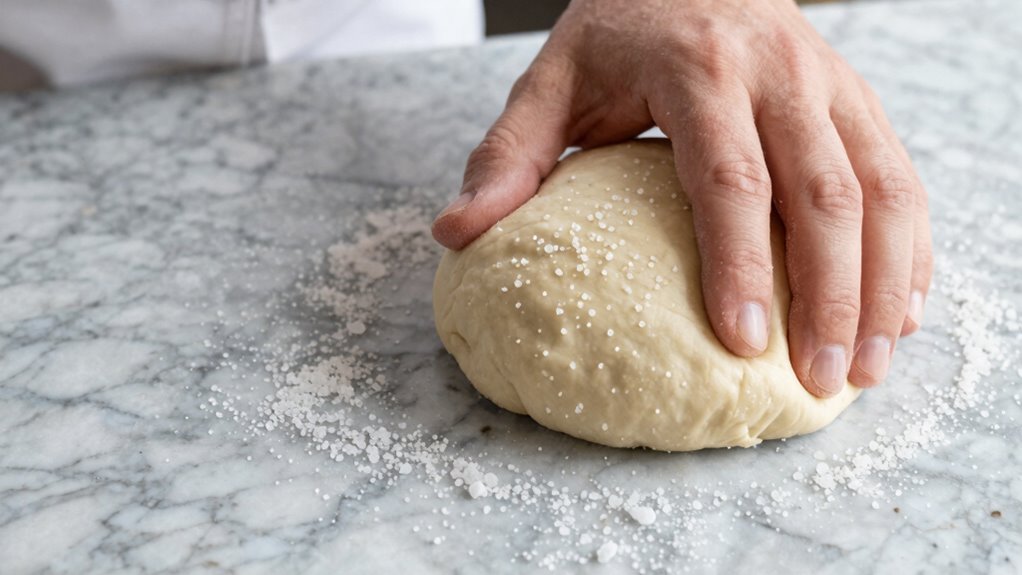
Salt plays a crucial role in bread baking, but when you add it can considerably impact your dough’s texture and development. The timing of salt incorporation isn’t just a minor detail—it influences how your dough ferments, develops gluten, and ultimately, how your bread turns out. When you add salt early in the process, it slows down fermentation, giving the yeast less room to work quickly. This controlled fermentation can lead to a more complex flavor and a finer crumb, but it also affects gluten development. Salt tightens the dough’s gluten network, making it more elastic and less sticky. This means your dough can handle more shaping without tearing, and it tends to rise more uniformly. If you add salt too late, after the initial mixing or during the final stages, you might notice your dough feels softer, less structured, and more difficult to handle. The gluten network might not be as strong, which can result in a denser crumb or uneven rise.
Adding salt early strengthens gluten and controls fermentation, resulting in a finer crumb and more uniform rise.
Timing impacts fermentation impact markedly. When salt is added early, it moderates yeast activity, preventing over-fermentation that can produce sour flavors or collapse. This moderation allows the dough to develop a better gluten structure over time, leading to improved overall texture. Conversely, late salt addition can cause rapid fermentation early on, which might produce a more open crumb but risks over-proofing or uneven gluten development. You’ll notice that dough with late salt tends to be softer, more extensible, and less resilient during shaping. Additionally, the impact of salt timing on dough feel can be quite significant, as it directly influences how the dough responds during kneading and shaping. Understanding the role of gluten development in this process helps explain why salt timing has such a profound effect. Moreover, the metaphysical significance of proper salt use can be seen as a metaphor for how timing and balance influence not just baking, but other aspects of life and spiritual practices. Achieving the right balance of ingredients is key to mastering bread baking, just as it is in many areas of life.
Adding salt at different stages also impacts the dough’s hydration level, which can alter how it handles and the final texture. Your touch and the dough’s feel change depending on when you add salt. Early salt will make the dough feel firmer and more cohesive, as the gluten strands tighten and strengthen. Late salt results in a softer, stickier dough that’s harder to shape but may have a slightly lighter crumb if fermented properly. If you’re aiming for a specific bread texture—say, a chewy artisan loaf or a tender sandwich bread—the timing of salt becomes a tool to influence those qualities. Experimenting with when you add salt allows you to control fermentation impact and gluten development, giving you more mastery over your final product.
In essence, understanding the effects of salt timing isn’t just about taste—it’s about how your dough feels and performs. Paying attention to when you incorporate salt can make a noticeable difference in the bread’s structure, texture, and flavor. The more intentional you are with this step, the better your dough will handle, rise, and ultimately, deliver that perfect crust and crumb you’re after.

Joydeem Electric Dough Maker with Ferment Function, Microcomputer Timing, Face-up Touch Panel, 7.4Qt, 304 Stainless Steel, JD-HMJ7L
Smart & Useful: Dough maker machine is controlled by microcomputer, which allows for time presetting and intelligent selection…
As an affiliate, we earn on qualifying purchases.
As an affiliate, we earn on qualifying purchases.
Frequently Asked Questions
How Does Salt Interact With Gluten Development?
Salt interacts with gluten development by strengthening the protein network, which improves dough elasticity and structure. It also enhances flavor, making the baked goods more appealing. When added early, salt can slow down yeast activity, allowing gluten to develop more fully and uniformly. This combination of gluten strengthening and flavor enhancement results in a dough that’s easier to handle and produces a better crumb in the final product.
Can Salt Timing Affect Dough Fermentation Speed?
Yes, salt timing can affect dough fermentation speed. When added early, salt slows fermentation, allowing more flavor enhancement and better crust texture development. If you add it too late, fermentation speeds up, potentially impacting dough strength and flavor. By adjusting when you add salt, you control fermentation, influencing the final bread’s flavor and crust. Proper timing helps you achieve the ideal balance of taste and texture.
Does Salt Influence the Yeast Activity During Mixing?
Salt subtly suppresses yeast activity during mixing, shaping the speed of fermentation. You’ll notice that salt’s influence enhances flavor and fortifies dough elasticity, giving it a firm, flexible feel. When you add salt early, it slows yeast action, allowing flavors to deepen and gluten to develop. Conversely, adding salt later keeps fermentation lively. Timing truly transforms the dough’s texture, taste, and overall quality, making every step essential.
How Does Salt Impact Dough Hydration Levels?
Salt impacts dough hydration levels by controlling how water interacts with the flour, which in turn influences dough elasticity. When you add salt at the right time, it helps strengthen gluten, making the dough more elastic and manageable. Salt flavor enhances the overall taste, but it also tightens the dough structure, reducing water absorption slightly. Proper salt timing guarantees a balanced dough that’s both flavorful and easy to shape.
Are There Differences in Salt Types Regarding Timing Effects?
Yes, different salt types affect timing effects differently. Fine table salt dissolves quickly, providing rapid flavor enhancement and preservation effects, while coarse sea salt dissolves more slowly, giving more gradual flavor development. Using kosher salt offers a balance, with moderate dissolution. These differences influence how salt interacts with dough, impacting texture and fermentation. Adjust your timing based on salt type to optimize flavor, preservation, and dough feel.

Etekcity Food Kitchen Scale, Digital Grams and Ounces for Weight Loss, Baking, Cooking, Keto and Meal Prep, LCD Display, Medium, 304 Stainless Steel
𝗘𝗳𝗳𝗼𝗿𝘁𝗹𝗲𝘀𝘀 𝗪𝗲𝗶𝗴𝗵𝗶𝗻𝗴: Supports 5 units (oz/lb:oz/fl'oz/g/mL), tare function, and includes 2 AAA batteries for hassle-free operation
As an affiliate, we earn on qualifying purchases.
As an affiliate, we earn on qualifying purchases.
Conclusion
Understanding when to add salt is like tuning a delicate instrument—you can’t just pluck the strings at any time and expect harmony. Timing influences how the dough develops, affecting both feel and structure in ways you might not immediately notice. By paying attention to when you incorporate salt, you’re orchestrating a symphony of texture and flavor, turning simple ingredients into a masterpiece. Master this timing, and your dough will sing with the perfect balance of strength and tenderness.

DOYOLLA Bread Proofing Baskets Set of 2 8.5 inch Round Dough Proofing Bowls and Liners Perfect Home Sourdough Bread Baking supplies
Perfect Home Proofing Baskets for Sourdough Bread Baking
As an affiliate, we earn on qualifying purchases.
As an affiliate, we earn on qualifying purchases.

SURDOCA Dough Scraper Bench Scraper – 3P 4.7×3.7" Plastic Flexible Bowl Scraper, Sharp Edge & Angles Cake Scraper. Non-Slip Bakeware Decorating Tools Sculpting & Modeling Tools – Green+White+Green
👩🍳👩🍳👩🍳PERFECT WORK WITH VARIOUS KNEADING BOWLS — Instead of traditional rigid PP plastic, These flexible dough scrapers are…
As an affiliate, we earn on qualifying purchases.
As an affiliate, we earn on qualifying purchases.