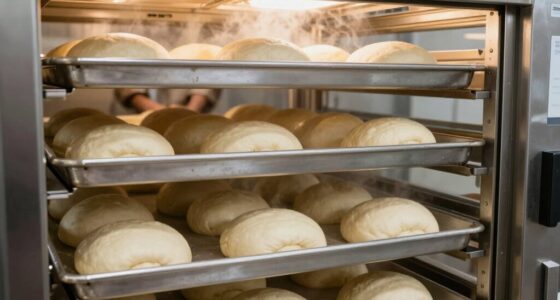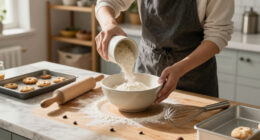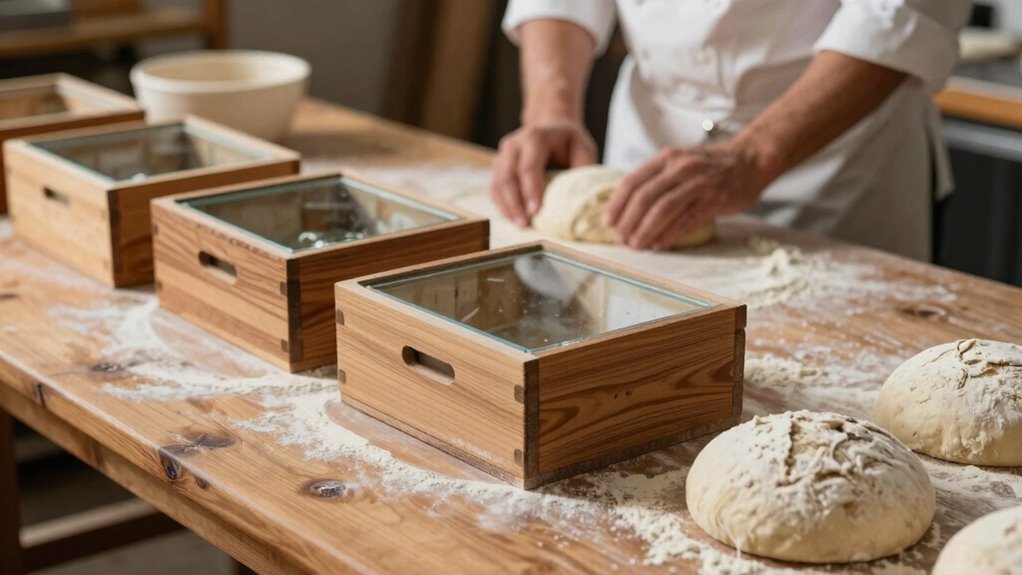
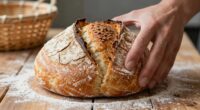
Proofing boxes can help maintain a consistent environment, but they don’t teach you how to judge dough’s readiness. Your skill in observing signs like dough size, texture, and elasticity is essential for perfect fermentation. Relying solely on temperature control means you might miss important cues that indicate whether your dough needs more time. Developing good fermentation judgment takes experience and attention—continue exploring, and you’ll discover how to refine your craft beyond just using proofing boxes.

Get baking supplies delivered free — and shop member deals
- Fast, free delivery on millions of items
- Access to Prime Big Deal Days deals on October 6–7
- Prime Video, Amazon Music and more included
Key Takeaways
- Proofing boxes provide a controlled environment but cannot replace the skill of observing dough cues.
- Good fermentation judgment relies on visual, tactile, and responsive assessment beyond just temperature control.
- Over-reliance on proofing boxes may lead to neglecting dough behavior and natural fermentation signs.
- Adjusting fermentation based on dough response is essential, which proofing boxes alone cannot facilitate.
- Experience and observation are crucial for optimal fermentation, which cannot be fully replicated by proofing boxes.
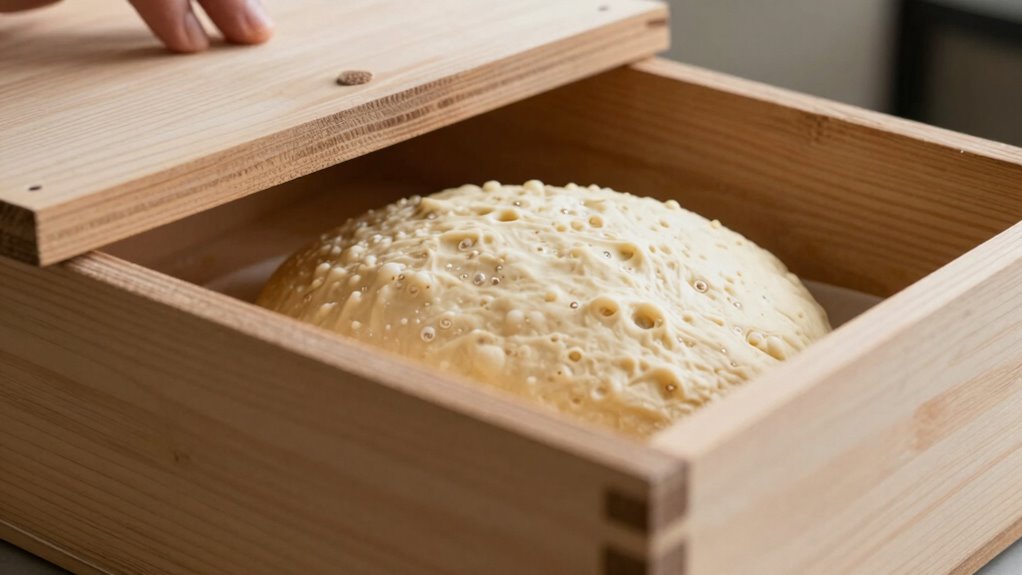
While proofing boxes can help create a controlled environment for dough, they can’t replace the essential skill of good fermentation judgment. Relying solely on a proofing box might give you a consistent temperature and humidity, but understanding how your dough behaves is fundamental for perfect fermentation. Temperature control is critical because yeast activity directly depends on it. If your dough gets too warm, fermentation speeds up, risking overproofing and losing that desirable airy texture. Too cold, and fermentation slows, leading to underproofed dough with dense results. You need to learn how your dough responds to different temperatures, adjusting proofing times accordingly.
Understanding your dough’s response to temperature is key to achieving perfect fermentation every time.
Dough hydration also plays a pivotal role in fermentation. The water content influences how quickly yeast activates and how gluten develops during proofing. Higher hydration doughs tend to ferment faster and often produce a more open crumb, but they can also be trickier to handle. If your dough is too dry, fermentation may slow, and gluten may not develop properly, resulting in a dense loaf. Conversely, overly hydrated dough might ferment rapidly but become difficult to shape and handle. You must observe how your dough’s hydration level affects fermentation, making adjustments based on how it feels and responds. Recognizing fermentation cues is crucial for timing your next steps effectively.
Understanding the nuances of fermentation involves more than just setting a temperature inside a proofing box. You need to watch for signs of proper fermentation, such as dough volume increase, surface smoothness, and elasticity. These visual and tactile cues are often more reliable than the settings on your proofing box. For example, if your dough has doubled in size and feels airy when gently poked, it’s likely ready for the next step. If it’s overly sticky or still dense, it needs more time, regardless of the timer or humidity level. This judgment comes from experience—knowing what good fermentation looks and feels like. Observation and experience are key components in developing good fermentation judgment.
Even with a proofing box, you should constantly monitor how your dough reacts to different conditions. Temperature and dough hydration are just starting points; your real skill lies in interpreting the dough’s behavior. Every batch might require slight adjustments, and your ability to recognize when to extend or shorten fermentation makes all the difference. Ultimately, proofing boxes are tools to aid consistency but can’t replace your understanding of fermentation’s subtleties. Your judgment, honed through observation and experience, will always produce better bread than simply relying on a machine. Developing this fermentation judgment is essential for achieving optimal results. Additionally, understanding the science of fermentation can help refine your intuition and improve your baking outcomes.
As an affiliate, we earn on qualifying purchases.
Frequently Asked Questions
Can Proofing Boxes Improve Bread Flavor?
Proofing boxes can slightly improve bread flavor by maintaining consistent temperature and humidity, which promotes better flavor development through controlled fermentation. They help you achieve ideal dough elasticity, making shaping easier and more uniform. However, they don’t replace your fermentation judgment; the flavor still depends on your fermentation techniques. Use proofing boxes as tools to support your process, but rely on your experience to develop the best flavor profile.
Are Proofing Boxes Suitable for All Bread Types?
Like a tailor selecting the right fabric, you’ll find proofing boxes suit some bread types better than others. They work well for artisan loaves, baguettes, and sourdoughs, giving consistent proofing environments. However, for delicate or enriched bread types, you might prefer traditional methods to preserve their unique qualities. Ultimately, while proofing boxes are versatile, you should judge each bread type’s needs, balancing technology with your expertise.
How Do Proofing Boxes Impact Fermentation Time?
Proofing boxes can speed up fermentation time by providing ideal temperature control and humidity regulation. When you set the right conditions, your dough ferments more consistently and efficiently, reducing overall proofing time. By maintaining stable environment factors, you prevent over-proofing or under-proofing, ensuring better dough development. However, you still need to monitor the fermentation process closely, as proofing boxes support but don’t replace your judgment for perfect results.
What Are the Cost Differences Between Proofing Boxes and Traditional Methods?
You’ll find proofing boxes often require a bigger upfront investment compared to traditional methods, but they can pay off in packaging innovation and cost efficiency over time. While the initial costs may seem steep, they streamline the process, saving you labor and energy costs in the long run. Think of it as planting seeds today for a harvest tomorrow—costs may be higher initially, but the benefits grow with time.
Do Proofing Boxes Require Special Maintenance or Cleaning?
Proofing boxes do require regular maintenance and cleaning to keep them in top shape. You should monitor humidity control and clean the interior surfaces to prevent mold or bacteria buildup. Use durable materials designed for easy cleaning, and wipe down the surfaces frequently. Proper upkeep ensures the box’s material durability remains intact, and humidity levels stay consistent, helping your dough proof perfectly every time.
bakery fermentation observation tools
As an affiliate, we earn on qualifying purchases.
As an affiliate, we earn on qualifying purchases.
Conclusion
Remember, even the best proofing box is no substitute for your judgment. Think of it like a GPS—helpful, but you still need to know your destination and read the map. I once watched a baker rely solely on her proofing box’s timer, only to end up with a misshapen loaf. Trust your senses, observe the dough’s behavior, and use tools as guides, not crutches. Your experience will always be the best baker’s secret.
As an affiliate, we earn on qualifying purchases.
As an affiliate, we earn on qualifying purchases.
Halloween Picks
halloween
As an affiliate, we earn on qualifying purchases.