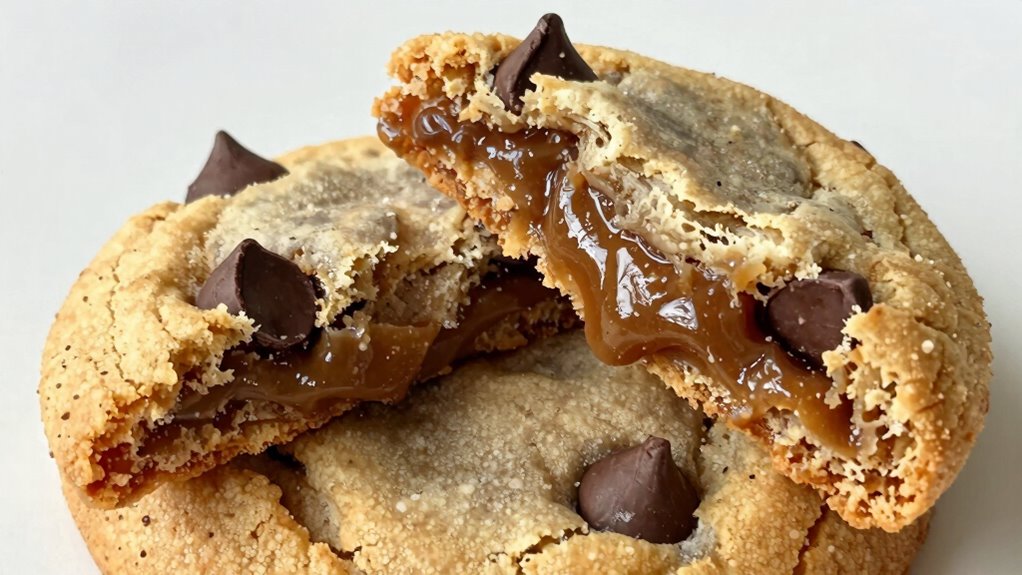

To tell if your cookie is underbaked or just soft, check its appearance, texture, and feel. Underbaked cookies look shiny, greasy, and may feel overly sticky or squishy, while properly baked ones have a matte finish with a slight firmness at the edges. Gently press the surface—if it feels firm but gives slightly, it’s done; if it’s fragile or overly soft, it might need more time. Keep going for more tips to perfect your baking.

Get baking supplies delivered free with Prime
- Fast, free delivery on millions of items
- Prime Video, Amazon Music and more included
- Member-only deals all year
Key Takeaways
- Check for a shiny, greasy, or wet center, indicating underbaking.
- Gently press the cookie; an underbaked one feels overly soft and squishy.
- Look for dull, matte surfaces with slight crispness at edges for proper doneness.
- Taste a small piece; raw flour or dough flavor suggests underbaking.
- Ensure the edges are firm and set, while the center is slightly soft but not raw.
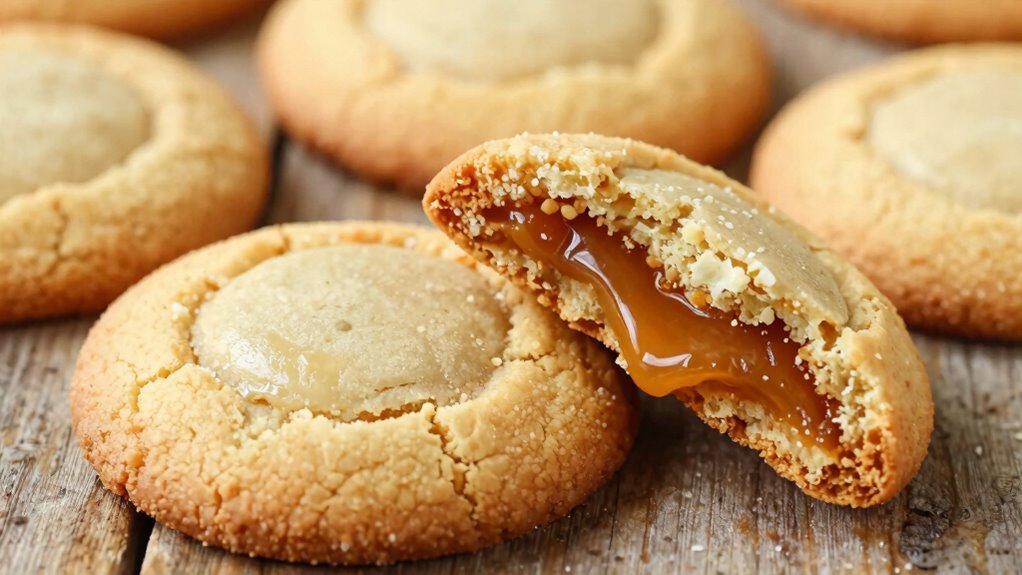
Baking cookies can be tricky because a cookie that’s underbaked often looks similar to one that’s just soft and chewy. The challenge lies in distinguishing whether your cookie is perfectly baked or needs a few more minutes. One of the best ways to determine this is by paying attention to flavor consistency and texture comparison. When you bite into a cookie, the flavor should be well-developed and balanced, not raw or overly doughy. If the taste is overly floury or has a pronounced raw flour or dough flavor, it’s a sign that the cookie is underbaked. Conversely, if the flavor is uniform and rich, it indicates proper baking.
Pay attention to flavor; underbaked cookies taste raw or floury, while properly baked ones are rich and balanced.
Texture is a more reliable indicator than appearance alone. Underbaked cookies often feel overly soft or gooey in the center, with a dense or sticky consistency that hasn’t fully set. They might also be fragile and prone to breaking apart easily. When you compare this to a cookie that’s just soft and chewy, you’ll notice that a properly baked cookie has a slight firmness around the edges, with a tender but not overly sticky center. The difference is subtle but important—soft and chewy cookies have a pleasant, resilient bite, whereas underbaked ones tend to be overly moist and lack structure. Understanding the baking process can help you better interpret the signs that your cookies are ready.
Another clue is the appearance of the cookie’s surface. Underbaked cookies typically look shiny or greasy in the center, because the dough hasn’t fully dried out or set. They may also appear duller or more raw in the middle, with a slightly wet or doughy look. On the other hand, cookies that are just soft and chewy will have a matte finish with a slight crispness around the edges. When you gently press the surface, a properly baked cookie will feel firm but give slightly under pressure, while an underbaked one might feel overly sticky or squishy. Additionally, understanding the baking process can help you better interpret the signs that your cookies are ready.
Timing also plays a role. If you’ve followed your recipe’s recommended baking time but the cookies seem underdone, consider your oven’s true temperature and your baking environment. Sometimes, oven hot spots or inaccurate temperature settings can lead to underbaking. In those cases, a visual and tactile check—looking at the texture and flavor—becomes even more important. Remember, a perfectly baked cookie should have a balance: just firm enough on the outside, with a soft, flavorful interior that’s not raw or overly doughy. Paying attention to these baking cues can help you improve your cookie-baking skills over time.
As an affiliate, we earn on qualifying purchases.
Frequently Asked Questions
Can Underbaked Cookies Be Safe to Eat?
Underbaked cookies can be safe to eat if they contain no raw eggs or raw flour, which can carry bacteria. However, they might be doughy and not fully cooked inside. To prevent this, store your cookies properly and bake at the right temperature. If you’re unsure, check the baking temperature and make certain the cookies reach an internal temperature of 165°F, making them safer and fully cooked.
How Long Do Cookies Stay Soft After Baking?
Imagine a warm cookie, soft and inviting, that stays tender for about 24 hours if you store it properly. When you use cookie storage, the texture comparison reveals that cookies remain chewy or soft, depending on their ingredients. To keep that delightful softness, store cookies in an airtight container. After a day, they might firm up slightly, but proper storage helps maintain their initial soft, melt-in-your-mouth texture longer.
Does Oven Type Affect Cookie Doneness?
Yes, oven type affects cookie doneness because different ovens have varying calibration and heat distribution. An oven with inaccurate calibration or inconsistent baking temperature can cause cookies to bake unevenly—some underdone, others overdone. To guarantee perfect cookies, check your oven’s calibration regularly and follow the recommended baking temperature precisely. Adjustments might be necessary based on your oven’s characteristics to get consistently baked cookies every time.
Can You Fix an Underbaked Cookie?
Think of fixing an underbaked cookie like rescuing a stranded ship. You can try returning it to the oven, but beware—overbaking can turn it dry. To improve, store cookies properly to prevent further underbaking issues. Adjust baking temperature next time, or pop the cookie back in briefly to finish baking. Just keep an eye on it, balancing doneness and moisture, so your cookies come out just right.
What Ingredients Influence Cookie Softness?
Ingredient chemistry plays a key role in cookie softness, influencing texture transformation during baking. Using more butter or shortening increases fat content, making cookies softer and chewier. Adding extra eggs introduces moisture and improves tenderness. Conversely, using less flour or opting for a lower-protein flour results in a softer texture. Sugar also affects softness—more sugar retains moisture, keeping cookies tender longer. Adjusting these ingredients helps you control the cookie’s final softness.
As an affiliate, we earn on qualifying purchases.
Conclusion
Knowing whether your cookie is underbaked or just soft guarantees you get that perfect treat every time. Remember, about 60% of bakers struggle with this dilemma, often overbaking or underbaking without realizing. By paying attention to the color, texture, and how the cookie feels, you can master the art of baking just right. Next time, you’ll confidently tell whether your cookie needs a few more minutes or is perfectly done, guaranteeing every batch is a success.
As an affiliate, we earn on qualifying purchases.
As an affiliate, we earn on qualifying purchases.
Halloween Picks
halloween
As an affiliate, we earn on qualifying purchases.