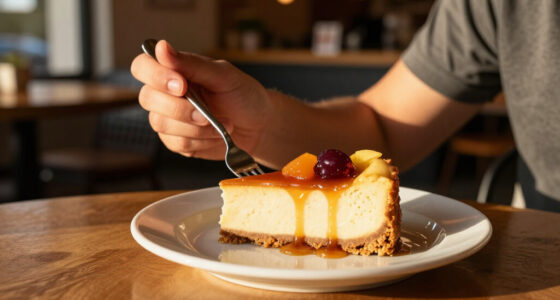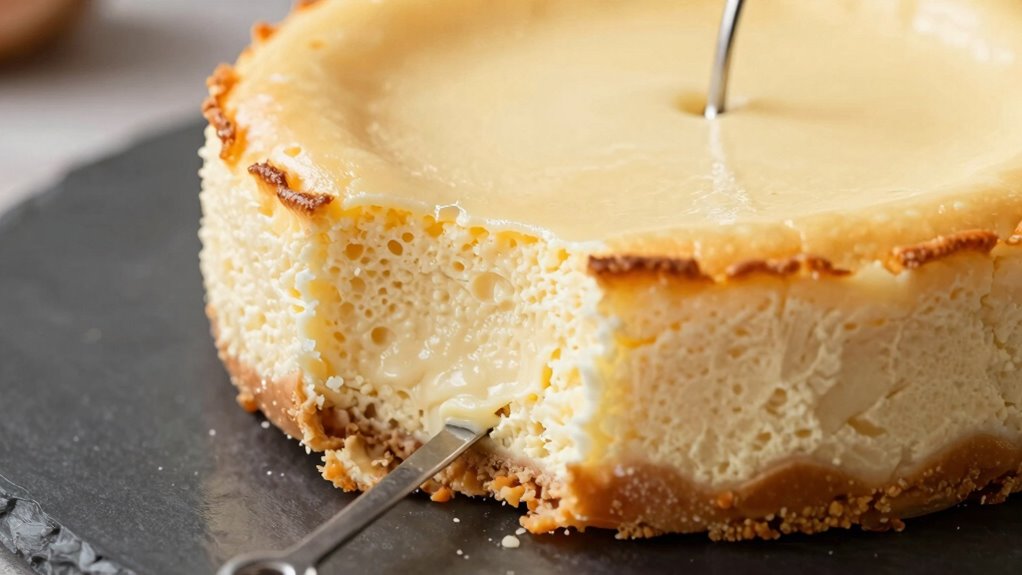

To accurately judge when your cheesecake is done, rely on visual and tactile cues. Look for slightly set edges that pull away from the pan and a center that gently jiggles like pudding. The surface should be matte, with no shiny patches. When you master these signs, you’ll avoid over- or underbaking. Paying attention to these subtle indicators can make all the difference; if you stick around, you’ll discover even more tips for perfect results.

Get baking supplies delivered free with Prime
- Fast, free delivery on millions of items
- Prime Video, Amazon Music and more included
- Member-only deals all year
Key Takeaways
- Use the gentle wobble test: center should jiggle like pudding, not be liquid or overly firm.
- Observe the edges: they should be slightly set and pulling away from the pan.
- Check surface appearance: look for a matte finish with no shiny or wet patches.
- Rely on residual heat: the cheesecake continues to set as it cools, so avoid overbaking.
- Ensure oven temperature is accurate to achieve consistent, reliable doneness cues.

Determining when a cheesecake is perfectly baked can be tricky, but relying solely on the appearance or a simple timer often leads to over- or undercooked results. Instead, paying attention to the subtle cues that indicate doneness will give you much more reliable results. One of the most important factors to deliberate is oven temperature. If your oven isn’t calibrated correctly or runs hot or cold, your cheesecake may not bake evenly or reach the ideal internal state. Use an oven thermometer to verify that your oven maintains a consistent temperature—most cheesecakes bake best around 325°F to 350°F. Too high, and the edges might turn brown or crack before the center sets; too low, and the center remains too runny. Maintaining a steady, precise oven temperature assures your cheesecake bakes evenly and helps you judge its doneness more accurately.
Use an oven thermometer to ensure your cheesecake bakes evenly at 325°F to 350°F.
Another essential aspect often overlooked is ingredient freshness. Fresh cream cheese, eggs, and other ingredients not only improve flavor but also affect how your cheesecake sets. Old or expired ingredients can alter baking times and result in a less-than-perfect texture. When your ingredients are fresh, you get a more predictable bake, which makes judging when it’s done easier. Additionally, ingredient quality can influence how well your cheesecake holds its shape and texture once cooled. Using high-quality ingredients also ensures that the baking process proceeds more consistently, reducing guesswork. Proper ingredient freshness can also help ensure your cheesecake develops the ideal texture and flavor, making it easier to recognize when it’s ready. Paying attention to oven calibration is equally crucial, as it influences how evenly your cheesecake bakes and how its doneness cues develop.
Knowing what to look for as your cheesecake approaches completion is key. The edges should look slightly set and start pulling away from the sides of the pan, but the center will still have a gentle wobble—think of it like jiggling a bowl of pudding. This wobble isn’t a sign of undercooking; it’s the hallmark of a perfectly baked cheesecake. As it cools, the residual heat will continue to set the center, so don’t overbake it just to eliminate any wobble. Instead, gently shake the pan and observe how the center moves; if it jiggles smoothly and slowly, you’re close.
Another useful indicator is the surface texture. When it’s done, the top should look slightly matte, with no shiny or wet patches. Cracks are common if you bake too long or at too high a temperature, but minor cracks aren’t a big deal—they’re part of the charm for many bakers. The real trick lies in understanding the subtle wobble and the appearance of the edges, combined with consistent oven temperature and ingredient freshness. Once you master these cues, you’ll avoid the guesswork and produce a flawlessly baked cheesecake every time.
As an affiliate, we earn on qualifying purchases.
Frequently Asked Questions
How Do Different Oven Types Affect Cheesecake Baking Times?
Different oven types affect baking times because they heat differently. Convection ovens, with their fans, bake faster and more evenly, so your cheesecake might need less time. Conventional ovens take longer since they rely on radiant heat. To avoid overbaking, keep an eye on your cheesecake and check for doneness earlier if you’re using a convection oven. Adjust your baking times accordingly based on your oven type for perfect results.
Can I Use a Food Thermometer to Check Cheesecake Doneness?
Yes, you can definitely use a food thermometer to check cheesecake doneness. Aim for a cream cheese texture that’s slightly jiggly in the center, around 150°F (65°C). This guarantees baking temperature accuracy and prevents overcooking. Insert the thermometer into the center, avoiding the crust. When it hits that temperature, your cheesecake is perfectly baked, with a creamy texture and no cracks.
What Are Common Mistakes That Cause Overbaked Cheesecake?
You often cause overbaked cheesecake by baking it too long or at too high a temperature, which leads to crust cracking and diminished flavor development. Rushing the baking process or opening the oven frequently also contributes. To avoid this, monitor the cheesecake closely and use gentle baking methods. This helps guarantee a smooth, creamy texture, prevents crust cracking, and allows ideal flavor development, keeping your cheesecake delicious and perfectly baked.
How Does Cheesecake Size Impact Baking and Testing Methods?
When baking cheesecake, size impacts both baking time and testing methods. Larger cheesecakes need longer, slow baking to maintain that creamy texture without overbaking, while smaller ones cook faster. You should check for doneness around the edges, ensuring the center remains slightly jiggly. Also, consider crust thickness, as a thicker crust might insulate the filling, requiring minor adjustments in baking time to prevent overbaking or underbaking.
Is It Better to Slightly Underbake or Overbake a Cheesecake?
It’s better to slightly underbake a cheesecake to maintain its creamy texture, rather than overbaking, which can cause it to crack or become dry. You should aim for a baking temperature that’s just right—around 325°F—so it cooks evenly without overdoing it. When you remove it from the oven, it’ll still jiggle slightly in the center, indicating it’s perfectly baked and still creamy inside.
As an affiliate, we earn on qualifying purchases.
Conclusion
Think of baking your cheesecake like tending a delicate garden. Just as you watch for the first bloom, trust those subtle signs—like a slight jiggle or a gentle crack—to tell you it’s ready. Patience and observation are your tools, guiding you through the process. When you recognize these quiet signals, you’ll harvest a perfectly baked cheesecake, tender and smooth, ready to delight. Trust your instincts, and let your baking journey blossom with confidence.
silicone baking pan for cheesecake
As an affiliate, we earn on qualifying purchases.
As an affiliate, we earn on qualifying purchases.
As an affiliate, we earn on qualifying purchases.
Fall Picks
fall essentials
As an affiliate, we earn on qualifying purchases.