
When baking larger loaves, you’ll notice they behave differently because their size affects fermentation, heat transfer, and crust development. Larger loaves ferment more slowly and require longer baking times at lower temperatures to cook evenly. Heat doesn’t distribute evenly, so you need to adjust oven settings to prevent burning or undercooking. Understanding these changes helps you produce better results. Keep exploring to discover how to perfect your baking process for these bigger loaves.

Get baking supplies delivered free with Prime
- Fast, free delivery on millions of items
- Prime Video, Amazon Music and more included
- Member-only deals all year
Key Takeaways
- Larger loaves require longer fermentation times to develop proper flavor and dough strength.
- Heat transfer efficiency decreases with size, affecting baking time and crust development.
- Bigger loaves need lower oven temperatures and extended baking to ensure even cooking.
- Crust formation slows in larger loaves, influencing texture and browning differently from smaller ones.
- Adjusting timing and temperature is essential to achieve desired crumb, crust, and flavor in larger loaves.
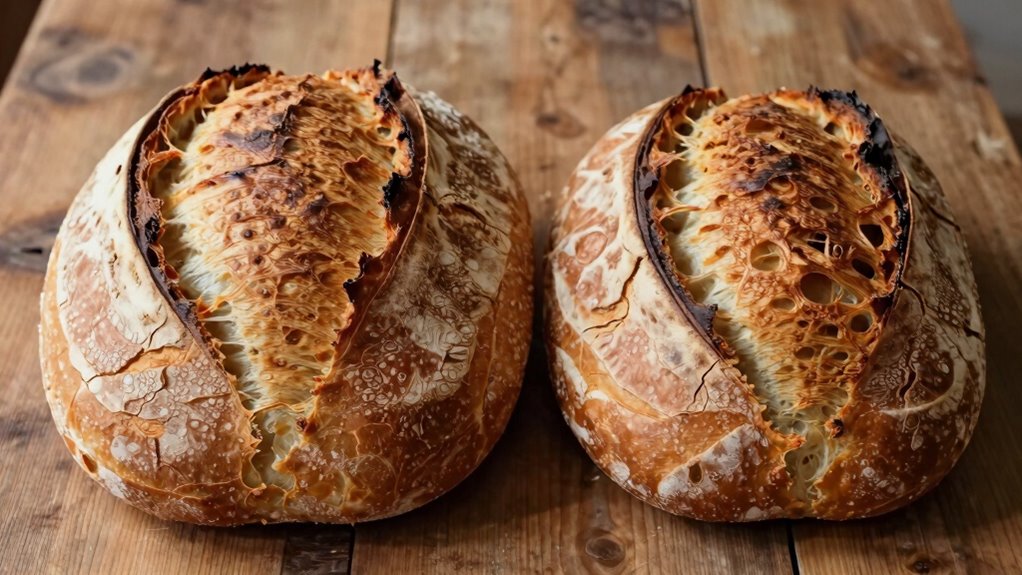
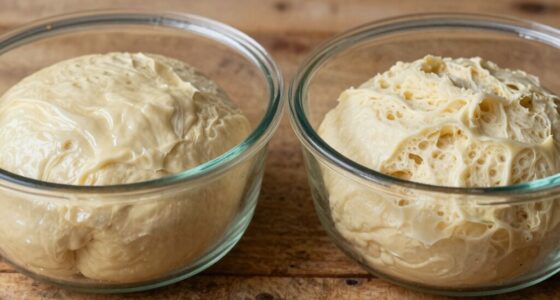
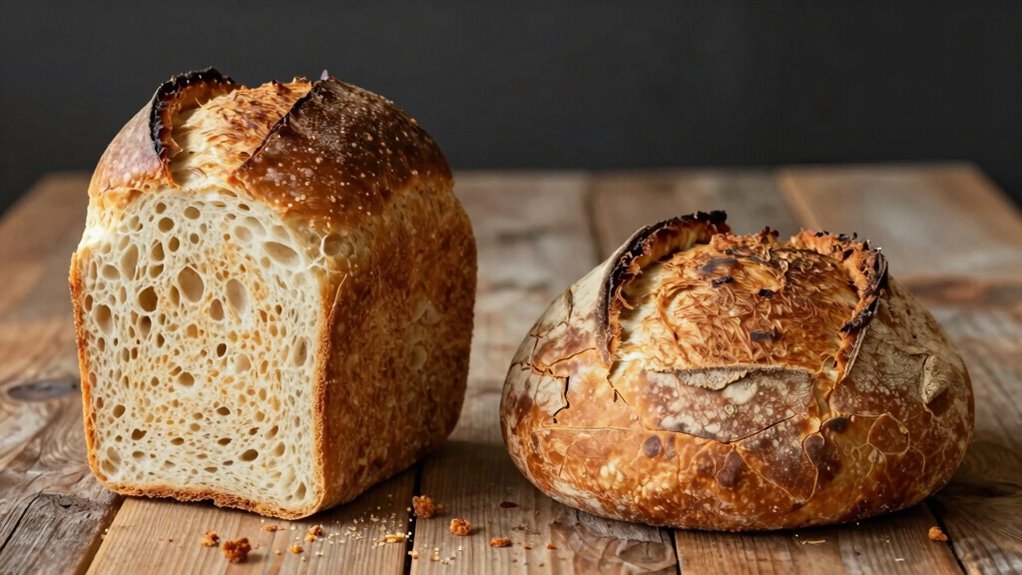
When you scale up a bread recipe, the resulting larger loaf doesn’t just look bigger—it behaves differently in the oven and during baking. One reason is that fermentation dynamics shift as the dough increases in size. Smaller loaves ferment quickly because heat penetrates evenly, and gases produced by yeast escape more readily. Larger loaves, however, require longer fermentation times because the interior dough takes more time to warm and develop flavor. If you don’t adjust fermentation properly, you risk underproofing the center or overproofing the exterior, which affects both texture and oven spring. Managing fermentation in bigger loaves means paying close attention to rising times and ensuring the dough has developed enough strength to hold its shape without collapsing. Additionally, heat transfer becomes less efficient as size increases, making heat distribution a critical factor in achieving an evenly baked loaf. Proper oven temperature control is essential to prevent uneven baking and ensure a consistent crumb structure. To better understand how heat and moisture transfer influence larger loaves, bakers often study baking physics to refine their techniques. Recognizing how dough mass impacts baking outcomes allows bakers to adapt their methods more effectively.
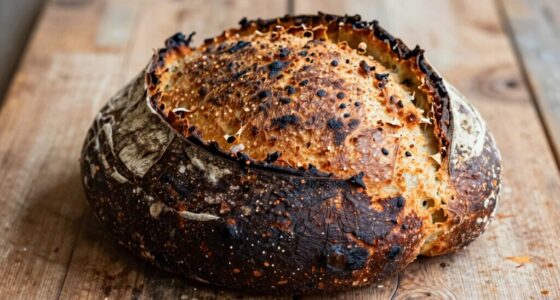
Crust development, too, changes significantly with size. In smaller loaves, heat reaches the surface rapidly, creating a thick, crispy crust early in baking. With larger loaves, the outer layer heats more slowly, which means the crust takes longer to form and may not develop the same crispness unless you modify baking techniques. Often, a bigger loaf requires a longer baking time at a slightly lower temperature to allow heat to penetrate deeper and to ensure the interior is thoroughly cooked without burning the crust. This slower process impacts how the crust forms, influencing its texture and color. If you skip these adjustments, you might end up with a burnt exterior and an underdone interior or a pale, soft crust that lacks crunch. The Maillard reaction, responsible for browning and flavor development, also responds differently as the size increases, requiring careful attention to baking conditions. In essence, when you increase the size of your bread, the interplay between fermentation dynamics and crust development becomes more complex. You must adapt your timing, temperature, and proofing methods to accommodate these changes. Failing to do so can lead to inconsistent results—either a dense interior or a tough, overly thick crust. By understanding how these factors shift with size, you gain better control over the baking process. This way, your larger loaves will not only look impressive but will also boast the right balance of flavor, crumb, and crust, making them behave much more like a different recipe altogether. Adjusting your approach based on loaf size ensures that your baked goods maintain quality, no matter the scale.
As an affiliate, we earn on qualifying purchases.
Frequently Asked Questions
How Does Oven Temperature Affect Larger Loaf Baking?
Oven temperature greatly impacts how a larger loaf bakes, affecting crust development and crumb structure. Higher temperatures can cause the outside to brown too quickly, risking burnt crusts, while lower temps may lead to underbaking. To guarantee even baking, you might need to adjust cooling techniques and consider ingredient substitutions, like adding steam or altering hydration, to support a balanced bake. Proper temperature control ensures your larger loaf bakes evenly and achieves the desired texture.
What Adjustments Are Needed for Different Types of Flour?
When adjusting for different types of flour, consider the flour’s protein content, as higher protein flour promotes better gluten development, giving your loaf structure. For bread flour, you might need slightly less water to prevent over-gluten formation, while all-purpose flour may require more hydration. Always observe dough consistency, and adjust water and kneading time accordingly to guarantee proper gluten development, resulting in a well-structured, airy loaf.
How Does Proofing Time Change With Loaf Size?
As your loaf size increases, proofing time extends because larger doughs require more time for fermentation dynamics to develop proper gluten structure and dough elasticity. You’ll notice that bigger loaves need longer to rise fully, ensuring even fermentation and good oven spring. Be patient and monitor the dough’s appearance rather than relying solely on time, as larger loaves need careful proofing to prevent over- or under-proofing.
What Role Does Pan Material Play in Baking Large Loaves?
Think of baking large loaves like choosing the right partner for a dance. Glass cookware heats evenly, giving you a gentle, consistent rise, perfect for delicate textures. Metal pans, on the other hand, heat faster and can create a crisper crust. When baking big loaves, your pan material influences how evenly heat penetrates, affecting the crust and crumb. So, pick your pan wisely to master your masterpiece.
How Can I Prevent Larger Loaves From Becoming Dense?
To prevent larger loaves from becoming dense, focus on proper ingredient scaling and shelf positioning. Scale ingredients accurately to guarantee the dough rises well, and avoid overmixing, which can lead to a dense crumb. Place the loaf on a middle or lower oven shelf for even heat distribution. Also, give your dough enough time to rise fully, and consider using a proofing basket to support its shape during baking.
oven thermometer for bread baking
As an affiliate, we earn on qualifying purchases.
As an affiliate, we earn on qualifying purchases.
Conclusion
As you explore baking larger loaves, you’ll notice they gently whisper their own subtle secrets, hinting that they’re more than just a scaled-up version. Embracing these nuances, you realize that bigger breads invite a tender patience and a keen eye, shaping your craft in quiet, profound ways. In this subtle dance of ingredients and time, you discover that sometimes, the most delicate adjustments reveal the most unexpected depths, enriching your baking journey beyond the surface.
bread proofing basket large size
As an affiliate, we earn on qualifying purchases.
As an affiliate, we earn on qualifying purchases.
As an affiliate, we earn on qualifying purchases.
Fall Picks
fall essentials
As an affiliate, we earn on qualifying purchases.