Spiral mixers use a helical arm that rotates within the bowl, steadily pulling, folding, and stretching the dough with consistent shear forces, making them ideal for heavy, dense doughs. Planetary mixers employ orbiting beaters that spin on their axis while circling the bowl, creating zones of shear and compression suited for lighter mixes. Understanding these mechanical differences helps you choose the right equipment—continue exploring to learn how these physics impact your baking results.
Key Takeaways
- Spiral mixers use a helical arm that folds and stretches dough with continuous shear and compression forces for uniform gluten development.
- Planetary mixers orbit beaters around the bowl, combining shear and localized compression for gentle mixing of delicate ingredients.
- Spiral mixers apply steady, consistent forces ideal for heavy, dense doughs, enhancing hydration and gluten formation.
- Planetary mixers generate variable, localized forces suited for light batters, minimizing overmixing and preserving airy textures.
- The mechanics of spiral mixers promote continuous kneading, while planetary mixers rely on orbital and spinning motions for thorough but delicate mixing.
How Do Spiral Mixers Work? The Basics of Their Mechanics

Spiral mixers operate by rotating a helical agitator that gently and thoroughly mixes dough or batter. This design helps develop dough elasticity by consistently applying shear forces, allowing gluten strands to form properly. The rotation speed and mixing duration are carefully controlled to optimize gluten development without overworking the dough. Because of their efficient mixing mechanics, spiral mixers require less time to achieve a uniform, well-kneaded dough compared to other types of mixers. The helical arm’s continuous motion ensures even distribution of ingredients, reducing mixing time while maintaining dough quality. This process results in a more elastic dough with better structure and texture. The energy-efficient design of spiral mixers further enhances their suitability for sustainable bakery operations. Additionally, the mechanics of spiral mixers are tailored to produce consistent results, making them ideal for high-volume baking operations. Proper calibration of the mixing parameters can further improve the quality and consistency of the final product. Moreover, understanding the gluten development process can help optimize mixer settings for different types of dough, ensuring optimal texture. Using the right dough handling techniques in conjunction with the mixer can also impact the final product’s quality.
What Is the Kneading Action in Spiral Mixers and Why Does It Matter?
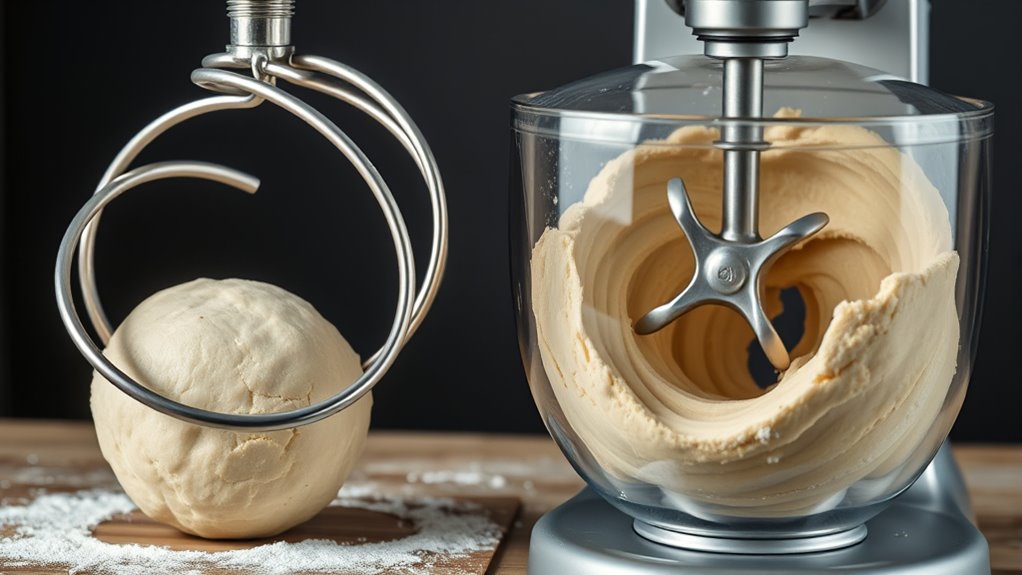
The kneading action in spiral mixers involves the helical arm rotating to gently fold and stretch the dough, creating a consistent and thorough mix. This dough kneading process relies on the unique mixer motion, where the spiral arm continuously pulls, folds, and turns the dough against the bowl’s sides. Unlike planetary mixers, spiral mixers focus on steady, uniform dough kneading, which helps develop gluten structure efficiently. This gentle yet effective kneading action reduces strain on the dough, preventing over-mixing or tearing. Additionally, the steady motion ensures that the dough is evenly kneaded without aggressive agitation. The design of spiral mixers inherently promotes uniform gluten development, making them ideal for artisan bread production. This consistent kneading also contributes to fewer dough defects and better texture in baked goods. As a result, your dough achieves ideal elasticity, texture, and proofing qualities. Understanding this kneading action highlights why spiral mixers are suitable for high-volume, artisan bread production, where consistent dough quality is essential. Free Floating
How Do Spiral Arms Turn and Interact With the Bowl During Mixing?

As the spiral arm rotates, it continuously engages the dough by pulling, folding, and turning it against the bowl’s sides. This arm movement creates a dynamic kneading action, encouraging the dough to stretch and develop gluten structure. The bowl rotation, usually at a slower speed, helps keep the dough in constant contact with the spiral arm, guaranteeing thorough mixing. The spiral arm’s curved design allows it to cut through and fold the dough efficiently, while the bowl’s rotation ensures even distribution of ingredients. This interaction between arm movement and bowl rotation produces a consistent kneading action, preventing ingredients from sticking or clumping. The precise coordination of these motions ensures uniform dough development, which is essential for achieving optimal gluten formation. In addition, the mixing efficiency is enhanced by the gear-driven mechanism of spiral mixers, providing consistent power for heavy doughs. As a result, the dough is worked evenly, leading to better texture and rise.
How Do Planetary Mixers Orbit and Mix Ingredients Effectively?

Planetary mixers follow an orbital path that allows the beater to move in a circular motion around the bowl’s center while spinning on its own axis. This pattern guarantees that ingredients are evenly mixed without missing spots. Understanding these mechanics helps you optimize mixing efficiency and achieve consistent results.
Orbital Path Patterns
Understanding how planetary mixers move their attachments is key to maximizing their mixing efficiency. Their orbital patterns involve the agitator moving in a circular orbit around the bowl’s center while simultaneously rotating on its own axis. This dual motion creates complex mixer trajectories, ensuring ingredients are thoroughly combined. Unlike spiral mixers, which primarily focus on a single direction of movement, planetary mixers follow a predictable, multi-directional path. This orbital pattern allows the attachment to reach all areas of the bowl, promoting uniform mixing and kneading. By understanding these mixer trajectories, you can optimize mixing times and ingredient incorporation, reducing the risk of uneven textures. Mastering the orbital path patterns helps you leverage the full potential of your planetary mixer for consistent, high-quality results.
Mixing Efficiency Mechanics
The key to a planetary mixer’s effective operation lies in its unique orbital motion, which combines the rotation of the agitator around the bowl’s center with its own axis rotation. This dual movement ensures thorough ingredient distribution, reaching even difficult spots. As the agitator orbits, it creates targeted energy transfer, breaking up clusters and mixing ingredients uniformly. The combination of motions accelerates kneading efficiency by constantly disrupting and reforming the mixture. To visualize this, consider the following:
| Motion Type | Effect on Mixing | Key Benefit |
|---|---|---|
| Orbital Rotation | Circulates ingredients | Uniform ingredient distribution |
| Axis Rotation | Spins the agitator | Effective energy transfer |
| Combined Motion | Enhances contact with ingredients | Faster, thorough mixing |
This synergy results in superior mixing efficiency, especially for complex doughs and batters. Additionally, the orbital path allows for more consistent kneading, which is essential for achieving the desired dough texture. The orbital motion also helps prevent the buildup of dough on the sides of the bowl, maintaining a cleaner workspace during operation. Furthermore, the orbital movement contributes to reducing mixing time by optimizing energy transfer and ingredient contact.
Introducing advanced engineering principles, planetary mixers are designed to maximize the effectiveness of their dual-movement system, ensuring optimal kneading performance.
What Are the Shear and Compression Forces in Spiral and Planetary Mixers?

Understanding the shear and compression forces at work helps you choose the right mixer for your needs. Spiral mixers primarily use shear forces to stretch and fold dough, while planetary mixers generate both shear and compression. Recognizing how these forces operate guarantees you select equipment that preserves ingredient quality and achieves your desired texture.
Shear Force Dynamics
Shear and compression forces play a essential role in how spiral and planetary mixers handle dough and batter. Shear forces are responsible for breaking down gluten networks, affecting dough elasticity, while compression influences dough density. In spiral mixers, shear forces are more consistent due to the rotating spiral arm, leading to uniform dough development. Planetary mixers generate shear primarily through the orbiting action of the beater, which can create localized shear zones. Viscosity effects are critical here, as higher viscosity dough resists shearing, requiring more force. Temperature influence also matters—heat generated during mixing reduces viscosity, making dough easier to shear but potentially affecting quality. Understanding these shear force dynamics helps optimize mixing parameters for better dough consistency and product quality.
Compression Mechanism
In addition to shear forces, compression plays a significant role in how spiral and planetary mixers develop dough and batter. Compression enhances dough elasticity by pressing ingredients together, influencing how well the dough holds together during mixing. Spiral mixers apply steady, consistent compression as the spiral arm pushes ingredients against the bowl, promoting uniform dough structure. Planetary mixers generate localized compression zones through their rotating beaters, affecting dough’s capacity to trap air. This compression impacts the mixing rhythm, controlling how quickly dough reaches ideal elasticity. Moreover, understanding the compression mechanics helps in selecting the right mixer type for specific bakery needs. – Spiral mixers provide continuous compression, ideal for developing gluten structure – Planetary mixers create intermittent compression points, affecting dough’s uniformity and texture – Compression influences dough elasticity, impacting final texture – Shear and compression forces work together to optimize kneading efficiency
How Does Mixing Speed Influence Dough Texture and Development?
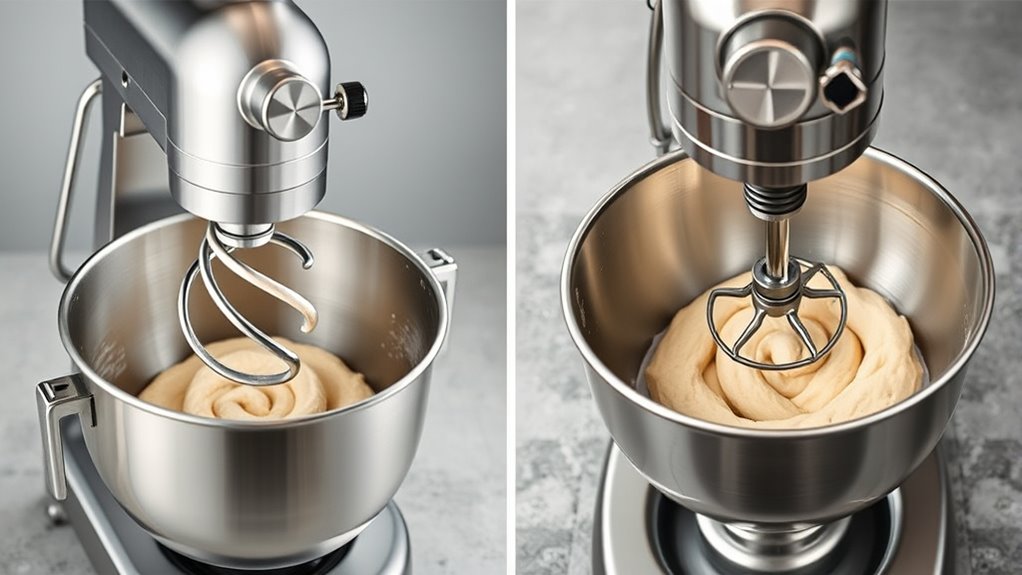
Mixing speed plays a essential role in shaping the texture and development of dough. When you adjust kneading speed, it directly impacts dough elasticity, influencing how well the dough stretches and holds gas. Higher kneading speeds can accelerate gluten development, creating a stronger, more elastic dough faster. However, if you go too fast, you risk overworking the dough, which can lead to a tough texture and reduced extensibility. On the other hand, slower speeds allow for gentle mixing, promoting even hydration and gluten formation without excessive strain. This balance is fundamental for achieving the desired dough characteristics, especially in bread-making or pastry production. Proper mixing techniques are essential for achieving the ideal dough consistency and quality. Additionally, understanding the mixing mechanics of different equipment types helps in fine-tuning the process for better results.
Why Are Spiral Mixers Better for Heavy Doughs and Bread Making?
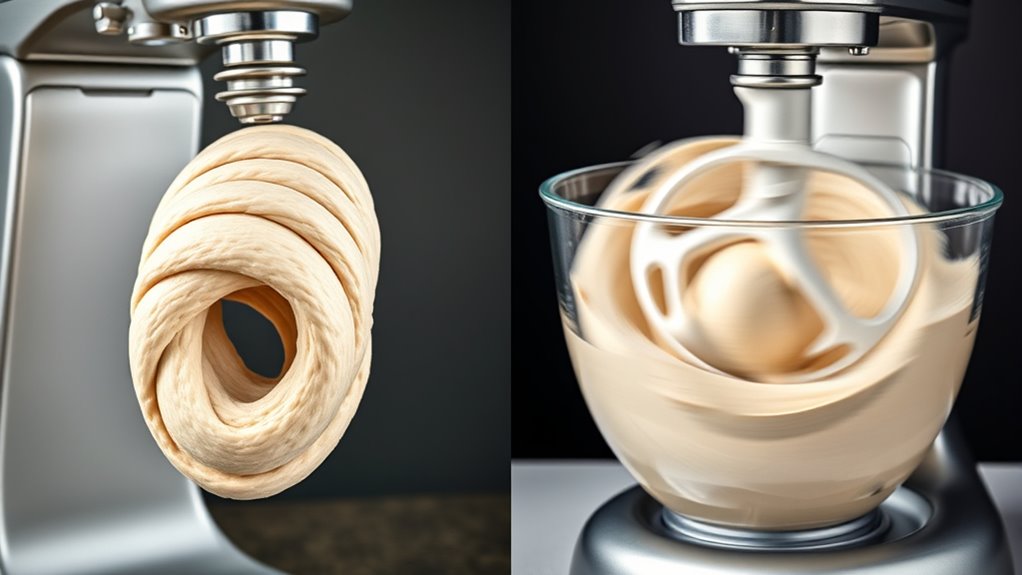
Spiral mixers are ideally suited for heavy doughs and bread making because their unique design provides powerful, consistent kneading that can handle dense ingredients with ease. Their shape allows for better dough hydration, ensuring ingredients are evenly incorporated and gluten development is optimized. This results in a more uniform dough, which is essential for bread quality. Additionally, the gentle yet thorough motion promotes yeast activation without overworking the dough, helping achieve the desired rise and texture. Efficient kneading motion helps improve overall mixing performance.
How Do Planetary Mixers Handle Light Mixes and Cake Batter?
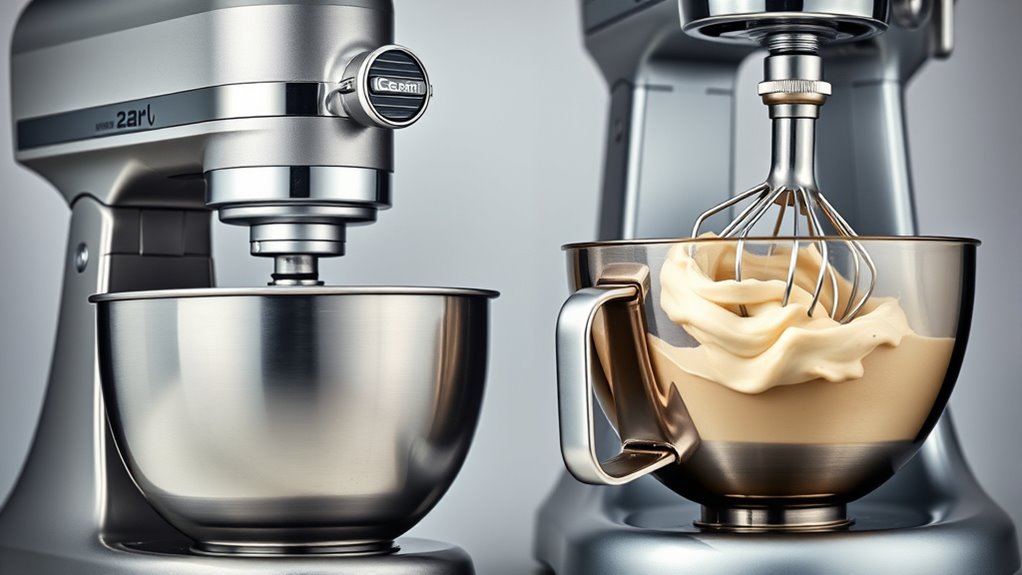
Ever wondered how planetary mixers perform with light mixes and cake batter? They excel at incorporating ingredients evenly, thanks to their orbiting beater that reaches all parts of the bowl. This design minimizes dough fermentation risks, preventing overmixing that can toughen delicate batters. Because planetary mixers operate at variable speeds, you can control ingredient hydration precisely, ensuring smooth, uniform batter consistency. Their gentle mixing action preserves the airy structure of light mixes, producing tender cakes and fluffy textures. Unlike spiral mixers, planetary models handle small batches efficiently without overworking the ingredients. This makes them ideal for delicate recipes that require gentle yet thorough mixing, keeping your batter light and well-integrated without compromising its rise or texture.
Which Mixer Type Is Right for Your Baking Needs? Key Factors to Consider
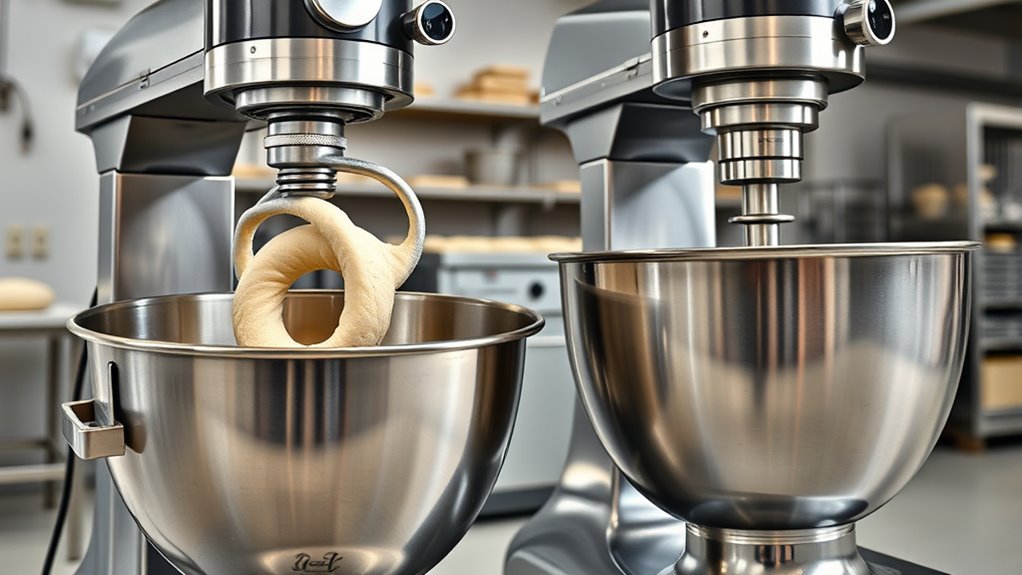
Choosing the right mixer depends on your baking needs, as each type offers specific advantages suited to different tasks. Spiral mixers excel at developing dough elasticity and maintaining consistent mixing temperature, ideal for bread and heavy doughs. Planetary mixers are versatile for light mixes, cake batters, and delicate ingredients. Consider these factors:
Choosing the right mixer depends on your baking needs and desired results.
- Dough elasticity: Spiral mixers promote strong gluten development, essential for chewy bread.
- Mixing temperature: Spiral mixers generate less heat, preventing dough overheating.
- Batch size and speed: Planetary mixers handle smaller batches quickly, perfect for pastry and frosting.
- Versatility: Planetary mixers accommodate various attachments for diverse tasks, while spiral mixers specialize in dough production.
- Additionally, understanding mixing efficiency can help you select a machine that best reduces mixing time and energy consumption for your specific needs.
Assess your volume, dough type, and desired texture to choose the best fit for your baking operations.
Frequently Asked Questions
What Are the Energy Consumption Differences Between Spiral and Planetary Mixers?
You’ll find spiral mixers generally use less power, making them more energy-efficient for large batches, thanks to their efficient kneading action. Planetary mixers tend to have higher power consumption because of their multiple attachments and varied speeds. If energy efficiency is your priority, spiral mixers are the better choice, especially for continuous, heavy-duty use. They save you money on electricity and reduce overall power consumption over time.
How Do Maintenance and Cleaning Procedures Vary for Each Mixer Type?
When it comes to maintenance and cleaning, you need to stay on top of things—don’t let it go to pot. For spiral mixers, cleaning protocols focus on the dough hook and bowl, often requiring more thorough scrubbing due to dough buildup. Planetary mixers, with their multiple attachments, need regular maintenance schedules for gears and motors. Both demand routine checks to keep them running smoothly and prevent breakdowns.
Can Both Mixers Be Used Interchangeably for Various Dough Types?
You can’t always use spiral and planetary mixers interchangeably for various dough types. Spiral mixers excel at handling high-volume, heavy doughs like bread, offering excellent dough versatility and consistent mixing precision. Planetary mixers are better suited for lighter, delicate doughs such as pastries or cake batters. Choosing the right mixer depends on your dough’s specific needs, ensuring ideal results and maintaining mixing accuracy.
What Are the Typical Cost Ranges for Spiral Versus Planetary Mixers?
The price comparison shows spiral mixers generally cost between $3,000 and $20,000, depending on size and features, while planetary mixers are more affordable, ranging from $300 to $3,000. Your initial investment depends on your dough volume needs and quality preferences. Spiral mixers are pricier but ideal for large batches, while planetary mixers suit smaller operations. Consider your production scale to determine the best value for your budget.
How Do Noise Levels Compare During Operation of Each Mixer?
During operation, spiral mixers tend to be quieter than planetary mixers, thanks to their more streamlined design and specialized motors. You’ll notice lower sound levels with spiral mixers, making them more suitable for noise-sensitive environments. Planetary mixers usually produce higher noise levels due to their multiple rotating parts and broader motion range. Overall, if sound comparison matters, spiral mixers provide a quieter experience, especially during long mixing sessions.
Conclusion
Ultimately, choosing between spiral and planetary mixers depends on your specific baking needs. But what if the perfect mix is just a decision away? Will you prioritize the heavy-duty power of a spiral or the gentle finesse of a planetary? The right choice could transform your baking game—if you dare to explore beyond the surface. Are you ready to unleash the true potential of your ingredients? The answer might surprise you.