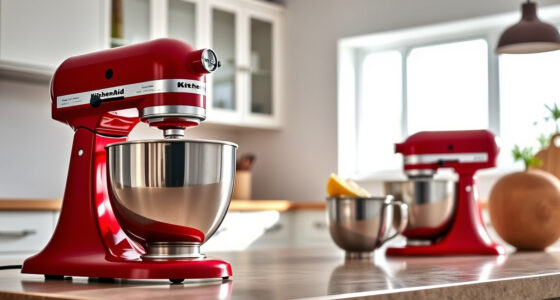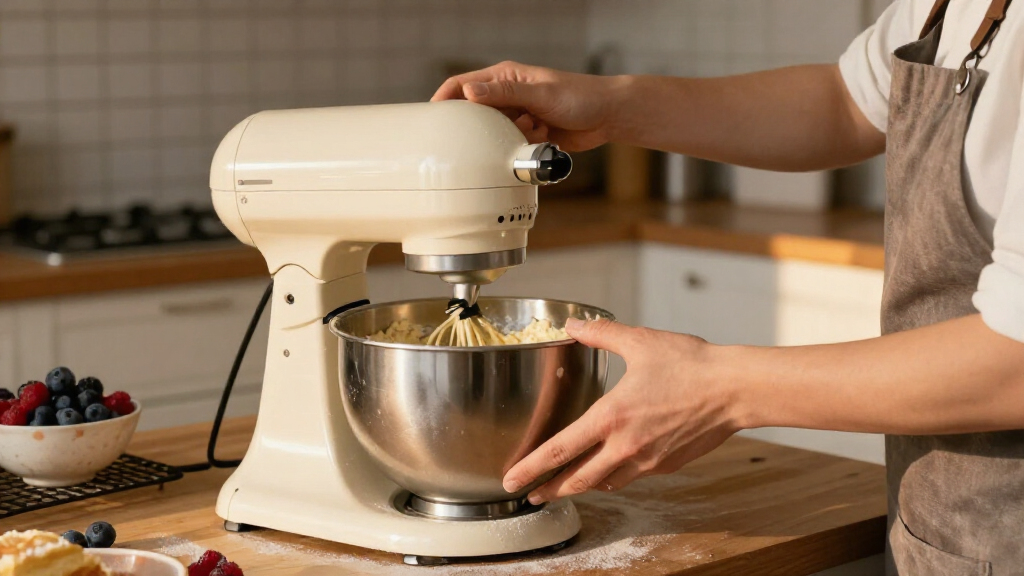

KitchenAid Artisan and Bosch Universal Plus mixers suit home bakers who want one machine to mix, knead, and whip, but they make different compromises. The Artisan’s tilt-head design, metal bowl, and extensive optional attachments make it an appealing everyday centerpiece; the Universal Plus prioritizes capacity and dough handling, with a lighter plastic bowl and less conventional layout. For cookies, cakes, and moderate bread batches, the KitchenAid is the more approachable all-rounder. For frequent bread baking, large batches, or dough that challenges smaller mixers, Bosch has the stronger case.

Get baking supplies delivered free with Prime
- Fast, free delivery on millions of items
- Prime Video, Amazon Music and more included
- Member-only deals all year

Martha Stewart 5.3-Quart Tilt-Head Stand Mixer, 12 Speeds, Stainless Steel Bowl
- ✔ Capacity: 5.3 quarts
- ✔ Speeds: 12
- ✔ Bowl: Stainless steel
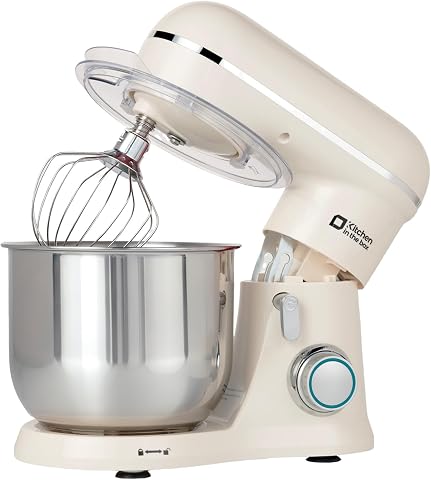
Kitchen in the Box 3.5-Qt Stand Mixer
- ✔ Model: KSM35A
- ✔ Bowl capacity: 3.5 quarts
- ✔ Motor power: 300 watts

Kitchen in the Box 3.2 Qt Stand Mixer with 6 Speeds, Black
- ✔ Model: 627 (SC-627)
- ✔ Capacity: 3.2 quarts
- ✔ Motor power: 300 watts
The choice is less about which machine can bake everything and more about what you make most often, how much counter space you have, and whether you will use specialty attachments. The comparisons below focus on practical differences; exact capacity, included accessories, and pricing can vary by package and retailer.
At a Glance
| Criteria | KitchenAid Artisan Series 5-Quart Tilt-Head Stand Mixer | Bosch Universal Plus Stand Mixer | Winner |
|---|---|---|---|
| Dough capacity and kneading | 5-quart bowl; suited to typical home batches and moderate dough quantities | Large bowl capacity, commonly around 6.5 quarts; designed for larger and heavier batches | B |
| Everyday mixing and whipping | Conventional planetary mixing with familiar beater, whisk, and dough hook | Strong for dough and batch mixing; whipping and small batches may take adjustment | Depends |
| Design and handling | Tilt-head access and sturdy metal bowl; recognizable, straightforward setup | Lightweight plastic bowl with a high-mounted motor and distinctive configuration | A |
| Attachments and versatility | Large optional attachment ecosystem, including food-preparation and pasta tools | Useful baking accessories, with fewer familiar powered add-ons than KitchenAid | A |
| Storage and footprint | Often substantial on the counter; bowl and head can make storage inconvenient | Motor and bowl have a different storage profile; check dimensions and cabinet fit | Depends |
| Value for baking habits | Strong value if you use its broad functions and prefer a polished everyday mixer | Worth the premium for frequent bread baking and batch capacity, less compelling for occasional cakes | Depends |
Martha Stewart 5.3-Quart Tilt-Head Stand Mixer, 12 Speeds, Stainless Steel Bowl
For bakers who make more than a single small batch at a time, the 5.3-quart bowl gives this mixer a practical advantage over both Kitchen in the Box models. That extra capacity can make it easier to combine ingredients without crowding the bowl, and the product listing says it can accommodate up to nine dozen cookies. We would still match the batch size to the recipe and mixer guidance rather than assume every dough fits comfortably.Its 12 speed settings provide the widest range in this group, compared with 10 on the 3.5-quart Kitchen in the Box and six on the 3.2-quart model. That broader selection gives us more choices for moving between gentler mixing and whipping. The tilt head helps with bowl access, while the whisk, dough hook, and silicone-edge flat beater cover common baking tasks. The beater’s edge is a distinctive inclusion among these options.The tradeoff is scale. A 5.3-quart mixer takes more space than either compact alternative, and the removable splash shield adds a setup and cleanup step. Buyers who mostly bake small recipes may find the capacity unnecessary; for them, the 3.5-quart Kitchen in the Box is easier to justify. But for regular baking with varied batch sizes, this is the most versatile pick in the lineup.
Pros:
- 5.3-quart stainless steel bowl offers the most capacity in this comparison.
- 12 speeds provide the broadest stated speed range among these three mixers.
- Includes a dough hook, stainless steel whisk, and silicone-edge flat beater.
- Tilt-head design provides access to the bowl.
Cons:
- The larger bowl may be unnecessary for small-batch baking and takes more space.
- The removable splash shield adds another part to fit and clean.
Best for: Home bakers who regularly make larger batches or want one mixer with more bowl room for varied recipes.
Not ideal for: Bakers with very limited counter or storage space, or those who usually mix only small quantities.
Bottom line: Choose the Martha Stewart mixer for the best balance of bowl capacity and mixing options when baking is a regular part of our routine.
“Choose the Martha Stewart mixer for the best balance of bowl capacity and mixing options when baking is a regular part of our routine.”
Kitchen in the Box 3.5-Qt Stand Mixer
This is the stronger of the two compact options for bakers who want a little room to grow without moving to a full-size bowl. At 3.5 quarts, its capacity edges the 3.2-quart Kitchen in the Box model, and its 10 speeds give us more adjustment than that model’s six. Those differences make it a better fit for someone who mixes different batters and small doughs, while still keeping a small footprint.The machine includes the familiar trio of dough hook, flat beater, and wire whisk, plus a splash guard. Suction cups are intended to help stabilize the lightweight mixer on the counter, and dishwasher-safe accessories can reduce cleanup work. The product description also calls out planetary mixing action, which is intended to move the attachment around the bowl during mixing.Capacity remains the defining limit: compared with the Martha Stewart’s 5.3-quart bowl, this one is for modest quantities, not ambitious baking sessions. Its construction also combines plastic with stainless steel, so buyers seeking a more substantial all-metal feel should look elsewhere. Choose it over the 3.2-quart model when the extra capacity and additional speed choices matter; choose the smaller sibling if minimizing size is the priority.
Pros:
- 3.5-quart bowl offers slightly more room than the other compact mixer here.
- 10 speeds give more adjustment than the 3.2-quart model’s six.
- Includes a dough hook, flat beater, wire whisk, and splash guard.
- Suction cups help stabilize the lightweight mixer, and accessories are dishwasher-safe.
Cons:
- The bowl is still small compared with the 5.3-quart Martha Stewart mixer.
- Plastic construction is used alongside the stainless steel bowl.
Best for: Bakers with limited space who make small batches but want more speed settings and slightly more bowl room than the 3.2-quart option.
Not ideal for: Households that often bake large batches or buyers who prefer a predominantly metal construction.
Bottom line: Pick this compact model when small-batch baking calls for more flexibility than the 3.2-quart mixer provides.
“Pick this compact model when small-batch baking calls for more flexibility than the 3.2-quart mixer provides.”
Kitchen in the Box 3.2 Qt Stand Mixer with 6 Speeds, Black
When the priority is a compact machine for straightforward baking, the 3.2-quart Kitchen in the Box covers the basics with a stainless steel bowl and three core attachments. Its tilt-head design gives access to the bowl, and the splash guard helps contain ingredients as we mix. Suction feet are included to help the mixer stay steady during use.This model is the most limited option in the lineup for capacity and speed range. Its six settings trail the 10 on the 3.5-quart version, while its 3.2-quart bowl is also slightly smaller. That makes the 3.5-quart sibling a more adaptable choice if we expect to bake a variety of small recipes. The 3.2-quart model makes sense when the simpler spec set is enough and storage is especially constrained.The listed construction combines ABS plastic, stainless steel, and aluminum; it is not presented as a fully metal-bodied mixer. The description says the accessories are dishwasher-safe but does not specify whether the bowl is, so we should plan to wash the bowl by hand unless its care instructions say otherwise. This is a sensible entry point for occasional mixing, but frequent bakers may outgrow the bowl sooner than they would the Martha Stewart model.
Pros:
- Compact dimensions and 7-pound listed weight suit smaller kitchens.
- Includes stainless steel bowl, whisk, flat beater, and dough hook.
- Tilt head and splash guard make bowl access and mixing more convenient.
- Suction feet help keep the mixer steady during use.
Cons:
- The 3.2-quart capacity is the smallest in this comparison.
- Six speeds offer less adjustment than the 3.5-quart Kitchen in the Box model.
- Dishwasher-safe care is stated for accessories, but bowl care is unspecified.
Best for: New or occasional bakers who make small batches and need a compact mixer that includes the basic attachments.
Not ideal for: Frequent bakers, larger households, or anyone who needs greater capacity or a wider range of speeds.
Bottom line: Choose this model for occasional small-batch baking when compact size matters more than capacity or speed flexibility.
“Choose this model for occasional small-batch baking when compact size matters more than capacity or speed flexibility.”
As an Amazon Associate we earn from qualifying purchases.
Key Differences
The largest practical gap is dough workload. Bosch’s capacity and design make it the better fit for bakers who regularly mix substantial bread or pizza dough batches. The Artisan can handle many home baking tasks, but its smaller bowl gives less room for scaling up, and demanding doughs can place greater strain on a compact mixer. Capacity figures alone do not guarantee a specific batch will work: dough hydration, recipe size, and the manufacturer’s limits matter.
For general use, KitchenAid’s familiar tilt-head arrangement and broad accessory range are real advantages. It is easy to add an attachment for tasks beyond mixing, and its metal bowl and classic form work well for many kitchens. Bosch trades that conventional feel for high-capacity function. Its lighter bowl and different mixing arrangement may be less intuitive, especially for small quantities or occasional whipping, but frequent bread bakers may find the capacity more useful than a traditional design.
Value follows your baking pattern. Pay more for Bosch when larger dough batches are a regular need and its capacity will replace multiple rounds of mixing. Choose KitchenAid when baking is varied, batches are moderate, and you will make use of optional attachments or prefer a traditional mixer setup. If you bake only occasionally, neither premium machine is automatically the best purchase; a smaller or less expensive mixer may cover your recipes.
Detailed Comparison
Dough capacity and kneading (Bosch Universal Plus Stand Mixer wins — major)
Bosch wins; the gap is major for bread-focused bakers. Its larger bowl and dough-oriented design make it better suited to repeated large batches of bread or pizza dough. KitchenAid’s 5-quart bowl is ample for many household recipes, but a baker scaling up may need smaller batches and should follow the model’s dough limits. If bread is occasional, Bosch’s extra capacity may sit unused; if it is weekly, it can change how much work one batch takes.
Everyday mixing and whipping (moderate difference)
Depends on the recipe; the gap is moderate. KitchenAid’s standard beater, whisk, and dough hook arrangement feels familiar across cakes, cookie dough, frosting, and whipped mixtures. Bosch is capable across baking tasks, but its design is especially compelling for dough, and very small quantities may be less convenient. Choose by the recipes you repeat: varied everyday baking favors KitchenAid, while frequent large-batch mixing favors Bosch.
Design and handling (KitchenAid Artisan Series 5-Quart Tilt-Head Stand Mixer wins — moderate)
KitchenAid wins; the gap is moderate. Its tilt head provides direct access to the bowl, while the metal bowl and conventional layout are easy for many users to understand. Bosch’s lighter plastic bowl can be easier to lift, but the motor-above-bowl design has a learning curve and less familiar access. This difference matters each time you add ingredients or scrape down a mixture, though preference and kitchen workflow play a part.
Attachments and versatility (KitchenAid Artisan Series 5-Quart Tilt-Head Stand Mixer wins — moderate)
KitchenAid wins; the gap is moderate to major if you want powered add-ons. Its attachment ecosystem extends the mixer into tasks such as pasta making and food preparation, though accessories are often sold separately and compatibility depends on the model. Bosch offers useful baking tools, but fewer widely recognized add-ons for expanding the machine’s role. KitchenAid is the more flexible purchase for cooks who will actually use those extras; for bread-only baking, this advantage matters less.
Storage and footprint (minor difference)
Depends; the gap is minor until space is tight. Both are substantial appliances that may be best left on the counter. Their shapes differ, so a cabinet that fits one may not fit the other, and the Bosch’s motor and bowl arrange differently from the Artisan’s tall tilt-head profile. Measure the full appliance and account for head clearance, bowl storage, and any accessories before buying.
Value for baking habits (major difference)
Depends on use; the gap is major when capacity saves repeat batches. KitchenAid is better value for a varied home baker who wants one familiar mixer and may add attachments over time. Bosch can justify its higher price for frequent large dough batches, where capacity and dough handling are central to the purchase. If you mostly make a cake or a small batch of cookies now and then, paying extra for either machine may not pay off.
KitchenAid Artisan Series 5-Quart Tilt-Head Stand Mixer: Pros and Cons
Pros:
- Familiar tilt-head design gives easy bowl access
- Metal bowl and conventional tools suit a wide range of common baking tasks
- Broad optional attachment ecosystem adds cooking uses
- More natural fit for varied, moderate-sized home baking batches
Cons:
- Smaller bowl limits how conveniently you scale up
- Heavy dough batches can be a less suitable regular workload
- Attachments can add considerable cost
- Large countertop appliance that may be awkward to store
Bosch Universal Plus Stand Mixer: Pros and Cons
Pros:
- Large capacity suits substantial batches
- Strong fit for frequent bread and pizza dough mixing
- Lighter bowl is easier to lift than a comparably sized metal bowl
- Practical choice for bakers who want to mix more dough at once
Cons:
- Distinctive design has a learning curve
- Plastic bowl and high-mounted motor may not appeal to every user
- Small batches and some whipping tasks may feel less convenient
- Fewer familiar powered add-ons than the KitchenAid ecosystem
Who Should Choose What
Choose KitchenAid Artisan Series 5-Quart Tilt-Head Stand Mixer if:
- You bake cakes, cookies, frosting, and moderate bread batches in roughly equal measure.
- You value a familiar tilt-head mixer and easy access to the bowl.
- You expect to use optional attachments for tasks beyond baking.
- You prefer a metal bowl and a traditional countertop appliance design.
Choose Bosch Universal Plus Stand Mixer if:
- You bake bread or pizza frequently and want to make larger batches.
- Your current mixer struggles with dough or forces you to split recipes.
- You value dough capacity more than a conventional tilt-head layout.
- The added capacity will save time often enough to justify the higher purchase cost.
Skip both if: You bake only occasionally, usually make small batches, or have limited counter and storage space; a compact or lower-cost mixer may fit your routine better.
Value for Money
KitchenAid is the better value for a broad mix of home baking and cooking, especially if its optional attachments will see regular use. The upfront price is only part of that equation: add-on tools raise the total, so buy them only for tasks you expect to do. Bosch costs more in many comparisons, but the premium can make sense for someone who regularly mixes large quantities of dough. It buys useful capacity, not an automatic improvement to every cake or cookie recipe. For occasional baking, neither premium option is an obvious value winner; spend less or choose a smaller machine.
Final Verdict
For most home bakers who want a versatile, approachable mixer for everyday recipes, choose the KitchenAid Artisan. Its familiar setup and wider accessory ecosystem make it the safer all-round purchase, and most household cake, cookie, and moderate dough recipes do not require Bosch’s extra capacity. Choose the Bosch Universal Plus if bread and pizza dough dominate your baking and you regularly make large batches; that is where its higher price has a clear practical payoff.
The deciding factor is batch size and frequency. If larger dough batches are an occasional project, KitchenAid makes more sense. If they are a weekly routine, Bosch is the stronger fit. Skip both if your baking is infrequent or your kitchen cannot comfortably accommodate a full-size mixer.
Frequently Asked Questions
Which mixer is better for bread dough?
The Bosch Universal Plus is generally the stronger fit for frequent, larger bread dough batches because of its capacity and dough-oriented design. Check the exact model’s instructions and recipe limits; dough type and hydration affect what a mixer can handle.
Is the KitchenAid Artisan enough for a home baker?
For many households, yes. It suits cakes, cookies, frosting, and moderate baking batches well. It is less convenient if you regularly need to mix very large quantities of dense dough.
Is Bosch worth paying more for?
It can be worth the extra cost for frequent bread bakers who will use the larger capacity. For occasional baking or mostly cakes and cookies, KitchenAid is usually the more balanced purchase.
Which mixer has more attachments?
KitchenAid has the broader and more familiar powered attachment ecosystem. Many attachments cost extra, and compatibility can vary, so check the specific accessory and mixer model before buying.