Baker’s percentages let you quickly scale bread recipes by expressing ingredient amounts as percentages of the flour weight. This system keeps ratios consistent, making adjustments simple whether you’re baking a small loaf or a large batch. You’ll learn to convert your recipes, tweak hydration, and maintain quality effortlessly. Mastering this method streamlines your process and guarantees reliable results every time—if you continue exploring, you’ll discover how to apply percentages confidently in any baking project.
Key Takeaways
- Use flour as 100% baseline to quickly calculate and adjust all other ingredients proportionally.
- Convert ingredient weights into percentages to streamline scaling for different batch sizes.
- Maintain consistent baker’s percentages across recipes for predictable results during scaling.
- Utilize percentage charts or software to rapidly modify recipes without recalculating from scratch.
- Adjust hydration and ingredient ratios easily, ensuring uniform quality when scaling recipes up or down.
Understanding Baker’s Percentages: How They Work and Why They Matter

Understanding baker’s percentages is essential because they provide a simple way to guarantee consistent results. By using ingredient relationships expressed as percentages of the total flour weight, you can easily analyze and adjust baking formulas. These percentages help you see the proportion of each ingredient, such as water, salt, and yeast, relative to flour. This system also allows for precise scaling, making it easy to adapt recipes for different batch sizes without altering the overall balance. Baker’s percentages also reveal how different ingredients interact and influence the dough’s texture and fermentation. By mastering this system, you gain advanced baking knowledge and control over your recipes, ensuring each bake maintains the same quality. Ultimately, understanding baker’s percentages streamlines your baking process and improves your ability to modify and troubleshoot recipes effectively.
Step-by-Step Guide: Converting Your Bread Recipes to Percentages
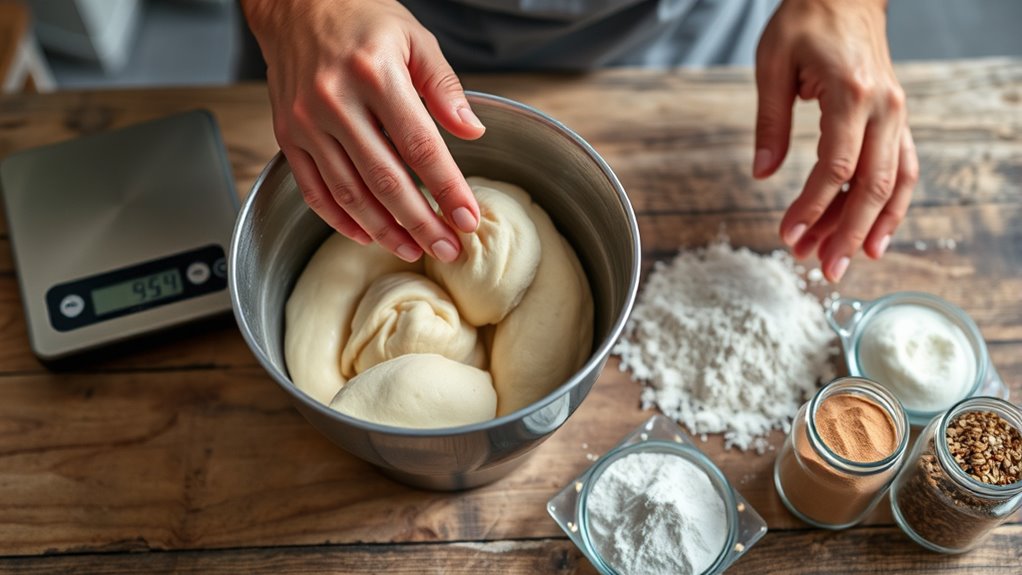
Converting your bread recipes to baker’s percentages might seem complicated at first, but breaking it down into clear steps makes it manageable. Start by choosing your total flour weight as 100%. Then, determine the weight of each ingredient relative to the flour. For example, if you use 500 grams of flour and 300 grams of water, water’s percentage is (300/500) x 100 = 60%. Keep your ingredient ratios consistent to maintain baking precision. Write down each ingredient’s percentage, and you’ll have a clear picture of your recipe’s proportions. This method simplifies scaling and adjusting recipes, ensuring consistent results every time. By mastering this process, you’ll improve your understanding of ingredient ratios and achieve better control over your bread’s texture and flavor.
How to Scale Bread Recipes With Baker’s Percentages
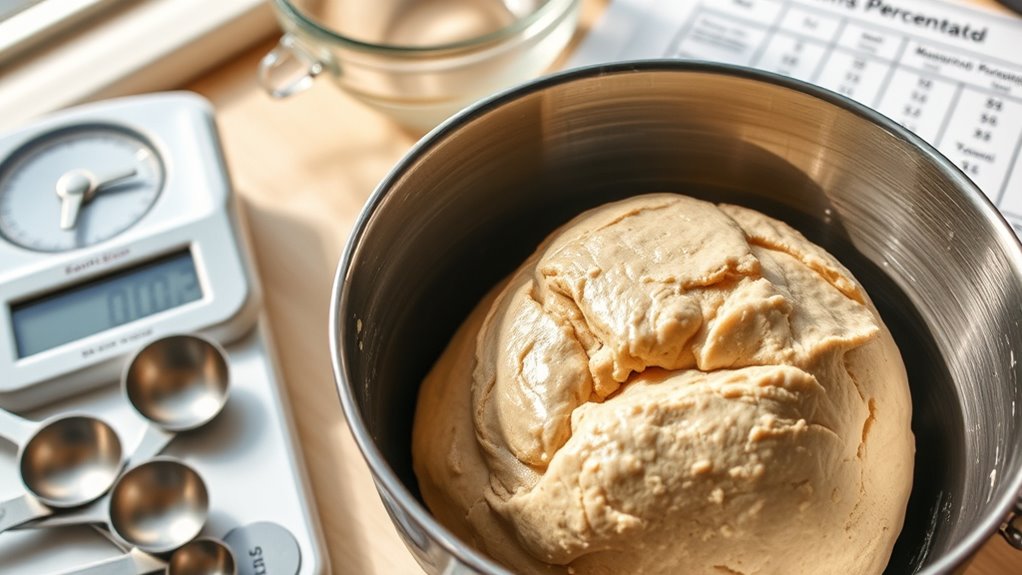
Once you have your recipe expressed in baker’s percentages, scaling it becomes straightforward. To increase or decrease batch size, simply adjust each ingredient proportionally based on the desired total flour weight. This method aligns perfectly with artisan techniques, ensuring consistency regardless of batch size. If you need to make ingredient substitutions—like swapping honey for sugar or using gluten-free flour—do so while maintaining the same percentage relationships. That way, the dough’s hydration and structure stay balanced, no matter the modifications. With baker’s percentages, scaling isn’t guesswork; it’s precise and efficient. You can confidently adapt recipes for small loaves, big batches, or experimental variations without losing the integrity of your bread. This approach streamlines your process and enhances your mastery of artisan baking. Understanding fundamental psychological tactics can also help you recognize and adapt to unexpected challenges in the kitchen or beyond.
Simple Ways to Apply Baker’s Percentages in Your Baking Practice
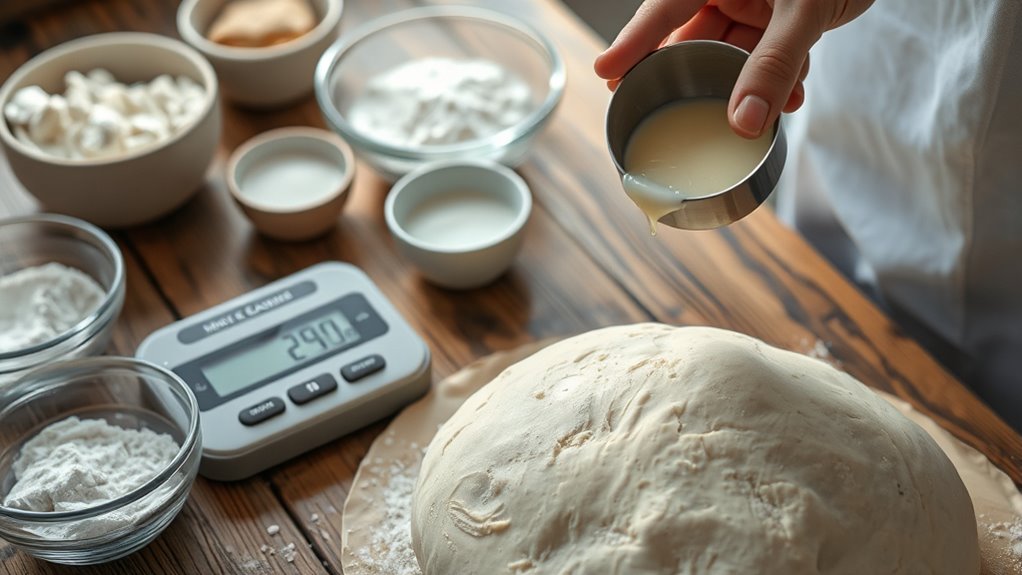
To apply baker’s percentages effectively, you need to measure your ingredients precisely. Using percentage charts makes it easier to keep ratios consistent across recipes. These simple tools help you bake with accuracy and confidence every time. Incorporating organized kitchen routines can further streamline your baking process and ensure consistent results. Additionally, understanding the visual and auditory cues involved in precise measurement can improve your overall baking accuracy. Practicing mindful ingredient measurement can also help reinforce baking precision in every batch you prepare. Paying attention to water temperature and hydration levels can also significantly impact dough consistency and final results.
Measure Ingredients Precisely
Measuring ingredients precisely is crucial for applying baker’s percentages effectively. Accurate measurements ensure ingredient precision and measuring accuracy, which are indispensable for consistent results. Use a digital scale for best results, as it provides precise weight measurements rather than volume. Keep your tools clean and calibrated regularly. Here’s a quick guide to typical ingredient weights:
| Ingredient | Approximate Weight | Measure Using |
|---|---|---|
| Flour | 120 grams | Digital scale |
| Water | 100 grams | Digital scale |
| Yeast | 3 grams | Digital scale |
| Salt | 2 grams | Digital scale |
| Sugar | 25 grams | Digital scale |
Use Percentage Charts
Using percentage charts simplifies the process of applying baker’s percentages during baking. They provide a clear visual guide, making it easy to adjust ingredient quantities based on your desired batch size or recipe changes. With a percentage chart, you can quickly see how ingredient substitutions affect the overall dough or batter, ensuring consistent results. This method also helps you experiment with flavor variations while maintaining proper balance. For example, swapping in different flours or sweeteners becomes straightforward, as the chart shows the exact percentage needed for each ingredient. Additionally, understanding Free Floating concepts like baker’s percentages enhances your ability to adapt recipes flexibly and confidently. By integrating percentage charts into your practice, you gain flexibility and confidence, enabling you to customize recipes efficiently without sacrificing quality or structure.
Essential Tools and Resources for Using Baker’s Percentages
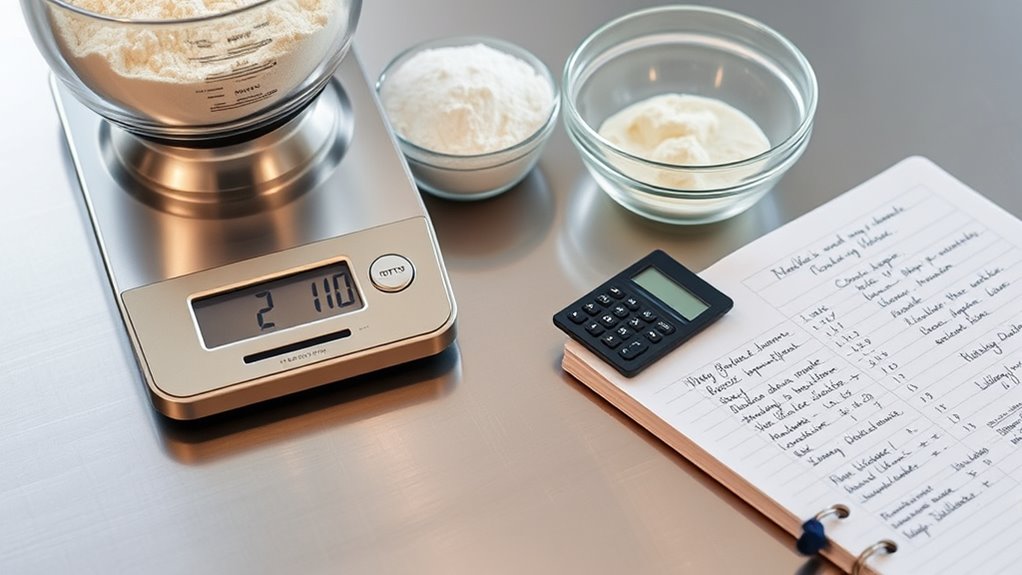
Having the right tools and resources makes working with baker’s percentages much easier. Accurate measuring tools are essential, especially digital scales, which provide precise weight measurements for ingredients. A reliable digital scale ensures you can easily weigh flour, water, and other components, making your calculations straightforward and consistent. Use graduated measuring cups and spoons for smaller quantities, but always verify with a scale for accuracy. Keep a clean, organized workspace with a calculator or smartphone app handy to quickly perform percentage calculations. Access to recipe templates or software designed for baker’s percentages can streamline your process even further. These tools help eliminate guesswork, improve accuracy, and save time, ensuring your scaling results are consistent every time. Additionally, understanding the importance of wave and wind considerations can influence hydration and fermentation times, leading to better bread quality. Being aware of atmospheric conditions can help you adjust hydration levels and fermentation schedules for optimal results. Moreover, monitoring humidity levels in your environment can significantly impact dough behavior and final texture. Recognizing how airflow affects dough fermentation can also help you fine-tune your baking process for consistent outcomes. Paying attention to seasonal variations can further enhance your ability to adapt recipes to different environmental factors.
Examples of Scaling Classic Bread Recipes Using Baker’s Percentages
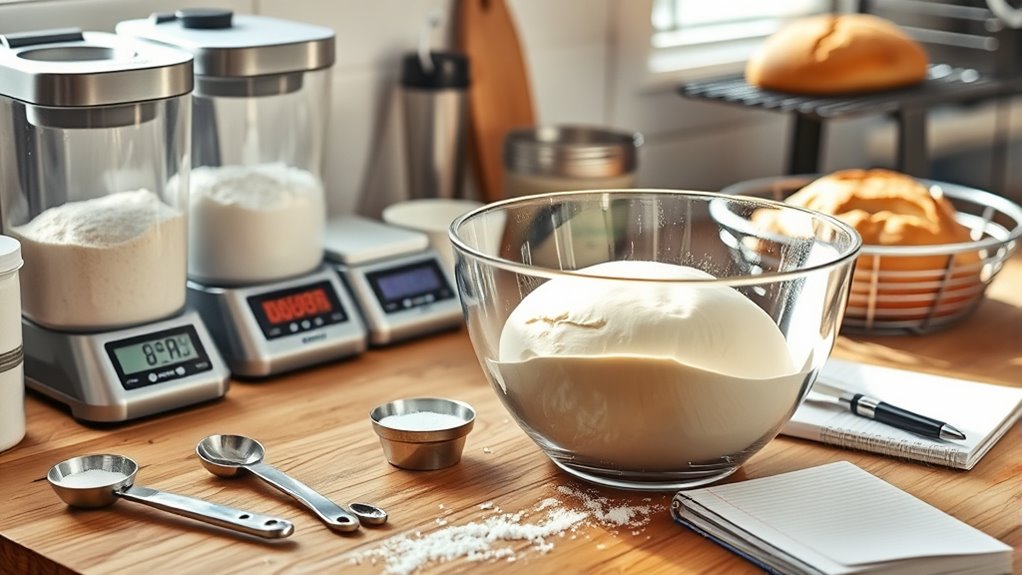
When scaling bread recipes, you’ll need to adjust the amounts of flour and water to keep the dough consistent. This guarantees the texture and fermentation stay reliable, even with larger batches. By understanding these adjustments, you can confidently prepare bigger quantities without sacrificing quality. Additionally, maintaining the correct baker’s percentages ensures your recipes remain predictable and successful regardless of the batch size. Knowing how to apply scaling techniques allows you to adapt recipes efficiently while preserving the desired outcome. Proper measurement accuracy is essential to ensure each scaled batch performs as expected, minimizing errors and waste, especially when working with large batches or commercial baking.
Adjusting Flour and Water
Adjusting flour and water in a bread recipe is straightforward once you understand baker’s percentages. Since hydration levels depend on the ratio of water to flour, you can easily modify the dough by adjusting these ingredients proportionally. Different flour types absorb water differently; for example, whole wheat flour typically requires a higher hydration level than bread flour. When scaling recipes, maintain the same baker’s percentage for water relative to flour, but consider these flour-specific hydration needs. If you switch to a different flour, tweak the water amount accordingly to achieve the desired dough consistency. This approach guarantees your bread retains its texture and crumb, no matter the scale or flour type. Mastering these adjustments helps you create consistent, high-quality bread every time.
Maintaining Dough Consistency
Scaling bread recipes while maintaining consistent dough characteristics is straightforward once you understand baker’s percentages. By keeping ingredient ratios steady, you guarantee the dough’s texture, hydration, and extensibility remain uniform across batches. Consistent ingredient ratios help control fermentation, preventing over- or under-proofing as you scale up or down. When adjusting recipe sizes, measure each ingredient precisely based on baker’s percentages, not volume, to preserve the original balance. Monitoring fermentation closely allows you to adapt proofing times, ensuring dough develops properly regardless of batch size. This consistency in ingredient ratios and fermentation control assures your bread’s quality, texture, and flavor stay reliable, whether baking a small loaf or a large batch. Mastering these principles simplifies scaling without sacrificing dough integrity.
Scaling for Larger Batches
To efficiently increase batch sizes, you need to apply baker’s percentages to your classic bread recipes. This method makes scaling straightforward, ensuring ingredient ratios stay consistent. When adjusting quantities, ingredient substitutions become simple; for example, swapping flours or fats doesn’t disrupt the percentage system. Keep fermentation timing in mind, as larger batches may require longer or adjusted proofing times to achieve proper structure and flavor. Monitoring dough behavior is vital, especially when working with different ingredients or batch sizes. By maintaining precise percentages, you can scale recipes confidently, avoiding guesswork and ensuring your bread turns out just as well in bigger batches. This approach streamlines production, saves time, and guarantees consistent results every time you scale up. Understanding dough hydration and proper temperature control are also essential components for successful scaling.
Frequently Asked Questions
Can Baker’s Percentages Be Used for Gluten-Free Bread Recipes?
You can use baker’s percentages for gluten-free bread recipes, but you need to adjust for gluten free binders and alternative flours. Since gluten-free flours behave differently, you’ll want to include binders like xanthan gum or psyllium husk to mimic gluten’s structure. By calculating based on the total weight of your ingredients and adjusting for these binders and alternative flours, you can scale your gluten-free recipes efficiently using baker’s percentages.
How Do Baker’s Percentages Differ for Sourdough Versus Yeasted Breads?
You’ll notice baker’s percentages differ for sourdough versus yeasted breads mainly due to fermentation differences and hydration variations. Sourdough often needs higher hydration and a larger percentage of starter, which affects the overall ratios. Yeasted breads typically have lower hydration and rely on commercial yeast. Adjustments in baker’s percentages help balance fermentation times, dough consistency, and flavor development, making scaling easier for each bread type.
Are Baker’s Percentages Applicable for Small-Batch or Artisanal Baking?
Yes, baker’s percentages work well for small-batch or artisanal baking. While they’re often associated with large-scale production, these percentages help you precisely scale recipes, ensuring consistency. You can easily adapt them to artisanal techniques, maintaining quality even in small batches. By scaling small batch, you keep control over ingredient ratios, which is essential for crafting high-quality, handcrafted bread with artisanal flair.
What Are Common Mistakes When Converting Recipes to Baker’s Percentages?
When converting recipes to baker’s percentages, you often make mistakes like measuring inaccuracies or scaling errors. To avoid these, double-check your measurements with a reliable scale and make certain all ingredients are accurately weighed. Also, remember to convert each ingredient proportionally, avoiding assumptions that can lead to uneven dough consistency. These small errors can considerably affect your final bread, so precision is key when using baker’s percentages.
How Do Baker’s Percentages Influence Baking Time and Temperature Adjustments?
Imagine you’re in the kitchen, like a baker from the 1800s, adjusting for modern ovens. Baker’s percentages help you understand how ingredient ratios impact oven temperature and baking duration. When scaling recipes, you might need to lower oven temperature or extend baking time for larger loaves. Always monitor your bread closely, as proper oven temperature and baking duration guarantee perfect crust and crumb, regardless of recipe size.
Conclusion
Mastering baker’s percentages unlocks endless possibilities in your baking. Once you grasp the basics, scaling recipes becomes effortless—and even exhilarating. Imagine the perfect loaf, crafted precisely to your needs, every time. But here’s the twist: as you explore deeper, you’ll discover even more secrets hidden within these numbers. Are you ready to elevate your baking game and uncover the full potential of baker’s percentages? The next step might just change everything.