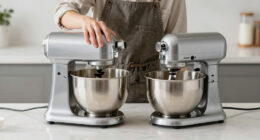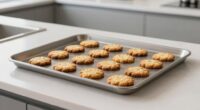
Butter melts faster and at lower temperatures than shortening because of their different compositions. Butter contains water and milk solids, which melt quickly, whereas shortening is made from hydrogenated vegetable oils with a higher melting point, making it stay solid longer. This difference impacts how each fat behaves in recipes, affecting texture and moisture. If you want to understand more about how these melting properties influence your cooking and baking, keep exploring further.
Key Takeaways
- Butter melts at a lower temperature (~90-95°F) due to its milk solids and water content, unlike shortening’s higher melting point.
- Shortening is made from hydrogenated vegetable oils with a more saturated fat profile, raising its melting point.
- The composition differences cause butter to melt quickly and contribute to tender textures, while shortening maintains structure at higher temperatures.
- Butter’s milk solids and water promote faster melting, whereas hydrogenated fats in shortening are more stable and melt later.
- Melting behavior influences how each fat interacts in recipes, affecting texture, flakiness, and emulsification.
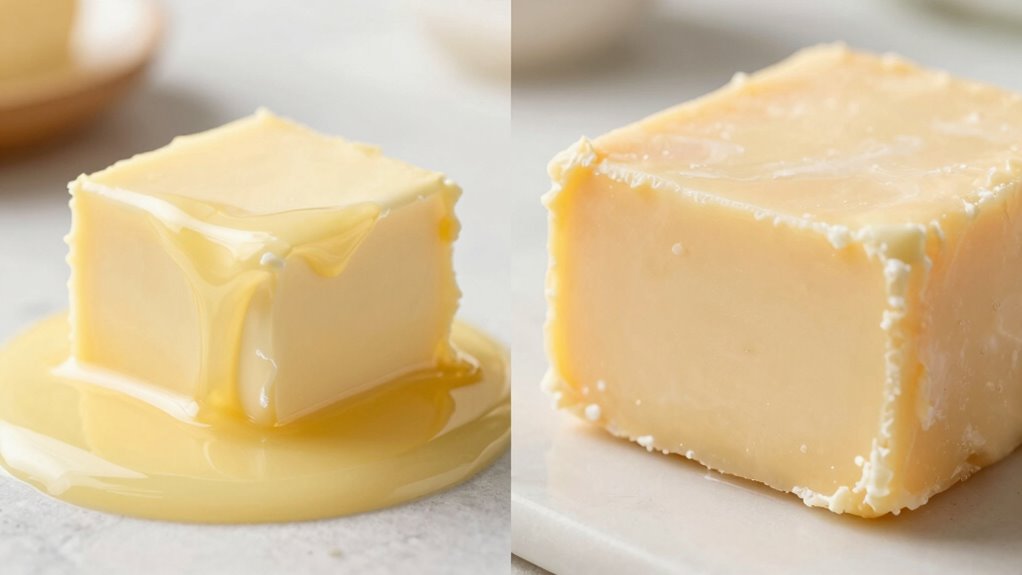
Understanding fat melting points is essential if you’re interested in how fats behave in cooking, nutrition, or health. Different fats melt at varying temperatures, influencing how they interact with other ingredients and affect the final texture of your dishes. For example, plant-based fats like coconut oil, olive oil, and palm oil have unique melting behaviors that impact both flavor and consistency. Knowing these differences helps you choose the right fat for your recipes, whether you’re aiming for a crispy crust, a smooth sauce, or a flaky pastry.
Butter and shortening are classic examples of fats with contrasting melting points. Butter, containing milk solids and water, melts relatively quickly around 90-95°F (32-35°C), giving baked goods a tender, moist crumb. Shortening, made from hydrogenated vegetable oils, remains solid at room temperature and melts at higher temperatures—typically around 117-122°F (47-50°C). This higher melting point allows shortening to create stable, flaky layers in pastries and pie crusts because it maintains its structure during baking. These differences are indispensable for bakers aiming for specific textures, as the melting behavior influences how fats distribute and interact with flour and other ingredients.
Butter melts quickly at 90-95°F, while shortening remains solid until 117-122°F, affecting texture and flakiness.
Understanding the melting points of fats also ties into emulsification processes. When you blend fats with liquids, such as in salad dressings or mayonnaise, the temperature and type of fat play essential roles. Plant-based fats often have different emulsification properties compared to animal fats like butter. For instance, certain plant fats contain emulsifiers naturally or can be processed to improve emulsification, making them ideal for creating stable emulsions. Knowing the melting points helps you control these processes because fats that melt too quickly or too slowly can destabilize emulsions, leading to separation or a less desirable texture. For instance, warming a plant-based fat just enough to reach its melting point can help it incorporate smoothly into other ingredients, creating a cohesive mixture.
In cooking, recognizing how fats behave at different temperatures enables you to optimize flavor and texture. Butter’s lower melting point makes it perfect for spreading and quick melting applications, while shortening’s higher melting point makes it suitable for layered, flaky baked goods. When working with plant-based fats, understanding their melting points and emulsification properties can help you develop healthier recipes without sacrificing quality. Whether you’re melting fats for sauces, baking, or creating emulsions, knowing these principles allows you to manipulate temperature and fat choice for the best results.

Honinst Stand Mixer, 6.5QT 10-Speed Tilt-Head Electric Stand Mixer, 3-In-1 Kitchen Mixer with Bowl, Dough Hook, Whisk and Beater, Food Mixer for Baking, Cake and Most Home Cooks, Red
【Pure copper motor & 10 Speed Control】Powerful pure copper motor with multi-speed adjustment and 6.5QT bowl, access to...
As an affiliate, we earn on qualifying purchases.
Frequently Asked Questions
How Does Processing Affect Butter’s Melting Point?
Processing affects butter’s melting point by altering fat crystal formation and moisture content. When you process butter, you can change how the fat crystals develop, which influences how quickly it melts. Additionally, removing or adding moisture impacts melting behavior, as higher moisture can lower the melting point. So, processing techniques directly shape butter’s melting characteristics, making it behave differently depending on how it’s handled.
Why Does Butter Melt Faster Than Shortening at Room Temperature?
You’ll notice butter melts faster than shortening because of its unique fat crystal structure and crystallization process. Butter contains larger fat crystals that break down quickly at room temperature, leading to faster melting. In contrast, shortening has a more uniform, finer fat crystal structure that melts more slowly. This crystallization difference affects how quickly each fat shifts from solid to liquid, making butter seem softer and melt quicker.
Can Adding Water Change Butter’s Melting Behavior?
Adding water can alter butter’s melting behavior because water content influences moisture effects and how heat transfers. Think of butter as a delicate snowball; if you add water, it’s like melting the snowball faster because the moisture makes it more susceptible to heat. The water’s presence creates tiny pockets that can make butter melt quicker or unevenly, especially if the water isn’t evenly distributed.
Do Additives in Commercial Products Influence Melting Points?
Additives in commercial formulations can markedly influence melting points. These additive effects alter the fat structure, either raising or lowering the melting temperature depending on the ingredients used. When you buy processed products, you’re often getting fats with stabilizers or emulsifiers that modify how they behave at different temperatures. So, yes, additives play a key role in shaping the melting behavior of commercial fats, making them different from pure, unprocessed fats like butter.
How Does Storage Temperature Impact Butter’s Melting Characteristics?
Did you know that storing butter at 70°F causes it to soften quickly, losing its firm consistency? Storage temperature directly impacts butter’s melting characteristics; the cooler you keep it, the firmer and more solid it remains. If you store butter in a warm environment, it melts faster, making it harder to spread. To maintain ideal butter consistency, keep it in the fridge or a cool, dark place.

KitchenAid Artisan Series 5 Quart Tilt Head Stand Mixer with Pouring Shield KSM150PS, Contour Silver, Zinc
10-speed slide control ranges from a very fast whip to a very slow stir. Cord length : 36...
As an affiliate, we earn on qualifying purchases.
Conclusion
So, it’s interesting how butter and shortening, despite both being fats, melt at different points—almost as if their unique compositions choose their own melting stories. You might find it coincidental that these differences influence your baking outcomes, but it’s really about their structures. Understanding this subtle dance of melting points helps you tweak recipes, making each baked good just right. After all, sometimes, the tiniest details make the biggest difference in your kitchen.

Honinst Stand Mixer, 6.5QT 10-Speed Tilt-Head Electric Stand Mixer, 3-In-1 Kitchen Mixer with Bowl, Dough Hook, Whisk and Beater, Food Mixer for Baking, Cake and Most Home Cooks, Beige
【Pure copper motor & 10 Speed Control】Powerful pure copper motor with multi-speed adjustment and 6.5QT bowl, access to...
As an affiliate, we earn on qualifying purchases.
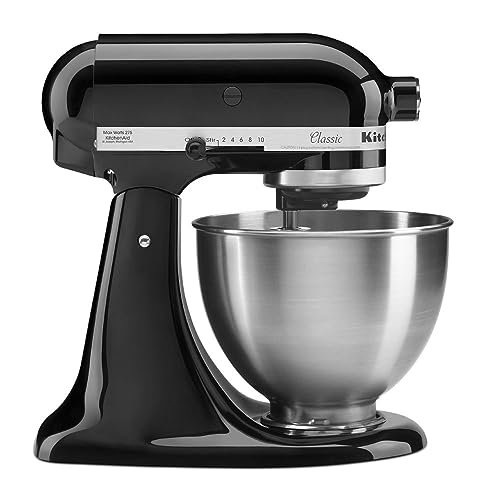
KitchenAid Classic Series 4.5 Quart Tilt-Head Stand Mixer K45SS, Onyx Black
Built to take it all on with the durable and built-to-last metal construction, and 59 touchpoints around the...
As an affiliate, we earn on qualifying purchases.