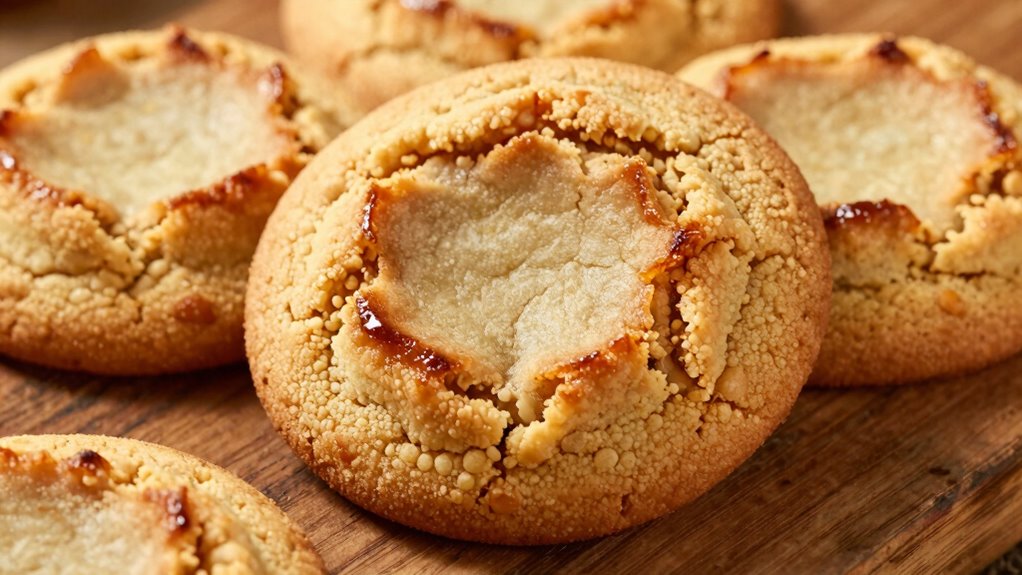

To achieve crispy edges and chewy centers, adjust your baking time and temperature carefully. Use a slightly higher oven temp for quicker crisping of edges while keeping the center moist, or lower temps for longer baking to guarantee even doneness. Rotating the tray and monitoring your oven’s heat can improve results. Small tweaks in time and temperature make a big difference. Keep exploring these techniques, and you’ll master perfect baked treats every time.

Get baking supplies delivered free with Prime
- Fast, free delivery on millions of items
- Prime Video, Amazon Music and more included
- Member-only deals all year
Key Takeaways
- Use higher oven temperatures for quick edge crisping while baking at lower temps for chewy centers.
- Adjust baking time based on item size and thickness to balance crispy edges and chewy middles.
- Rotate the baking sheet halfway to promote even heat distribution and consistent texture.
- Incorporate ingredient substitutions (like less moisture) to influence baking time and achieve desired textures.
- Monitor oven temperature with a thermometer for precise control, ensuring optimal crispness and chewiness.

If you’ve ever struggled to get your baked goods perfectly cooked, mastering a simple baking time trick can make all the difference. One of the most common issues is achieving that ideal balance between crispy edges and chewy centers. The secret lies in understanding how oven temperature and ingredient substitutions influence baking time. Adjusting your oven temperature slightly can help your baked goods develop crispy edges without overbaking the center. For instance, baking at a slightly higher temperature for a shorter period encourages the outer layers to crisp up faster, while the interior remains moist and chewy. Conversely, lowering the oven temperature and extending the baking time allows heat to penetrate evenly, ensuring the center cooks thoroughly without burning the edges. The key is to find that sweet spot where the oven temperature complements the type and size of your baked good. Smaller or thinner items benefit from a higher temperature, which crisps the exterior quickly, while larger or thicker items often require a lower, more consistent heat to cook evenly. Understanding how oven heat transfer affects your baked goods can help you make more precise adjustments. Ingredient substitutions also play a vital role in controlling baking time and texture. For example, replacing some of the butter with applesauce or yogurt can extend baking time because these substitutions tend to retain moisture, making the center chewier. On the other hand, reducing moisture-rich ingredients like liquids or adding more sugar can accelerate browning and crisping, allowing you to bake at a slightly higher oven temperature without risking an undercooked center. When experimenting with ingredient substitutions, keep in mind that they can alter not just flavor but also how heat distributes during baking. This means you might need to tweak your oven temperature or baking duration accordingly. It’s also helpful to use an oven thermometer to monitor the actual temperature inside your oven, as many home ovens don’t display the precise setting. This guarantees you’re baking at the right temperature, especially when trying to develop crispy edges. Additionally, consider rotating your baking sheet halfway through the process to promote even browning. By understanding the relationship between oven temperature, ingredient substitutions, and baking time, you gain better control over your baked goods. You’ll find it easier to achieve those crispy edges and chewy centers consistently, without having to rely solely on guesswork or overbaking. Small adjustments in temperature and ingredient choices can make a big difference, allowing you to produce bakery-quality treats right in your own kitchen.
Products Worth Considering

Le Creuset Signature Enameled Cast Iron Round Dutch Oven, 5.5 qt, Deep Teal

Le Creuset Enameled Cast Iron Round Dutch Oven, 5.5 Qt, Flame

Cuisinart ICE-70P1 2-Quart Ice Cream Maker with Countdown Timer
As an affiliate, we earn on qualifying purchases.
Frequently Asked Questions
How Do Oven Types Affect Baking Times?
You should know that oven types substantially impact baking times because of variations in oven calibration and baking surface materials. For example, convection ovens typically bake faster due to better heat circulation, while older or uncalibrated ovens may require extra time. Additionally, baking surface materials like metal, glass, or silicone influence heat transfer, so you might need to adjust your baking time accordingly to achieve perfect results.
Can Altitude Change Baking Results?
Yes, altitude changes can affect your baking results. At higher elevations, you need to make altitude adjustments by increasing the baking temperature slightly and reducing baking time. This helps the dough or batter set properly, preventing over-expansion and dryness. You might also need to tweak other factors like leavening agents. Always test small batches first to find the perfect altitude adjustments for consistent, delicious baked goods.
What Ingredients Influence Cookie Texture?
You influence cookie texture through ingredient variations and mixing techniques. Using more butter or shortening creates a tender, chewy center, while adding nuts or oats adds crunch. Overmixing dough develops gluten, resulting in a chewier cookie, whereas gentle mixing keeps cookies tender and soft. Adjusting these ingredients and techniques lets you customize your cookie’s texture, from crispy edges to chewy centers, for perfect results every time.
How Does Cookie Size Impact Baking Duration?
You might think bigger cookies take longer to bake, but the key is cookie thickness and dough density. Thicker cookies need more time because heat takes longer to penetrate, while thinner ones bake faster. If your dough is dense, it also requires extra baking time to cook through evenly. Always check for doneness by looking for golden edges and a slightly firm center, adjusting your baking time accordingly.
Are There Tips for Even Heat Distribution?
To guarantee even heat distribution, place your oven racks in the middle and avoid overcrowding. Use baking mats to promote uniform heat transfer and prevent hot spots. Turn your baking sheets halfway through the baking process for consistent results. Additionally, preheating the oven thoroughly helps maintain even temperature. These tips help your cookies bake uniformly, giving you crispy edges and chewy centers every time.
Conclusion
Mastering the baking time trick transforms your cookies into legendary treats—crispy edges and irresistibly chewy centers that could make even the most seasoned bakers jealous. Just a few seconds can make all the difference between a good batch and an unforgettable one. So, don’t be afraid to experiment and trust your instincts. With this simple tip, you’ll turn every bake into a masterpiece, creating cookies that are truly out of this world—beyond your wildest dessert dreams!