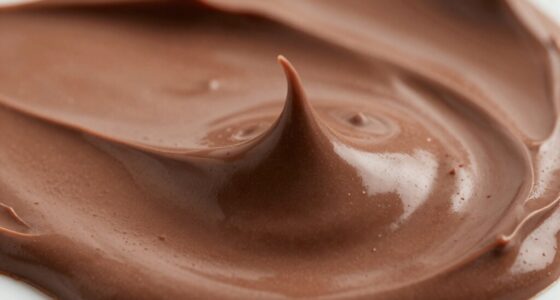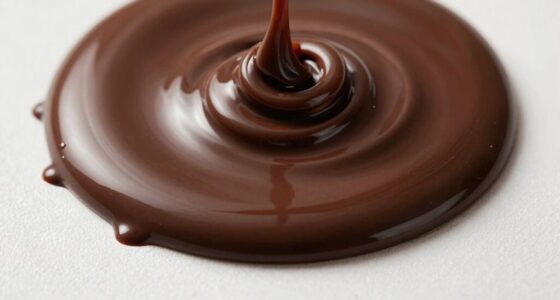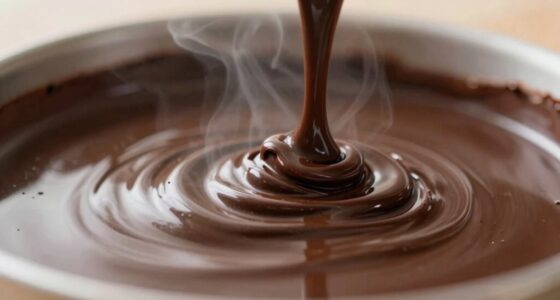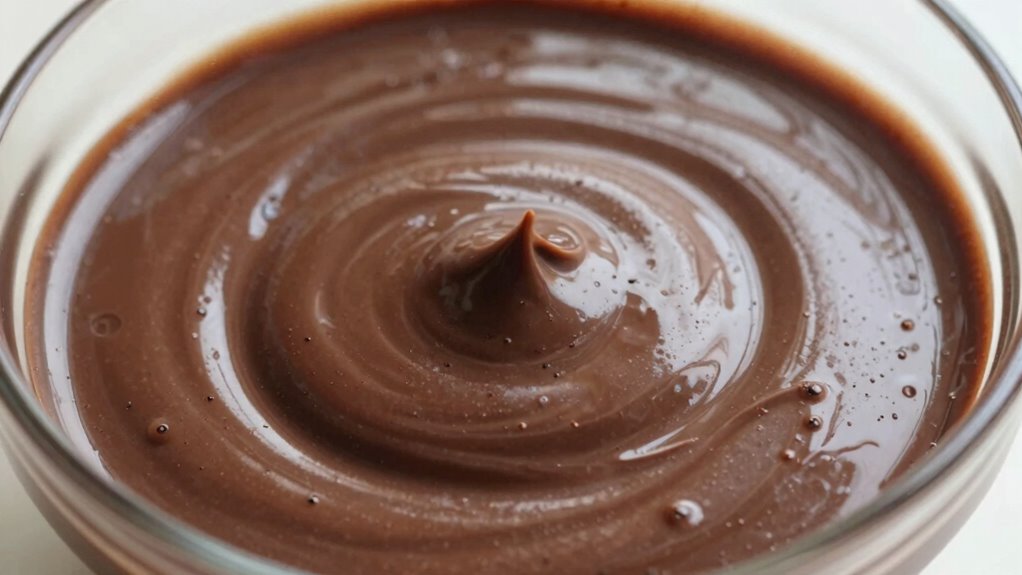

To know when your ganache is truly emulsified, look for a smooth, glossy, and uniform texture that coats the back of a spoon without streaks or oil separation. It should be velvety and hold its shape when spread, flowing smoothly when poured. If the mixture appears grainy or separates, it’s broken, but gentle stirring and proper temperature control can fix that. Keep exploring how to perfect your ganache for flawless results.

Get baking supplies delivered free with Prime
- Fast, free delivery on millions of items
- Prime Video, Amazon Music and more included
- Member-only deals all year
Key Takeaways
- The mixture appears smooth, shiny, and homogeneous without streaks or oil separation.
- It coats the back of a spoon evenly, with a velvety texture and no visible separation.
- The ganache maintains a mirror-like sheen and holds shape when spread or poured.
- Properly emulsified ganache is thick yet pourable, without graininess or oiliness.
- Gentle stirring and correct temperature control help achieve a stable, fully emulsified mixture.
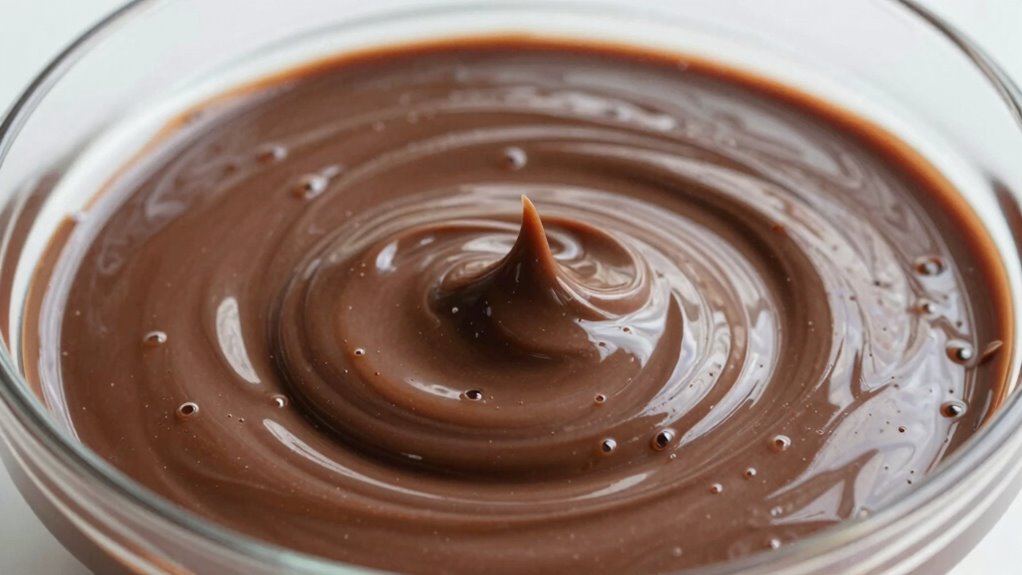
Achieving a perfectly emulsified ganache is essential for a smooth, glossy finish, but knowing when it’s truly emulsified can sometimes be tricky. The key lies in understanding the signs of proper emulsion, which involves blending chocolate and cream until they form a homogeneous, velvety mixture. One of the best ways to gauge this is by observing the cream consistency and the appearance of the mixture. When you’ve reached the right stage, the ganache should be smooth, shiny, and thick enough to coat the back of a spoon without any separation. If you see streaks or oil separation, it means the emulsion isn’t complete yet.
A properly emulsified ganache is smooth, shiny, and coats the back of a spoon without separation.
Chocolate tempering plays a vital role in achieving that glossy, professional look. While tempering involves heating and cooling chocolate to specific temperatures to stabilize its crystalline structure, it also influences how well your ganache emulsifies. Properly tempered chocolate melts smoothly and blends seamlessly with the cream, making the emulsion process easier. When chocolate is well-tempered, you’ll notice a more fluid, uniform mixture that’s less likely to separate or develop a greasy texture. This stability is essential because it guarantees the ganache remains glossy and smooth once cooled. Additionally, understanding the emulsification process can help you troubleshoot and improve your technique for consistently excellent results. A good understanding of emulsification helps prevent common issues like separation or graininess.
The cream consistency is another critical indicator. When you heat the cream, it should be steaming but not boiling vigorously. The ideal cream is warm, with a silky, almost velvety texture, which facilitates a better blend with the chocolate. As you pour the warm cream over chopped chocolate, you should see the mixture begin to melt smoothly without lumps or clumps. Stir gently, and if the ganache starts to come together into a uniform, glossy mass, you’re on the right track. If it remains lumpy or streaky, give it more time and gentle stirring. Proper temperature control is essential to prevent the cream from cooling too quickly or overheating, both of which can hinder emulsification. Recognizing the correct temperature range ensures a successful blend and prevents breaking or separation. Maintaining the right temperature also helps in achieving a stable emulsion, which is crucial for a perfect finish.
Finally, pay attention to the texture and appearance. When the ganache is truly emulsified, it should be thick yet pourable, with a mirror-like sheen. It should hold its shape when spread but still be fluid enough to pour smoothly. If you notice any oil separation or graininess, it indicates that the emulsion has broken, and you may need to start over or re-emulsify by gently warming and stirring. Achieving this perfect balance between chocolate tempering and cream consistency guarantees your ganache turns out glossy, smooth, and perfectly emulsified every time. Proper technique and attention to detail are crucial in ensuring a flawless finish.
professional chocolate ganache thermometer
As an affiliate, we earn on qualifying purchases.
As an affiliate, we earn on qualifying purchases.
Frequently Asked Questions
Can I Reuse Ganache That Hasn’t Fully Emulsified?
Yes, you can reuse ganache that hasn’t fully emulsified, but it may not have the same smooth consistency. Store it properly in an airtight container, and when reheating, stir vigorously to encourage emulsification. Use emulsification tips like adding a bit of warm cream or butter to help it come together. Keep in mind, if the ganache remains separated after reheating, it might be best to start fresh for the best results.
How Long Does It Typically Take for Ganache to Emulsify?
Ironically, patience isn’t your best friend here. Ganache typically takes about 5 to 10 minutes to emulsify if you maintain proper chocolate temperature and use the right mixing techniques. Keep the chocolate warm but not hot, and stir steadily until the mixture becomes glossy and smooth. If it refuses to blend, gently warm the bowl or add a splash of cream, and continue mixing until it’s perfectly emulsified.
What Are Common Causes of Failed Emulsification in Ganache?
Failed emulsification often happens if your chocolate consistency is off or if you don’t control the temperature well. If the chocolate is too hot or too cold, it won’t mix smoothly with the cream, causing separation. Additionally, using low-quality chocolate or adding ingredients too quickly can disrupt the process. To prevent this, keep your ingredients at a consistent temperature and stir gently until you see a smooth, glossy ganache.
Is It Safe to Consume Ganache if It’s Not Fully Emulsified?
If your ganache isn’t fully emulsified, it’s generally safe to consume, but the consistency might be uneven, affecting how it coats or fills. You might notice a separation or oiliness, which can impact the overall flavor enhancement. While it won’t harm you, incomplete emulsification could alter the texture and appearance, so for the best results, aim for a smooth, glossy consistency that guarantees ideal taste and presentation.
Can I Fix Broken Ganache After It Has Cooled?
A stitch in time saves nine, so fixing broken ganache is possible if you act quickly. Reheat it gently, ensuring the chocolate temperature stays warm but not too hot, and add a splash of fresh cream or butter. Stir vigorously to re-emulsify, paying close attention to ingredient ratios. Keep the mixture smooth and glossy, and you’ll rescue your ganache, turning a disaster into a delicious success.
As an affiliate, we earn on qualifying purchases.
Conclusion
Once your ganache reaches that smooth, glossy, and thick consistency, you’ll know it’s truly emulsified. Keep in mind, about 70% of home bakers say achieving perfect ganache boosts their confidence in chocolate desserts. When it’s properly emulsified, it not only looks stunning but also guarantees your creations hold together beautifully. So, don’t rush—wait for that velvety texture, and you’ll be rewarded with a flawless finish every time.
double boiler for melting chocolate
As an affiliate, we earn on qualifying purchases.
As an affiliate, we earn on qualifying purchases.
high-quality chocolate for baking
As an affiliate, we earn on qualifying purchases.
As an affiliate, we earn on qualifying purchases.
Halloween Picks
halloween
As an affiliate, we earn on qualifying purchases.