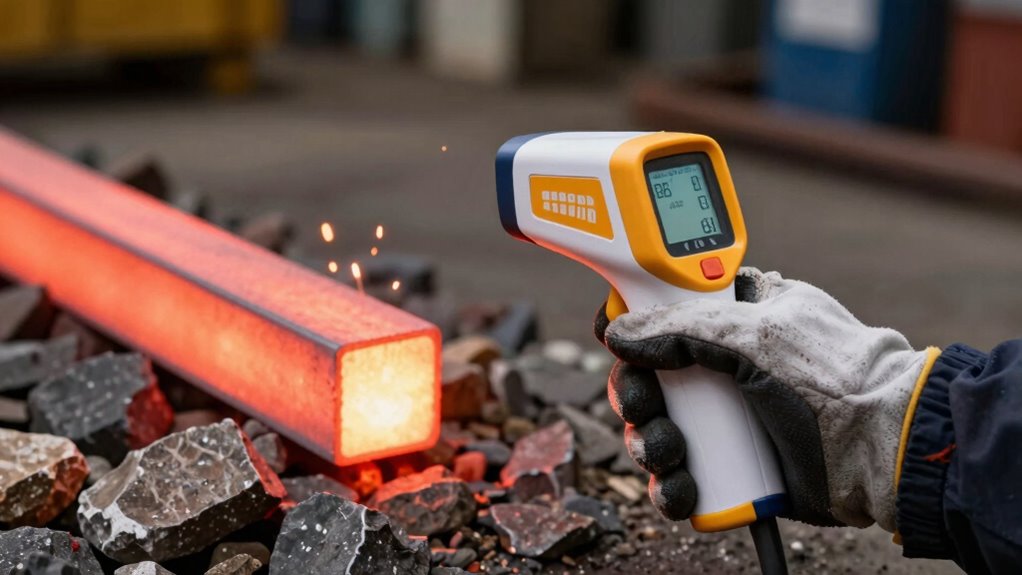

Infrared thermometers help you quickly and safely measure the surface temperatures of stones and steel without contact, providing real-time results. They are especially useful when traditional methods are impractical or unsafe. Steel’s high thermal conductivity means heat disperses fast, while stones may have uneven temperature spots, making infrared measurements valuable. Understanding surface emissivity helps improve accuracy, especially with reflective metals. Keep exploring to learn how material properties and surface finishes can further enhance your temperature assessments.

Get baking supplies delivered free with Prime
- Fast, free delivery on millions of items
- Prime Video, Amazon Music and more included
- Member-only deals all year
Key Takeaways
- Enable quick, contactless temperature measurement of stones and steel surfaces, improving safety and efficiency.
- Account for differing emissivity of materials to ensure accurate infrared temperature readings.
- Help identify surface temperature variations caused by heat transfer properties of stones and steel.
- Facilitate rapid assessments in environments where traditional contact thermometers are impractical.
- Allow adjustments based on material properties to improve measurement accuracy and reliability.
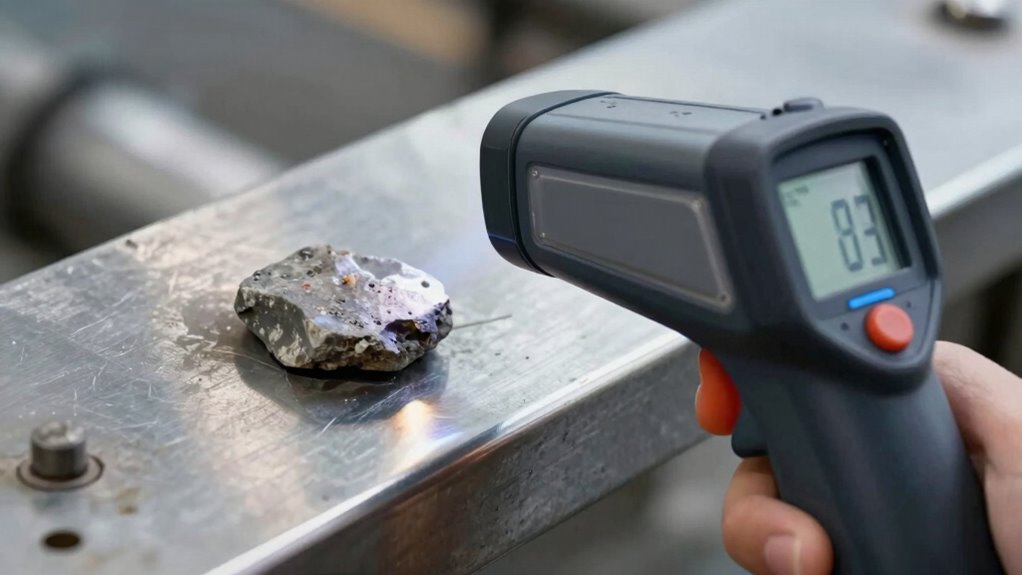
Infrared thermometers have become essential tools for measuring the temperature of stones and steel quickly and accurately. When working with these materials, understanding how heat transfers and how surfaces emit infrared radiation is critical. Infrared thermometers detect this radiation, providing real-time temperature readings without contact. This makes them invaluable in environments where traditional contact thermometers might be impractical or unsafe.
Infrared thermometers offer quick, contactless temperature readings for stones and steel in various environments.
One of the key factors affecting infrared temperature measurement is thermal conductivity. Stones and steel vary considerably in how they conduct heat—steel generally has high thermal conductivity, meaning it distributes heat rapidly across its surface, while stones usually have lower thermal conductivity, causing localized hot or cold spots. When you measure temperature with an infrared thermometer, you need to keep in mind that the surface temperature may not accurately reflect the internal temperature, especially if the material has uneven heat distribution. Recognizing these differences helps you interpret readings more precisely and decide when additional measurements or adjustments are necessary. Additionally, surface emissivity can change with surface finishes or coatings, influencing measurement accuracy. Surface emissivity is a vital aspect to consider for precise readings, especially when dealing with reflective materials.
Surface emissivity also plays an essential role in accurate infrared temperature measurement. Emissivity refers to a material’s ability to emit infrared radiation, and it varies widely between different surfaces. Metals like steel often have low emissivity, causing them to reflect infrared radiation from surrounding objects rather than emit their own, which can lead to inaccurate readings if not properly accounted for. Stones tend to have higher emissivity, making their surface temperature easier to measure. To get accurate results, you might need to calibrate your infrared thermometer or apply a high-emissivity coating to reflective surfaces like steel. This guarantees the device captures the true infrared radiation emitted by the material rather than reflected radiation, which could skew the measurement. Being aware of thermal properties and how they impact infrared measurements ensures more precise and reliable results. Moreover, understanding the emissivity variations allows for better adjustment of the device settings to improve measurement accuracy. Considering surface coatings can also enhance measurement reliability by standardizing emissivity across different materials.
infrared thermometer for steel and stones
As an affiliate, we earn on qualifying purchases.
As an affiliate, we earn on qualifying purchases.
Frequently Asked Questions
Can Infrared Thermometers Measure Temperature Through Coatings or Paint?
Infrared thermometers generally can’t measure temperature through coatings or paint because coatings cause interference, blocking the infrared signals from reaching the surface. Paint insulation and other surface layers absorb or reflect the infrared energy, leading to inaccurate readings. If you need precise measurements on coated surfaces, you might consider removing the paint or using contact thermometers instead. Always verify your thermometer’s specifications match your measurement needs for the best accuracy.
How Accurate Are Infrared Thermometers Compared to Contact Thermometers?
Think of infrared thermometers as skilled archers, aiming for precise hits. They’re quite accurate, but calibration procedures guarantee they stay on target. Unlike contact thermometers, they don’t rely on direct contact, making them faster. Just keep an eye on battery life, as it impacts performance. While slightly less precise than contact models for some applications, with proper calibration, infrared thermometers reliably provide quick, accurate temperature readings.
Are Infrared Thermometers Suitable for Measuring Hot Steel Surfaces?
Yes, infrared thermometers are suitable for measuring hot steel surfaces. You should consider surface emissivity, as steel’s emissivity varies and affects accuracy. To guarantee precise readings, calibrate your thermometer according to the manufacturer’s procedures, especially for high-temperature surfaces. Regular calibration and understanding emissivity settings help you get reliable measurements, making infrared thermometers a practical tool for monitoring hot steel surfaces safely and effectively.
What Maintenance Is Required for Infrared Thermometer Sensors?
You need to regularly maintain your infrared thermometer sensors by checking sensor calibration and guaranteeing accurate readings. Calibration should be performed periodically, following the manufacturer’s instructions, to keep measurements precise. Additionally, monitor the battery life and replace batteries as needed to prevent measurement disruptions. Proper maintenance helps extend your device’s lifespan, ensures reliable readings, and keeps your infrared thermometer functioning at its best in demanding environments.
Can Temperature Readings Be Affected by Environmental Conditions?
Yes, environmental interference can affect your temperature readings. Factors like wind, humidity, or ambient temperature can cause inaccuracies. Surface reflectivity also plays a role; shiny or reflective surfaces may reflect infrared radiation, leading to erroneous readings. To guarantee accuracy, you should consider these environmental conditions and surface properties, possibly adjusting your measurements or using proper calibration techniques to counteract interference and obtain reliable temperature data.
contactless temperature gun for metals
As an affiliate, we earn on qualifying purchases.
As an affiliate, we earn on qualifying purchases.
Conclusion
With infrared thermometers, you’ll practically have a superpower to instantly detect temperature changes in stones and steel. Imagine having a magic wand that reveals hidden hot spots or cold zones in a flash—saving you time, money, and headaches! These tools turn you into a temperature detective, making complex tasks feel effortless. Say goodbye to guesswork and hello to precision so sharp, it’s almost like having a thermal vision that transforms your work into a breeze!
high emissivity infrared thermometer
As an affiliate, we earn on qualifying purchases.
As an affiliate, we earn on qualifying purchases.
digital infrared temperature sensor
As an affiliate, we earn on qualifying purchases.
As an affiliate, we earn on qualifying purchases.
Fall Picks
fall essentials
As an affiliate, we earn on qualifying purchases.