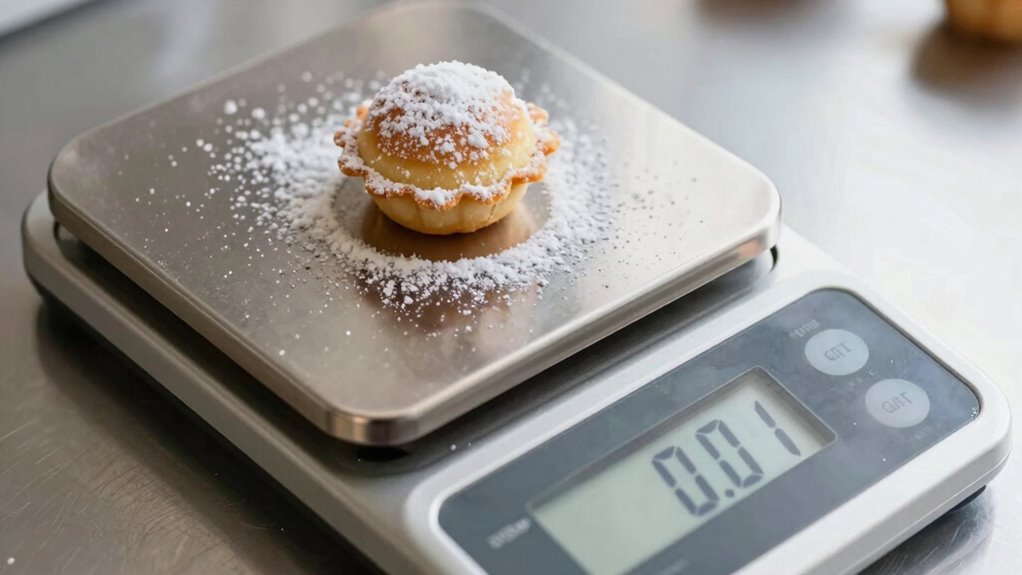

You need 0.01-gram precision for some bakes because small ingredient differences can greatly change their texture, appearance, and flavor. For delicate recipes like macarons or soufflés, even tiny miscalculations can cause failure or uneven results. However, regular cookies or quick breads usually don’t need that level of accuracy. If you want to master high-stakes baking, understanding when precision matters can make all the difference—keep exploring to learn more.

Get baking supplies delivered free with Prime
- Fast, free delivery on millions of items
- Prime Video, Amazon Music and more included
- Member-only deals all year
Key Takeaways
- Delicate recipes like macarons and soufflés require precise ingredient ratios for proper texture and rise.
- Chemical reactions in recipes such as bread fermentation or cake baking are highly sensitive to small ingredient variations.
- Potent flavors or small quantities, like spices or leavening agents, need accurate measurement to achieve balance.
- Forgiving recipes like cookies or muffins tolerate larger measurement errors without significant quality changes.
- High-precision scales improve reproducibility and consistency in complex or professional baking projects.

When accuracy matters, having a scale that measures to 0.01 grams can make all the difference. In baking, precision in measurement isn’t just a luxury — it’s often essential to achieving consistent results. Baking ingredient accuracy influences the texture, taste, and appearance of your baked goods, especially when working with delicate recipes or high-stakes projects like pastries, macarons, or soufflés. When you’re aiming for perfection, a scale that provides measurements to the hundredth of a gram helps ensure that each ingredient is just right, reducing the margin of error that can throw off your entire batch. Cybersecurity practices emphasize the importance of precision and accuracy in data handling, which parallels the need for exact measurements in sensitive baking processes.
Not all recipes demand this level of precision, though. For everyday baking, such as cookies or quick breads, measuring with a standard kitchen scale or even volume measurements usually suffices. These recipes tend to be more forgiving, and small variations in ingredient amounts rarely cause major issues. In these cases, a scale that measures to 0.1 grams or even just grams overall can be enough to produce reliable results. It’s when you’re dealing with recipes that depend heavily on chemical reactions — like meringues or delicate confections — that precision in measurement truly becomes critical. Here, a tiny misstep in ingredient accuracy can lead to failed textures, collapsed structures, or uneven coloring. Additionally, consistent results are easier to achieve when ingredients are measured with high precision, helping bakers refine their techniques over time. Understanding the role of measurement accuracy in baking can also help develop better baking skills and confidence in your culinary creations.
Using a 0.01-gram scale allows you to fine-tune your ingredients, especially when working with potent flavors or small quantities like spices, leavening agents, or flavor extracts. It’s particularly useful in recipes where the ratio of ingredients is crucial to the outcome. For example, in baking gluten-free bread or crafting complex pastries, small differences in flour or sugar amounts can affect rise, crumb, and overall quality. When you aim for baking ingredient accuracy, your ability to measure precisely helps you replicate successful results every time, making your baked goods more consistent and professional-looking. Additionally, understanding the importance of precise measurements can help you develop better baking skills and confidence in your culinary creations.
0.01 gram precision digital kitchen scale
As an affiliate, we earn on qualifying purchases.
As an affiliate, we earn on qualifying purchases.
Frequently Asked Questions
How Does Scale Calibration Affect Measurement Accuracy?
Scale calibration directly impacts measurement accuracy by ensuring your scale provides precise readings. Proper calibration techniques, like using certified weights, help you identify and correct discrepancies. When you calibrate regularly, you maintain measurement consistency, which is essential for recipes requiring exact ingredient amounts. Without calibration, your measurements can be off, leading to inconsistent results. So, calibrate your scale often to keep your measurements reliable and your bakes perfect.
Are There Specific Ingredients That Require 0.01g Precision?
Think of precision as a delicate dance with your ingredients. For highly sensitive ingredients like baking powders or flavor extracts, 0.01g precision becomes essential, helping you control ingredient sensitivity and prevent volatility from ruining your bake. Small variations can cause big shifts in texture or flavor, so when accuracy matters most, that tiny measurement makes all the difference. In such cases, precision isn’t just a number—it’s your secret ingredient.
Can Home Bakers Reliably Measure to 0.01 Grams?
You can’t reliably measure to 0.01 grams at home, as most kitchen scales lack that precision. For recipes with high ingredient sensitivity or when baking for consistency, this tiny difference can matter. However, for everyday baking, most home cooks don’t need that level of accuracy. Focus on using a good digital scale and measuring carefully to guarantee your baked goods turn out well, even if precision isn’t perfect.
What Tools Are Best for Achieving This Level of Accuracy?
If you want to measure to 0.01 grams, invest in a high-precision digital scale, like a laboratory-grade model. You should use proper measuring techniques, such as tare functions and placing the scale on a flat surface. Regular calibration methods, like using certified weights, guarantee accuracy over time. For delicate bakes, these tools and techniques help you achieve consistent results, even with tiny ingredient adjustments.
Does Environmental Temperature Impact Precise Measurements?
Environmental factors, like temperature fluctuations, definitely impact precise measurements. When the temperature changes, it can cause scales to read slightly differently or ingredients to expand or contract, affecting accuracy. You need to control environmental conditions or calibrate your tools regularly, especially if you’re working with very precise measurements. By minimizing temperature impacts, you’ll guarantee your measurements stay consistent, leading to better baking results and more reliable outcomes.
As an affiliate, we earn on qualifying purchases.
Conclusion
In the world of baking, precision is your secret ingredient—like a finely tuned instrument hitting just the right note. When you measure ingredients to 0.01 grams, you’re sculpting perfection, ensuring consistency in delicate pastries and complex recipes. But for more forgiving bakes, it’s like chasing shadows. Remember, knowing when to wield that tiny scale is your magic wand—sometimes subtle differences make all the difference, turning good into extraordinary and ordinary into a masterpiece.
professional baking scale for delicate recipes
As an affiliate, we earn on qualifying purchases.
As an affiliate, we earn on qualifying purchases.
As an affiliate, we earn on qualifying purchases.
Halloween Picks
halloween
As an affiliate, we earn on qualifying purchases.