
TL;DR
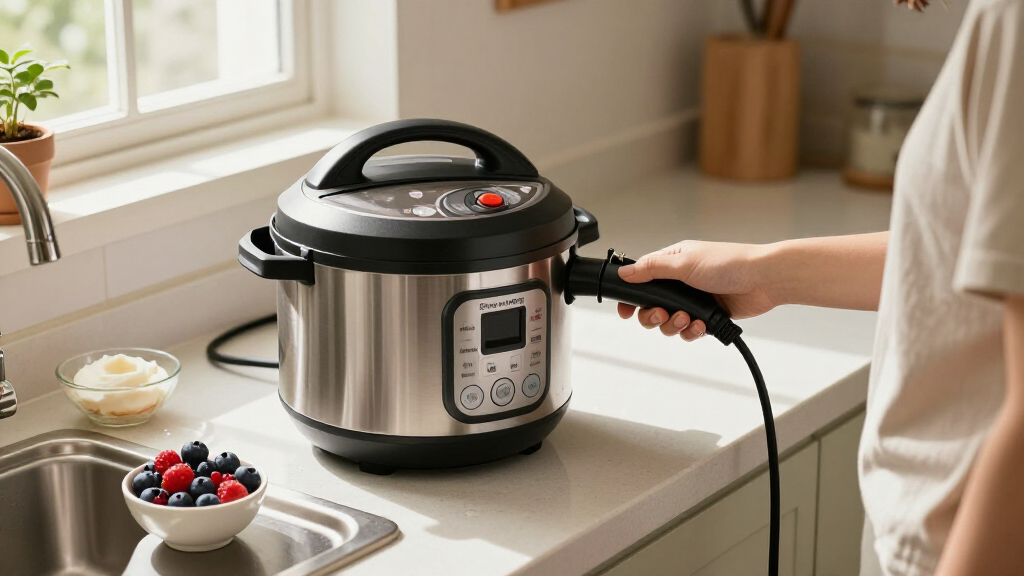
Good Housekeeping’s report warns against powering a pressure cooker through an indoor extension cord because some cookers draw 1,250 watts or more, while some cords are rated for only 10 amps. It also advises against running multiple high-powered appliances on the same circuit and recommends keeping the cooker’s cord away from heat, edges and floor-level hazards.
Good Housekeeping has advised against plugging a pressure cooker into an indoor extension cord, warning that some models draw more power than lower-rated cords can safely handle. The report says a cord rated for 10 amps may have a capacity of about 1,200 watts, while some pressure cookers operate at 1,250 watts or higher, creating a risk of overheating and fire.

Get baking supplies delivered free with Prime
- Fast, free delivery on millions of items
- Prime Video, Amazon Music and more included
- Member-only deals all year
The report compares the appliance’s power demand with the capacity of common household electrical equipment. It says a typical kitchen outlet rated at 15 amps and 120 volts can handle around 1,500 watts. Some indoor extension cords, however, may be rated for only 10 amps, or about 1,200 watts. Those figures mean a pressure cooker’s draw can exceed the stated capacity of such a cord; the report does not say that every extension cord has the same rating or that every pressure cooker draws the same amount.
According to Good Housekeeping, the concern is that high current passing through a cord with wiring too small for the load could overheat or damage it, potentially creating a fire hazard. The cord and cooker could also be damaged. The report gives no testing data, incident count or product-specific assessment, so it should be read as general safety guidance rather than a finding about every appliance-and-cord combination.
The article also warns against operating two or more high-powered appliances on the same electrical circuit. Its writer describes a toaster oven and pressure cooker running at once on separate kitchen outlets that shared a circuit; the breaker tripped. Separate sockets do not necessarily mean separate circuits. The report says older homes with ungrounded outlets may face added hazards if overloaded wiring heats up, but it does not assess any particular home’s wiring.
Avoiding Cord Overheating at Home
The practical issue is a mismatch between an appliance’s electrical demand and the rating of the cord or circuit supplying it. Overloading a cord can cause heat buildup, which may damage equipment and increase fire risk. This matters because an extension cord can seem like a convenient way to move a bulky cooker off the counter, while its rating may not be suitable for a high-wattage appliance.
Checking the pressure cooker’s rating and the cord’s label can help identify that mismatch, but the report’s guidance is to plug the appliance directly into an appropriate wall outlet rather than rely on an indoor extension cord. Readers should follow the appliance manufacturer’s instructions and seek advice from a qualified electrician if an outlet, breaker or home wiring appears damaged or unsuitable. A breaker trip is a warning that a circuit has been overloaded, not a reason to keep resetting it while the same load remains connected.
The placement advice also addresses risks beyond electrical capacity. A cord hanging over a counter edge can be pulled by a child or pet, and a cord near a gas flame or hot electric cooktop can catch fire or melt. Keeping the cooker near a suitable outlet and away from heat and traffic can reduce these avoidable hazards.
Products Worth Considering

Cuisinart Precision Pro 5.5-Quart Digital Stand Mixer, Graphite

Instant Pot Duo Crisp 8-Quart 11-in-1 Air Fryer and Pressure Cooker

Weber Searwood XL 600 Wood Pellet Smoker Grill, 36-Inch, Black
As an affiliate, we earn on qualifying purchases.
Why Outlet Ratings Matter
The source report frames its advice around the difference between watts, amps and voltage. It gives a common kitchen outlet example of 15 amps at 120 volts, corresponding to about 1,500 watts, and contrasts it with indoor extension cords that may be rated at 10 amps. These are examples from the article, not a guarantee that every home outlet or cord has those ratings. The product label, manufacturer’s instructions and condition of the home’s electrical system matter.
Good Housekeeping also notes that pressure cookers and multi-cookers with high-powered sear settings can place substantial demand on a circuit. The writer’s account of a tripped breaker illustrates that outlets in different positions may still share one circuit. The report does not identify the home’s wiring or provide a technical inspection, and a single anecdote cannot establish how frequently this happens.
Other recommendations in the article are to unplug the cooker when it is not in use, prevent its cord from dangling, keep the cord clear of cooktops and flames, and avoid outlets positioned low on a kitchen island where the cord may be exposed. The source gives these as preventive steps; it does not report a new regulation or product recall.
“That’s a hard no.”
— Good Housekeeping report
What the Report Does Not Establish
The source does not identify a specific pressure cooker, extension-cord model or outlet, and it provides no independent testing results. Ratings vary by product, so the stated 1,250-watt appliance draw and 1,200-watt cord capacity are examples, not universal specifications. The article also does not quantify how often extension-cord overheating or related fires occur.
It is not clear from the report how the advice applies to every type of cord or every manufacturer’s instructions. Nor does it establish whether a particular reader’s kitchen outlets share a circuit, whether the outlets are grounded, or whether the wiring is in safe condition. Those details require checking the relevant labels and documentation or getting a qualified electrical assessment. The source does not announce a recall, government warning or change in safety standards.
Check the Appliance and Circuit
Before using a pressure cooker, readers can check its wattage and the electrical instructions supplied by its manufacturer, then use an outlet and circuit rated for the appliance. Avoid an indoor extension cord unless the appliance manufacturer and cord specifications explicitly support that use. Keep the cord away from hot surfaces, flames, water, counter edges and places where children or pets can pull it.
If a breaker trips, unplug or switch off the appliances on that circuit and identify the source of the overload before using them again. Repeated trips, warm outlets, damaged wiring or uncertainty about grounding should be handled by a qualified electrician. The source report gives no follow-up action, recall or deadline; the next step for households is to check their own equipment and follow its manufacturer’s safety guidance.
Key Questions
Can I plug a pressure cooker into an extension cord?
Good Housekeeping advises against using an indoor extension cord for a pressure cooker. Some models draw 1,250 watts or more, while some indoor cords are rated for about 1,200 watts. Check the appliance instructions and ratings rather than assuming every cord is suitable.
Why can an extension cord be a fire risk?
If an appliance draws more power than a cord is rated to handle, the cord’s wiring may overheat or become damaged. The report says that can create a fire hazard, though it does not provide an incident rate or product-specific test results.
Can two appliances use separate outlets at the same time?
They may still share the same electrical circuit. The report describes a pressure cooker and toaster oven plugged into separate outlets but running on one circuit; the breaker tripped. Check the circuit and appliance instructions, and do not keep running a combination that trips the breaker.
Where should I place the pressure cooker cord?
Keep it away from cooktops, open flames, counter edges and places where children or pets could pull it. The source also advises against using low, floor-level island outlets that leave the cord exposed.
Should I unplug a pressure cooker when it is not in use?
The Good Housekeeping report recommends unplugging it when not in use. It cites possible electrical surges or faults as reasons to avoid leaving the appliance connected, but does not provide incident data supporting a specific level of risk.
Source: rss