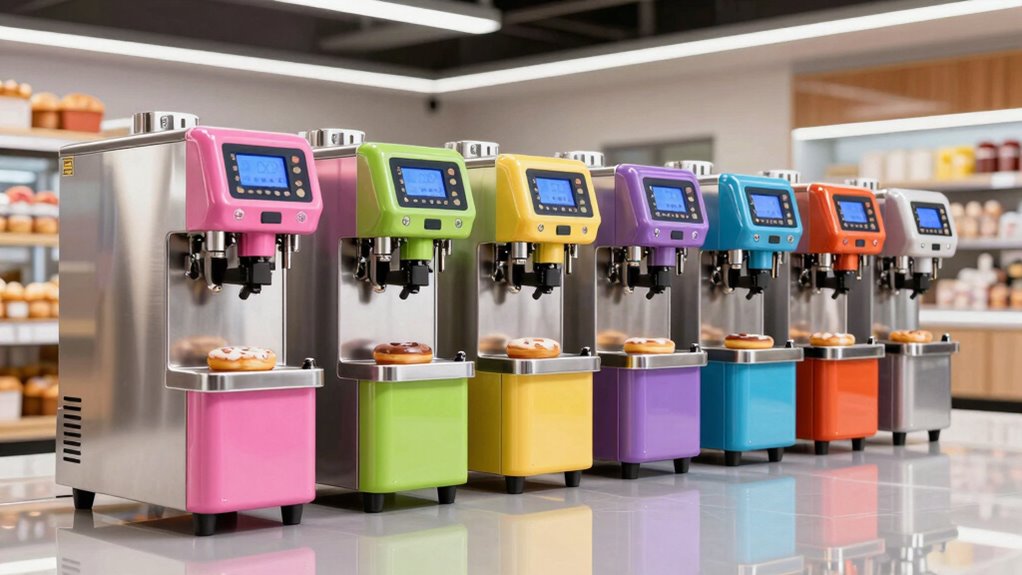

A commercial donut maker machine can range from a compact single-row unit to an automatic multi-row fryer, so the right choice depends on your expected volume and kitchen setup. My best overall pick is the VEVOR Commercial Automatic 4-Row Donut Maker, which pairs a stated output of 240 donuts per hour with a practical middle-ground format. For higher-volume production, the Kolice Heavy-Duty 220V 4-Row model offers adjustable mold sizes and a much higher stated capacity, while the Wtecom Single-Row Mini Donut Maker suits smaller batches and tighter workspaces. The central tradeoff is output versus footprint, electrical demands, and the amount of automation your staff can manage. Read on for the full breakdown of all 15 options and guidance on choosing a machine that fits your menu and service pace.

Get baking supplies delivered free with Prime
- Fast, free delivery on millions of items
- Prime Video, Amazon Music and more included
- Member-only deals all year
Complete the kit


Key Takeaways
Capacity claims vary widely: the lineup ranges from the VEVOR 4-row model’s stated 240 donuts per hour to Kolice models claiming output in the thousands, so compare production assumptions and test conditions before treating those figures as directly comparable.
Row count is not the whole story: the six-row PYY, VEVOR, and Kolice machines emphasize throughput, while mold configuration, donut size, feed method, and operator workflow also affect actual output.
Electrical compatibility can narrow the field: the Kolice heavy-duty 4-row machine specifies 220V, making it a better fit for a prepared commercial kitchen than a site that only has standard outlets.
Not every product makes the same kind of donut: the 6-hole donut waffle maker is a different cooking format from the automatic mini-donut fryers, so buyers should match the machine to the menu rather than compare capacity alone.
Compact and entry-level options trade speed for a smaller commitment: the Wtecom single-row unit and DSP Mini Donut Maker may suit modest service needs, while multi-row automatic machines make more sense when steady volume can justify their space and setup.
| VEVOR Commercial Automatic 4-Row Donut Maker, 240 Donuts per Hour |  | Best for Predictable Mid-Volume Frying | Model: ZDT-4 | Production capacity: Up to 240 donuts per hour | Rows: 4 | VIEW ON AMAZON | See Our Full Breakdown |
| 6-Hole Commercial Donut Waffle Maker |  | Best for Countertop Batch Baking | Model: YD-6A | Capacity: 6 holes | Power: 1600 W, 110 V | VIEW ON AMAZON | See Our Full Breakdown |
| HNZXIB Commercial 4-Row Mini Donut Maker |  | Best for Maximum Stated Mini-Donut Throughput | Model: N-TTQ01 | Production rate: More than 1,800 donuts per hour | Hopper capacity: 5.5 L | VIEW ON AMAZON | See Our Full Breakdown |
| VEVOR Commercial Automatic Donut Maker with 3 Molds |  | Best for Multiple Donut Sizes | Model: DH-15L | Power: 3000 W | Mold sizes: Mini: 30–50 mm; standard: 55–90 mm; large: 70–120 mm | VIEW ON AMAZON | See Our Full Breakdown |
| Kolice Commercial Automatic Donut Making Machine |  | Best for Integrated Production Steps | Production rate: 450–800 pieces per hour | Power and electrical supply: 3000 W; 110 V; 60 Hz | Hopper capacity: 7 L | VIEW ON AMAZON | See Our Full Breakdown |
| Kolice Commercial Heavy-Duty 220V Automatic 4-Row Donut Maker – 500‑1900 pcs/hr, 12 Molds, 2″‑4.72″ Diameter |  | Best for High-Volume, Varied Donut Sizes | Voltage: 220V, 60Hz | Power: 10,000W | Production rate: 500–1,900 pieces per hour | VIEW ON AMAZON | See Our Full Breakdown |
| Wtecom Commercial Single-Row Mini Donut Maker Machine |  | Best for 110V Small-Batch Commercial Use | Voltage and frequency: 110V, 60Hz | Power: 3,000W | Production capacity: 450–800 pieces per hour | VIEW ON AMAZON | See Our Full Breakdown |
| FOHERE Commercial 4-Row Mini Donut Maker, 1750W |  | Best Compact Entry-Level Commercial Machine | Power: 1,750W | Production capacity: Up to 250 donuts per hour | Hopper capacity: 3 L | VIEW ON AMAZON | See Our Full Breakdown |
| PYY Commercial Automatic Mini Donut Maker, 1800W, 6 Rows |  | Best for Maximum Stated Mini-Donut Throughput | Power: 1,800W | Voltage: 110V | Production capacity: Up to 2,600 mini donuts per hour | VIEW ON AMAZON | See Our Full Breakdown |
| Kolice Commercial Donut Fryer with 3 Molds |  | Best for Shape Variety on 110V | Voltage and frequency: 110V, 60Hz | Power: 3,000W | Production capacity: Approximately 500–2,000 donuts per hour, depending on shape | VIEW ON AMAZON | See Our Full Breakdown |
| PYY Commercial Automatic Mini Donut Maker, 1800W, 4 Rows |  | Best for Automated Mid-Volume Production | Power: 1800 W | Voltage: 110 V | Production capacity: Up to 1,800 mini donuts per hour | VIEW ON AMAZON | See Our Full Breakdown |
| Kolice Commercial 2600pcs/hour Mini 6 Rows Donuts Machine, Doughnut Maker, Frying Donuts Maker, Mini Donut Maker, Street Food Snack Food Equipment |  | Best for High-Volume Mini Donut Output | Voltage: 110 V, 60 Hz | Power: 1500 W | Production capacity: Up to 2,600 donuts per hour | VIEW ON AMAZON | See Our Full Breakdown |
| VEVOR 6-Row Commercial Automatic Donut Maker |  | Best for Ring Donuts and Measured Oil Capacity | Model: ZDT-6 | Production capacity: Up to 360 donuts per hour | Rows: 6 | VIEW ON AMAZON | See Our Full Breakdown |
| DSP Mini Donut Maker |  | Best for Small-Batch Baking | Batch capacity: 16 mini donuts | Donut size: 1.93 in | Cooking time: Approximately 3 minutes | VIEW ON AMAZON | See Our Full Breakdown |
| Kolice Commercial 6-Row Automatic Donut Machine |  | Best for High-Capacity Runs with Timer Controls | Power and voltage: 2000 W, 110 V 60 Hz | Production capacity: Up to 2,600 pieces per hour | Mold rows: 6 | VIEW ON AMAZON | See Our Full Breakdown |
| commercial donut maker machine | Hopper capacity | Dimensions | Power | Production capacity |
|---|---|---|---|---|
| VEVOR Commercial Automatic 4-R | 3 L | — | 1750 W, 120 V | Up to 240 donuts per hour |
| 6-Hole Commercial Donut Waffle | — | 10.8 × 9.19 × 12 in | 1600 W, 110 V | — |
| HNZXIB Commercial 4-Row Mini D | 5.5 L | — | — | — |
| VEVOR Commercial Automatic Don | 5.5 L | 15.74 × 41.34 × 25.59 in | 3000 W | — |
| Kolice Commercial Automatic Do | 7 L | 41.34 × 15.75 × 25.60 in | — | — |
| Kolice Commercial Heavy-Duty 2 | 30 L | 45.86 × 26.77 × 27.16 inches | 10,000W | — |
| Wtecom Commercial Single-Row M | 7 L | 41.34 × 15.75 × 25.6 in | 3,000W | 450–800 pieces per hour |
| FOHERE Commercial 4-Row Mini D | 3 L | 21.85 × 14.76 × 14.57 in | 1,750W | Up to 250 donuts per hour |
| PYY Commercial Automatic Mini | 9 L | 23.23 × 21.85 × 12.6 in | 1,800W | Up to 2,600 mini donuts per hour |
| Kolice Commercial Donut Fryer | 9 L | — | 3,000W | Approximately 500–2,000 donuts per hour, depending on shape |
| PYY Commercial Automatic Mini | Listed as 5.5 L and 9 L | 22.24 × 18.11 × 12.6 in | 1800 W | Up to 1,800 mini donuts per hour |
| Kolice Commercial 2600pcs/hour | — | 31.50 × 23.62 × 15.75 in | 1500 W | Up to 2,600 donuts per hour |
| VEVOR 6-Row Commercial Automat | 4.5 L | — | — | Up to 360 donuts per hour |
| DSP Mini Donut Maker | — | 12.4 × 10.3 × 3.15 in | — | — |
| Kolice Commercial 6-Row Automa | 9 L | 31.50 × 23.62 × 15.75 in | — | Up to 2,600 pieces per hour |
More Details on Our Top Picks
VEVOR Commercial Automatic 4-Row Donut Maker, 240 Donuts per Hour
For a small bakery or cafe that needs a steady flow of full-size ring donuts, I rank this VEVOR as a practical mid-volume choice. Its stated output of 240 donuts per hour and automatic flipping give it a more production-focused setup than the 6-Hole Commercial Donut Waffle Maker, which bakes donuts in batches rather than frying them on a conveyor-style process. The 3 L hopper and 6.1 L oil tank suit recurring service, while the 120 V connection may be easier to accommodate than equipment specified for higher-voltage circuits. The tradeoff is scale: it falls well short of the HNZXIB’s claimed 1,800-plus mini donuts per hour, and donut size can shift with recipe and frying time. I’d choose it for consistent, moderate output, not peak-volume production.
Pros:- Rated for up to 240 donuts per hour
- Automatic flipping supports more even cooking
- 304 stainless steel body is suited to frequent kitchen use and cleaning
- 3 L hopper and 6.1 L oil tank support ongoing production
Cons:- Output is far below the HNZXIB four-row machine’s stated mini-donut rate
- Donut size may vary with recipe and frying time
- At 21.85 inches long and 33.1 pounds, it needs dedicated counter space
Best for: Cafes and small bakeries needing automated, full-size ring donuts at a moderate hourly pace.
Not ideal for: High-volume shops that need thousands of mini donuts per hour or businesses that need tightly specified donut sizing.
- Model:ZDT-4
- Production capacity:Up to 240 donuts per hour
- Rows:4
- Donut size:Approximately 50 mm diameter and 25 mm thick
- Hopper capacity:3 L
- Oil tank capacity:6.1 L
- Power:1750 W, 120 V
- Material:304 stainless steel
- Dimensions and weight:21.85 × 15 × 14.5 in; 33.1 lb
Our verdict“Choose this VEVOR for automated, moderate-volume frying when a 120 V setup and full-size ring donuts matter more than maximum throughput.”
6-Hole Commercial Donut Waffle Maker
I’d place this model in a different lane from the oil-frying machines: it bakes six donuts at a time, making it a better fit for a cafe serving made-to-order snacks than a shop seeking continuous fryer output. Its double-sided heating, adjustable temperature, and short timer range give staff control over batches, while the non-stick tray is intended to simplify release. Compared with the VEVOR ZDT-4, it avoids a large oil tank and the associated frying workflow, but its six-cavity format cannot match the VEVOR’s stated 240 fried donuts per hour. The listed 1600 W power and 110 V supply make it a compact commercial-style appliance, though the product details offer little guidance on cleaning or maintenance. I’d favor it for baked donut service, not as a substitute for a production fryer.
Pros:- Six cavities support small, fresh batches
- Double-sided heating cooks from both sides
- Adjustable temperature and 1–5 minute timer offer process control
- Non-stick tray supports easier release
Cons:- Six-hole batch format limits throughput compared with the VEVOR ZDT-4 fryer
- Bakes rather than fries donuts, so it serves a different product style
- Cleaning and maintenance instructions are not specified in the provided product details
Best for: Cafe operators and snack counters that want baked donuts made in small, adjustable batches without managing a fryer tank.
Not ideal for: Donut shops needing continuous frying, high hourly output, or automated forming and flipping.
- Model:YD-6A
- Capacity:6 holes
- Power:1600 W, 110 V
- Temperature range:50–300°C
- Timer range:1–5 minutes
- Tray:Non-stick baking tray
- Housing:Stainless steel
- Dimensions:10.8 × 9.19 × 12 in
- Weight:6.8 kg
Our verdict“Pick this machine for small batches of baked donuts at a cafe counter, but choose a fryer if your business depends on continuous production.”
HNZXIB Commercial 4-Row Mini Donut Maker
The HNZXIB is the throughput-focused choice here, with a claimed rate of more than 1,800 mini donuts per hour and automation for forming, frying, flipping, and counting. That makes it a very different proposition from the VEVOR ZDT-4, which lists 240 ring donuts per hour and takes up less space. A 5.5 L hopper, four molds, and five thickness settings give operators more control over size and a workflow suited to sustained service. Overheating protection and a double-switch start system add safeguards for a commercial setting. The tradeoff is substantial: at 31 inches long and 40 pounds, this is dedicated equipment, not a casual countertop appliance. Its output figure is a product claim, so I’d confirm expected production with the seller and my own recipe before planning staffing around it.
Pros:- Claims production exceeding 1,800 mini donuts per hour
- Automates forming, frying, flipping, and counting
- Five thickness settings and adjustable temperature support recipe control
- Overheating and double-switch start protection are specified
Cons:- Large footprint and 40 lb weight make placement and movement difficult
- Its claimed output greatly exceeds the VEVOR ZDT-4, so it may be excessive for modest demand
- The listed production rate should be verified against the operator’s recipe and workflow
Best for: Busy bakeries, concession operators, and food businesses built around rapid mini-donut production.
Not ideal for: Home users, small counters, or shops whose demand does not justify a large machine and a high-output workflow.
- Model:N-TTQ01
- Production rate:More than 1,800 donuts per hour
- Hopper capacity:5.5 L
- Molds:4
- Thickness settings:5
- Power and voltage:2000 W, 110 V
- Donut size:1.18–1.97 in (3–5 cm)
- Safety features:Overheating protection and double-switch start protection
- Dimensions and weight:31 × 15.7 × 15.7 in; 40 lb
Our verdict“Choose the HNZXIB when mini-donut volume is the priority and your kitchen can dedicate space to a large automated line.”
VEVOR Commercial Automatic Donut Maker with 3 Molds
For a kitchen that wants to switch between mini, standard, and large rings on one fryer, this VEVOR’s main advantage is three mold sizes rather than a published hourly production figure. Adjustable thickness from 15 to 30 mm gives operators another way to tailor the result, while automatic flipping helps keep the frying process less hands-on. Against the Kolice Automatic Donut Making Machine, which lists 450–800 pieces per hour and includes counting and collection functions, this VEVOR offers clear size flexibility but less information about production rate and downstream handling. Its 14.5 L oil tank and 5.5 L hopper point toward sustained commercial use. The cost of that capacity is a large, heavy footprint: at 61.7 pounds and over 41 inches long, it needs a planned station rather than occasional countertop use.
Pros:- Three molds cover mini, standard, and large donut sizes
- Adjustable thickness from 15–30 mm allows product variation
- Automatic flipping supports more even cooking
- 5.5 L hopper and 14.5 L oil tank suit sustained operation
Cons:- At 61.7 pounds, it is difficult to move between work areas
- Its 41.34-inch length calls for a dedicated equipment station
- No hourly production rate is provided, unlike the Kolice model
Best for: Donut businesses that rotate between mini, standard, and large ring sizes and can dedicate a fixed station to production.
Not ideal for: Small cafes with limited counter space or buyers who need a stated hourly output and integrated counting or collection.
- Model:DH-15L
- Power:3000 W
- Mold sizes:Mini: 30–50 mm; standard: 55–90 mm; large: 70–120 mm
- Adjustable thickness:15–30 mm
- Hopper capacity:5.5 L
- Oil tank capacity:14.5 L
- Material:304 stainless steel
- Dimensions:15.74 × 41.34 × 25.59 in
- Weight:61.7 lb
Our verdict“Choose this VEVOR if changing donut sizes matters more than a published output rate or a compact footprint.”
Kolice Commercial Automatic Donut Making Machine
The Kolice earns its place for businesses that want more than automated frying: it forms, fries, flips, collects, and counts, with a listed output of 450–800 pieces per hour. That makes it a more workflow-complete option than the VEVOR ZDT-4, whose published output is lower and whose description does not list automatic counting or collection. Three molds cover small, medium, and large donuts, and the 7 L hopper and 15 L oil tank support ongoing batches. I’d still pay close attention to installation and operation: it runs on 110 V, and the seller recommends direct circuit-breaker wiring; it also must not run without oil or water in the tank. At 28 kg and more than 41 inches long, it is substantial equipment, so this suits a dedicated commercial station better than a flexible counter setup.
Pros:- Automates forming, frying, flipping, collection, and counting
- Listed production rate of 450–800 pieces per hour
- Three molds support small, medium, and large donuts
- 304 stainless steel construction and an oil drain support commercial operation
Cons:- Seller recommends direct circuit-breaker wiring, which may require electrical planning
- Must not be operated without oil or water in the tank
- Large dimensions and 28 kg weight make it unsuitable for frequently moved setups
Best for: Commercial kitchens seeking an automated forming-to-collection workflow with several donut sizes and a stated 450–800-piece hourly range.
Not ideal for: Operators without a suitable electrical installation or a disciplined process for keeping oil or water in the tank.
- Production rate:450–800 pieces per hour
- Power and electrical supply:3000 W; 110 V; 60 Hz
- Hopper capacity:7 L
- Oil tank capacity:15 L
- Donut sizes:Small: 3–5 cm; medium: 6–8 cm; large: 7–10 cm
- Controls and functions:Timer, temperature control, automatic counting, flipping, collection, and output speed regulator
- Material:304 stainless steel
- Dimensions:41.34 × 15.75 × 25.60 in
- Weight:28 kg
Our verdict“Pick the Kolice if integrated counting and collection can streamline a dedicated production station and your electrical setup supports it.”
Kolice Commercial Heavy-Duty 220V Automatic 4-Row Donut Maker – 500‑1900 pcs/hr, 12 Molds, 2″‑4.72″ Diameter
For a commercial kitchen that needs a broad size range and substantial throughput, this Kolice stands apart from the smaller Wtecom single-row machine. Its four-row automatic line forms, fries, flips, and outputs donuts, while 12 interchangeable molds let operators make pieces from 1 inch to 4.72 inches. The stated capacity reaches 1,900 per hour, giving busy shops more headroom than the FOHERE, which is rated for up to 250 per hour. That capacity comes with a major installation commitment: this unit weighs 85 kg, occupies a large footprint, and requires 220V power and 10,000 watts. I’d shortlist it for a dedicated production space, not a flexible counter setup. Stainless steel, adjustable controls, and safety features add practical value, but the electrical and handling requirements narrow its audience.
Pros:- Rated for up to 1,900 donuts per hour with an automated forming-to-output process.
- Twelve molds cover a wide range of donut diameters.
- 304 stainless steel construction supports routine commercial cleaning.
- Overheat protection, double start switches, and adjustable controls support safer operation.
Cons:- Requires 220V, 10,000W power, which may call for dedicated electrical infrastructure.
- At 85 kg, it is difficult to reposition without planning.
- Its footprint and production scale may exceed the needs of a small shop.
Best for: Donut shops and institutional kitchens with 220V service, a dedicated production area, and demand for several donut sizes at high volume.
Not ideal for: Small cafes or mobile vendors using standard 110V outlets, or operators who need to move equipment frequently.
- Voltage:220V, 60Hz
- Power:10,000W
- Production rate:500–1,900 pieces per hour
- Molds:12 interchangeable molds; diameters from 1 inch to 4.72 inches
- Hopper capacity:30 L
- Oil tank volume:43 L total
- Dimensions:45.86 × 26.77 × 27.16 inches
- Net weight:85 kg
- Material and temperature:304 stainless steel; maximum 250°C
Our verdict“Choose this Kolice when high throughput and multiple donut sizes justify a fixed, 220V production station.”
Wtecom Commercial Single-Row Mini Donut Maker Machine
The Wtecom is a more accessible fit for a cafe that wants automation without the electrical demands of the 220V Kolice four-row machine. It runs on 110V power and is rated for 450–800 mini donuts per hour, with automatic flipping, counting, and collection to reduce repetitive handling. Three mold tools give it more size flexibility than the FOHERE’s fixed 40 mm molds, although its single-row design and 7 L hopper make it a smaller-scale choice than the six-row PYY. The 41-inch length and 62 lb weight are real space and handling considerations, especially for a counter that also serves customers. Adjustable speed and dual temperature controls support production adjustments, but buyers should plan for a dedicated, substantial work surface rather than treating it as a compact countertop appliance.
Pros:- Uses 110V power rather than requiring the 220V supply needed by the heavy-duty Kolice.
- Automatic flipping, counting, and collection reduce manual handling.
- Three mold tools accommodate multiple donut size ranges.
- Stainless steel body and an oil drain hole support commercial operation and cleanup.
Cons:- Its 41.34-inch length and 62 lb weight demand a large, stable work area.
- Single-row production has less stated capacity than the six-row PYY.
- The 7 L hopper may require more frequent refilling during extended production.
Best for: Cafe and restaurant operators who have 110V service and want automated mini-donut production at moderate volume with several mold sizes.
Not ideal for: High-volume shops needing multi-row output, or compact kitchens with limited counter depth and storage space.
- Voltage and frequency:110V, 60Hz
- Power:3,000W
- Production capacity:450–800 pieces per hour
- Hopper capacity:7 L
- Mold sizes:Small: 1.18–1.97 in; medium: 2.36–3.15 in; large: 2.76–3.94 in
- Dimensions:41.34 × 15.75 × 25.6 in
- Weight:62 lb
- Material:Food-grade stainless steel
- Included components:Brush, lid, recipe booklet, and spatula
Our verdict“Pick the Wtecom for a 110V cafe that needs hands-off mini-donut production but not the output scale of a multi-row machine.”
FOHERE Commercial 4-Row Mini Donut Maker, 1750W
Among these commercial machines, the FOHERE is the most restrained choice for operators who value a smaller footprint over speed. At up to 250 mini donuts per hour, it falls well below the Wtecom’s 450–800 and the much higher stated capacities of the PYY and Kolice models. In return, its 21.85-inch length and 35.2 lb weight are easier to accommodate than the Wtecom’s 41-inch body. The four fixed 40 mm molds keep production consistent, but they do not offer the size variety of Wtecom’s three mold tools. It automates forming, frying, flipping, counting, and output, with temperature and speed adjustments plus overheating protection. The key operating caveat is firm: the fryer must have oil in its tank before use, so this is not a dry-heating appliance.
Pros:- Smaller and lighter than the Wtecom single-row machine, making placement easier.
- Automates forming, frying, flipping, counting, and output.
- 304 food-grade stainless steel body with overheating protection and double-switch start safety.
- Adjustable temperature and frying speed allow process tuning.
Cons:- Rated output of up to 250 per hour is lower than the Wtecom and PYY machines.
- Four molds produce one listed donut diameter, limiting size options.
- Must not be operated without oil in the tank.
Best for: Small bakeries, concession stands, and cafes that need automated mini donuts in modest batches and have limited equipment space.
Not ideal for: Shops serving sustained high demand or menus that require several donut diameters; its output and fixed 40 mm molds are restrictive.
- Power:1,750W
- Production capacity:Up to 250 donuts per hour
- Hopper capacity:3 L
- Molds:4 molds; 40 mm donut diameter
- Dimensions:21.85 × 14.76 × 14.57 in
- Weight:35.2 lb
- Material:304 food-grade stainless steel
- Safety features:Overheating protection and double-switch start safety
- Included components:Tray, food clips, and 4 fuses
Our verdict“Choose the FOHERE when a compact automated machine and modest mini-donut output matter more than mold variety or production speed.”
PYY Commercial Automatic Mini Donut Maker, 1800W, 6 Rows
The PYY’s main draw is its claimed output: up to 2,600 mini donuts per hour from a six-row automatic system. That makes it a higher-throughput proposition than the Wtecom’s single-row layout and the FOHERE’s 250-per-hour rating, though buyers should treat the figure as the manufacturer’s stated capacity rather than a guarantee of real-world service output. Its 9 L hopper, adjustable donut size, and nonstick molds add flexibility for a small-donut menu, while 110V operation is less demanding than the 220V Kolice heavy-duty machine. The tradeoff is a substantial 48.1 lb unit with a 23.23 × 21.85-inch footprint, plus output focused on donuts measuring 1.18–1.97 inches. It suits high-volume mini production, not shops that need larger conventional donuts.
Pros:- Six rows and a stated capacity of up to 2,600 mini donuts per hour target fast production.
- 110V power avoids the 220V requirement of the heavy-duty Kolice.
- Adjustable size, temperature, and timer controls provide production flexibility.
- A 9 L hopper and nonstick molds support longer runs and easier release.
Cons:- Stated throughput is high and may not match actual output under every recipe or operating condition.
- Donut size is limited to the mini range of 1.18–1.97 inches.
- Its 48.1 lb weight and broad footprint make it unsuitable for frequent moves or tight counters.
Best for: Concession operators and donut counters focused on high-volume mini donuts who have a suitable 110V circuit and space for a six-row machine.
Not ideal for: Businesses whose menu centers on larger donuts, or home kitchens where the machine’s commercial capacity and footprint are excessive.
- Power:1,800W
- Voltage:110V
- Production capacity:Up to 2,600 mini donuts per hour
- Mold rows:6
- Hopper capacity:9 L
- Donut size:Adjustable; 1.18–1.97 in
- Dimensions:23.23 × 21.85 × 12.6 in
- Weight:48.1 lb
- Warranty:1 year
Our verdict“Choose the PYY for a dedicated 110V station focused on high-volume mini donuts, not for a mixed-size donut menu.”
Kolice Commercial Donut Fryer with 3 Molds
This Kolice is the shape-flexible alternative to the PYY, which concentrates on six rows of small, adjustable-size donuts. Its three molds—ring, flower, and ball—give a shop more visual variety, with adjustable thickness and listed diameters suited to small and medium pieces. The manufacturer states approximately 500–2,000 donuts per hour depending on shape, a wide range that buyers should verify against their intended product and workflow. The 110V, 3,000W setup is less demanding than the 220V heavy-duty Kolice, but the seller recommends a dedicated circuit, so standard voltage alone does not make electrical planning unnecessary. A 25 L oil tank, 9 L hopper, stainless steel construction, and drain hole suit routine service; the machine still occupies over 41 inches in length. It must not run without oil or water in the tank.
Pros:- Three mold styles provide more shape variety than the PYY’s mini-donut-focused setup.
- Adjustable thickness helps adapt the product to different serving preferences.
- A 25 L oil tank and 9 L hopper support production runs.
- Food-grade stainless steel and a drain hole aid cleaning.
Cons:- The 41.34-inch length requires substantial counter or equipment space.
- The manufacturer’s 500–2,000-per-hour capacity varies by shape and should be checked against the intended workflow.
- Requires careful electrical setup, and operation without oil or water in the tank is not allowed.
Best for: Small commercial kitchens that want ring, flower, and ball-shaped donuts from one machine and can provide a dedicated 110V circuit.
Not ideal for: Operators seeking a compact counter machine, or shops that need multiple large donut sizes rather than the listed small-to-medium shapes.
- Voltage and frequency:110V, 60Hz
- Power:3,000W
- Production capacity:Approximately 500–2,000 donuts per hour, depending on shape
- Molds:3: ring, flower, and ball
- Hopper capacity:9 L
- Oil tank capacity:25 L
- Dimensions and weight:41.34 × 25.6 × 27.56 in; 77 lb
- Donut dimensions:Ring and flower: 1.97–3.54 in; ball: 1.18–1.97 in
- Material and temperature:Food-grade stainless steel; maximum 250°C
Our verdict“Pick this Kolice when three donut shapes matter more than compact size and you can support its electrical and tank requirements.”
PYY Commercial Automatic Mini Donut Maker, 1800W, 4 Rows
The PYY stands out for automating the full sequence—forming, frying, flipping, collecting, and counting—without stepping up to the footprint of the six-row machines. Its stated output of up to 1,800 mini donuts per hour makes it a stronger fit for a busy counter or small production kitchen than the VEVOR 6-Row Commercial Automatic Donut Maker, which is specified at up to 360 ring donuts per hour. Adjustable temperature, timer, and donut size give operators some room to tune batches, while the nonstick molds and stainless steel body support routine cleanup. The tradeoff is its 39.4-pound weight and substantial counter footprint. Hopper capacity is also listed as both 5.5 L and 9 L, so I would confirm that detail before planning production around it.
Pros:- Automates forming, frying, flipping, collecting, and counting
- Stated capacity reaches up to 1,800 mini donuts per hour
- Adjustable temperature, timer, and donut size
- Stainless steel construction with nonstick molds
Cons:- Hopper capacity is inconsistently listed as 5.5 L and 9 L
- At 39.4 lb and over 22 inches deep, it takes dedicated counter and storage space
Best for: Small bakeries, concession counters, and food-service operators who want automated mini-donut production without a six-row machine’s stated maximum output.
Not ideal for: Kitchens short on counter or storage space, or buyers who need a confirmed hopper volume before setting production plans.
- Power:1800 W
- Voltage:110 V
- Production capacity:Up to 1,800 mini donuts per hour
- Mold rows:4
- Hopper capacity:Listed as 5.5 L and 9 L
- Donut diameter:1.18–1.97 in
- Dimensions:22.24 × 18.11 × 12.6 in
- Weight:39.4 lb
- Warranty:1 year
Our verdict“Choose the PYY if automated mini-donut production and adjustable controls matter more than a compact footprint or clearly documented hopper capacity.”
Kolice Commercial 2600pcs/hour Mini 6 Rows Donuts Machine, Doughnut Maker, Frying Donuts Maker, Mini Donut Maker, Street Food Snack Food Equipment
When the production target is the deciding factor, this Kolice six-row machine has the clearest stated capacity in this group: up to 2,600 donuts per hour. Its automatic forming, frying, flipping, and counting reduce the manual handling that separates it from countertop bakers such as the DSP Mini Donut Maker, which bakes 16 bite-sized donuts per batch rather than running a continuous commercial process. The 9 L hopper and 17 L oil tank are sized for sustained batches, and 304 stainless steel suits a professional food-prep setting. That throughput comes with a large 31.5-by-23.62-inch body, so it needs a fixed station and careful operating procedures. The listing gives no warranty or support details, a less reassuring ownership picture than the PYY, which specifies a one-year warranty.
Pros:- Stated production capacity of up to 2,600 donuts per hour
- Six-row automatic forming, frying, flipping, and counting
- 9 L hopper and 17 L oil tank support extended runs
- 304 stainless steel construction
Cons:- Large footprint requires a dedicated work surface
- The listing does not specify warranty or customer support details
- Requires careful handling to avoid overheating or equipment damage
Best for: Food trucks, snack stalls, and production kitchens with steady demand for mini donuts and room for a dedicated machine.
Not ideal for: Home bakers, low-volume sellers, or operators who need documented warranty and service coverage before purchasing.
- Voltage:110 V, 60 Hz
- Power:1500 W
- Production capacity:Up to 2,600 donuts per hour
- Oil tank:17 L
- Hopper:9 L
- Donut size range:1.18–1.97 in (3–5 cm)
- Material:304 stainless steel
- Dimensions:31.50 × 23.62 × 15.75 in
Our verdict“Pick this Kolice for high-volume mini-donut production if you have the space and can accept limited published warranty information.”
VEVOR 6-Row Commercial Automatic Donut Maker
This VEVOR takes a different path from the two Kolice six-row machines: rather than claiming thousands of mini donuts per hour, it is specified for up to 360 ring donuts per hour, with each donut approximately 50 mm across and 25 mm thick. That makes its output figure easier to match to a smaller, defined ring-donut operation, though buyers should not compare it directly with the Kolice machines’ much higher stated counts without checking how each machine’s output is measured. The 9.1 L oil tank, 4.5 L hopper, and automatic flipping support continuous frying, while the smart control panel gives operators a central place to manage the process. Its stainless steel build is practical for kitchen cleanup. Recipe and frying time can affect final size, and at 41.2 lb it is not an easy machine to move between shifts.
Pros:- Automatic flipping supports more consistent cooking
- Specifies ring-donut dimensions and output capacity
- 9.1 L oil tank and 4.5 L hopper for ongoing operation
- 304 stainless steel construction
Cons:- Listed capacity of up to 360 per hour is far below the Kolice six-row machines’ stated counts
- Donut size can vary with recipe and frying time
- At 41.2 lb, it is cumbersome to reposition
Best for: Small commercial kitchens or concession operators seeking an automatic ring-donut fryer with stated donut dimensions and oil capacity.
Not ideal for: Businesses whose priority is maximum listed hourly output, or buyers who need final donut size to remain fixed across changing recipes.
- Model:ZDT-6
- Production capacity:Up to 360 donuts per hour
- Rows:6
- Donut dimensions:Approximately 50 mm diameter × 25 mm thick
- Hopper capacity:4.5 L
- Oil tank capacity:9.1 L
- Power and voltage:1750 W, 120 V
- Dimensions and weight:22 × 19.5 × 15 in; 41.2 lb
Our verdict“Choose this VEVOR when defined ring-donut output and a sizeable oil tank matter more than the highest stated hourly count.”
DSP Mini Donut Maker
The DSP is the outlier here: it bakes 16 bite-sized donuts in about three minutes rather than forming and frying donuts in a commercial oil tank. That makes it a practical fit for a café adding made-to-order mini treats or a small operation testing demand, but not a substitute for the PYY or Kolice machines when continuous commercial output is needed. Its compact 12.4-by-10.3-inch body, cool-touch exterior, and indicator lights are easier to accommodate and operate than those heavy automatic fryers. The included piping bags and basic tools also help with finishing and serving. The tradeoff is the small batch size and baked format, which differs from fried commercial donuts. Cleanup calls for wiping the surface, so it is less suited to a high-throughput station with repeated batches.
Pros:- Bakes 16 mini donuts per batch in approximately three minutes
- Compact dimensions suit counters with limited space
- Cool-touch exterior and indicator lights support straightforward use
- Includes piping bags and several baking and handling tools
Cons:- Bakes bite-sized donuts rather than frying standard commercial donuts
- Small batch capacity limits output during busy service
- Cooking surface needs to be wiped clean after use
Best for: Cafés, small kiosks, and home-based sellers making limited batches of bite-sized baked donuts to order.
Not ideal for: Commercial operators who need fried donuts, continuous production, or output comparable to the PYY and Kolice automatic machines.
- Batch capacity:16 mini donuts
- Donut size:1.93 in
- Cooking time:Approximately 3 minutes
- Power and voltage:1400 W, 110 V
- Dimensions:12.4 × 10.3 × 3.15 in
- Weight:2.56 kg
- Features:Cool-touch exterior, nonstick coating, indicator lights
- Warranty:365 days
Our verdict“Choose the DSP for compact, small-batch baked treats, not for the continuous frying capacity expected from a commercial donut maker.”
Kolice Commercial 6-Row Automatic Donut Machine
This Kolice shares the up to 2,600 pieces-per-hour claim and large six-row format of the other Kolice machine in this list, but its published details emphasize a 2000 W power rating and a timer alongside temperature control. Those controls, plus automatic turning and counting, suit operators who want a more managed production sequence than the PYY’s four-row setup. Its 9 L hopper, 17 L oil tank, and 304 stainless steel body point to extended commercial runs, not occasional countertop use. The machine’s 31.5-by-23.62-inch footprint is the same space commitment as its Kolice counterpart, and the temperature scale is Celsius only. It also requires oil or water in the tank before operation. I would compare its control details with the other Kolice listing carefully, since their published capacities match but their specifications differ.
Pros:- Stated capacity of up to 2,600 donuts per hour
- Automatic forming, frying, turning, and counting
- Includes temperature control and timer
- 9 L hopper and 17 L oil tank with 304 stainless steel construction
Cons:- Temperature setting is in Celsius only
- Large footprint is difficult to accommodate in compact kitchens
- Tank must contain oil or water before operation
Best for: High-volume snack vendors and production kitchens that can use Celsius controls and want an automatic six-row machine with timer functions.
Not ideal for: Small kitchens, operators who need Fahrenheit settings, or buyers expecting a clearly documented difference in throughput from the other 2,600-piece Kolice model.
- Power and voltage:2000 W, 110 V 60 Hz
- Production capacity:Up to 2,600 pieces per hour
- Mold rows:6
- Hopper capacity:9 L
- Oil tank capacity:17 L
- Maximum temperature:250°C
- Donut size range:1.18–1.97 in (3–5 cm)
- Dimensions:31.50 × 23.62 × 15.75 in
- Material:304 stainless steel
Our verdict“Pick this Kolice if you need a high-capacity automatic line with a timer and can work with Celsius-only temperature settings.”

How We Picked
I ranked these machines by how clearly their listed format and specifications match a commercial use case: production capacity, number of rows or molds, donut-size flexibility, electrical requirements, and the degree of automation. I also considered whether a product appears suited to a distinct need, such as a compact operation, a high-volume shop, or a menu built around donut waffles rather than fried mini donuts. A high stated output can help narrow options, but it does not prove real-world throughput; staffing, batter consistency, replenishment, cooking time, and finishing all shape the number of saleable donuts a kitchen can produce.
The ranking favors machines that offer a useful balance of output and practical fit, rather than placing every multi-row model above every smaller one. The VEVOR 4-row model leads for its stated 240-donut-per-hour capacity and less specialized position; the Kolice heavy-duty model ranks higher for shops that can use its large capacity and 220V connection. Compact and single-purpose machines appear lower not because they are poor choices, but because they suit narrower workloads. Product details supplied for this roundup do not establish independent performance testing, so buyers should confirm dimensions, electrical specifications, included molds, cleaning instructions, and support with the seller before purchase.
Factors to Consider When Choosing Commercial Donut Maker Machine
Choosing a commercial donut maker starts with the work the machine must do during a real service window, not with the biggest capacity number on a listing. I recommend working through these factors before deciding between compact, multi-row, and heavy-duty formats.
Match Rated Output to Your Busy-Period Demand
Estimate how many donuts you need to sell during your busiest hour, then allow room for setup, refilling, and finishing. A machine’s advertised hourly output may assume uninterrupted operation and may not account for staff loading batter, removing product, or adding toppings. A higher-capacity unit can help with queues, but it can also create waste if demand is uneven or the rest of the kitchen cannot keep up. Ask the seller how output is calculated and what donut size, recipe, and operating conditions apply. For a new menu, a smaller machine can be a sensible way to test demand before committing to a high-throughput workflow.
Choose the Donut Format Before Comparing Rows
Confirm whether you want fried mini donuts, larger ring donuts, or waffle-style donuts; these are different products with different customer expectations and prep routines. The 6-hole donut waffle maker should not be judged against automatic frying machines as though they make interchangeable results. For fryer-style units, check which mold sizes and shapes are included and whether extra molds can be purchased. A wider selection can support a varied menu, but it may add changeover time and storage needs. Avoid choosing a machine by row count alone if its output size does not match your portion, pricing, or serving style.
Check Power, Ventilation, and Available Counter Space
Before ordering, compare the machine’s voltage and power requirements with the circuits available at the installation site. The 220V Kolice heavy-duty model illustrates why this check matters: a high-output machine is of limited use if the kitchen cannot connect it safely. Measure the full operating footprint, including room for batter handling, finished-product trays, and access for cleaning. Frying equipment may also require suitable ventilation and compliance with local fire and food-service rules. Confirm these needs with a qualified electrician or equipment installer instead of relying on an outlet adapter or a product photo.
Plan the Operator Workflow, Not Just the Cooking Cycle
Automation can reduce repetitive handling, but it does not remove the need to prepare batter, replenish ingredients, monitor cooking, and move product to finishing. Think through how many staff members will run the machine during a rush and where each step will happen. Multi-row models can produce more at once, yet they may be harder to manage in a crowded workspace or with a small team. A single-row unit can be easier to fit into a limited operation, though its lower production ceiling may become a bottleneck as demand grows. Ask for operating instructions and a demonstration of loading, release, and recovery between batches before selecting a workflow-heavy unit.
Compare Cleaning and Service Needs Before Buying
Routine cleaning affects both food safety and how quickly the machine can return to service. Ask which parts contact batter or oil, whether molds detach, and what cleaning methods the manufacturer permits. Fixed or complicated assemblies can take longer to clean than a simpler design, even when their production capacity is greater. Check what replacement parts, technical support, and warranty coverage are available in your region, especially for an automatic machine with moving components. A modestly sized unit with clear maintenance instructions may be a better operational choice than a faster machine that is difficult to keep clean or repair.
Evaluate Total Operating Fit, Not the Equipment Listing Alone
Build your decision around the complete station: the maker, ingredients, oil or cooking supplies, finishing space, storage, and staff time. A machine that requires a dedicated circuit, a larger hood, or extra molds may add setup work beyond what its listing suggests. Ask the supplier to confirm what accessories are included and which items must be sourced separately. For a seasonal stall or a small café, flexibility and storage may matter more than peak throughput; for a dedicated donut counter, production consistency and service support may carry more weight. This broader check helps prevent a machine from arriving without the infrastructure needed to put it to work.
Frequently Asked Questions
Is a higher stated donuts-per-hour figure enough to choose a machine?
No. Output claims may use different donut sizes, recipes, and operating assumptions, so they are not always comparable across manufacturers. Actual service capacity also depends on batter preparation, loading, cooking, removal, finishing, and the number of staff available. Ask the seller for the conditions behind the stated figure and whether it describes cooked pieces or ready-to-serve product. If possible, request a demonstration using a recipe and portion size close to your planned menu.
Should I choose a 220V machine if my kitchen currently uses standard outlets?
Only if you can provide a compatible, properly installed circuit and the machine fits your production needs. The Kolice heavy-duty 4-row model specifies 220V, so a standard outlet should not be assumed to support it. Have a qualified electrician verify the circuit, plug, and installation requirements before ordering. If upgrading power adds substantial work, compare the unit’s expected production benefit with a model that matches your existing electrical setup.
Is a donut waffle maker a substitute for a mini-donut fryer?
Not if your menu depends on the texture and shape of fried donuts. A donut waffle maker produces a waffle-style item, while the multi-row machines in this lineup are aimed at automatic donut production. The waffle format may suit a café serving made-to-order sweets, but it will not meet the same production or product expectations as a fryer. Choose by the finished item your customers will buy, then compare capacity and workflow within that format.
When does a single-row machine make more sense than a multi-row model?
A single-row machine can be a better fit when demand is modest, counter space is limited, or the donut station is run by a small team. It can also help a business validate a menu before expanding to a more involved automatic setup. The tradeoff is a lower production ceiling, which may create delays during busy periods. Estimate peak demand and leave room for growth before deciding whether a compact format will remain practical.
What should I confirm with the seller before placing an equipment order?
Confirm the machine’s dimensions, voltage, power draw, included molds, compatible donut sizes, and installation requirements in writing. Ask how the capacity figure was measured and whether it applies to your intended recipe and portion. Request details on cleaning, replacement parts, warranty coverage, and technical support for your location. For any fryer-style machine, also check ventilation and local food-service requirements with the appropriate professionals before purchase.
Conclusion
For most buyers seeking a balanced commercial starting point, I recommend the VEVOR Commercial Automatic 4-Row Donut Maker as the best overall pick, based on its stated 240-donut-per-hour output and middle-ground format. The best value for a smaller operation is the Wtecom Single-Row Mini Donut Maker, provided its production capacity matches demand. For a prepared kitchen with heavy volume needs, the best premium choice is the Kolice Heavy-Duty 220V 4-Row model, whose high stated capacity and multiple mold sizes come with a more demanding electrical setup. Beginners should start by comparing compact options such as the Wtecom and DSP Mini Donut Maker, then confirm operating and cleaning requirements before choosing. For a waffle-style menu, the 6-Hole Commercial Donut Waffle Maker is the specific-format pick; for multi-row mini-donut production, compare the PYY, VEVOR, FOHERE, and Kolice six-row machines against your space, power, and verified output needs.
Halloween Picks
halloween
As an affiliate, we earn on qualifying purchases.