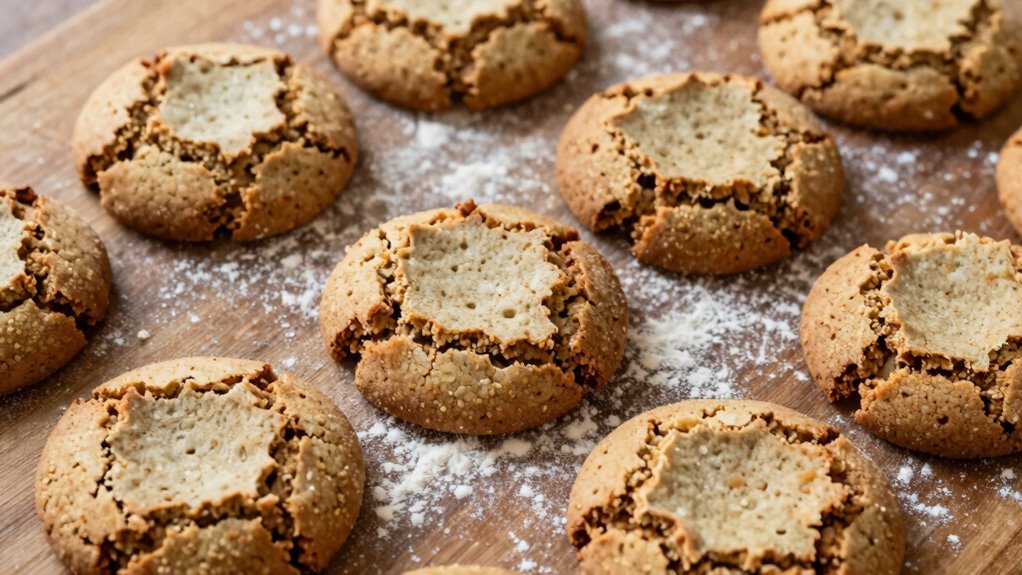

Gluten-free cookies tend to spread weirdly because they lack the gluten network that helps cookies hold their shape and develop structure, causing uneven or excessive spread during baking. Without gluten, your dough may be too sticky or dry, and the absence of this binding helps or harms the shape. Using the right binders like xanthan gum, chilling your dough, and adjusting ingredients can improve your results. Keep exploring, and you’ll learn how to perfect your gluten-free cookies.
Key Takeaways
- Lack of gluten reduces dough cohesion, causing cookies to spread unevenly during baking.
- Insufficient binders like xanthan gum lead to poor structure and excessive spreading.
- High-fat content or warm dough can make cookies spread more than desired.
- Not chilling the dough before baking allows fats to melt too quickly, increasing spread.
- Using gluten-free flours without adjusting moisture or temperature can cause irregular spreading.

Have you ever wondered how to enjoy delicious cookies without gluten? It’s a common question among those exploring gluten-free baking, especially when their cookies don’t turn out quite like traditional ones. One of the main reasons gluten-free cookies spread weirdly has to do with how gluten influences cookie texture. In regular baking, gluten forms a stretchy network that gives cookies their structure and chewiness. When you switch to gluten-free ingredients, that network disappears, and you’re left with a different set of texture differences to navigate. Without gluten, the dough often spreads unevenly, resulting in cookies that are flat, crumbly, or oddly shaped. Understanding these texture differences can help you troubleshoot and improve your baking results.
Gluten-free baking relies on alternative ingredients like almond flour, coconut flour, or gluten-free oats, which don’t have the same binding properties as wheat flour. These substitutions often cause cookies to spread more during baking because they lack the elasticity that gluten provides. For example, a cookie dough made with almond flour may spread out too much if you don’t adjust the fat content or chilling time. On the other hand, some gluten-free flours absorb moisture differently, leading to dough that’s either too dry or too sticky. These inconsistencies can make it tricky to achieve uniform shapes and sizes, which adds to the spread irregularity.
Another factor is the type and amount of binders you use. Many gluten-free recipes incorporate xanthan gum or guar gum to mimic gluten’s binding ability. If you don’t add enough, your cookies might spread excessively or break apart easily. Too much binder, however, can make cookies dense and rubbery. Finding the right balance is key, and it’s often a matter of trial and error. Additionally, the temperature of your dough and oven can influence how cookies spread. Chilling the dough before baking helps solidify fats and prevents excessive spreading, while baking at the right temperature ensures even heat distribution, reducing weird spreading patterns.

It's Just – Xanthan Gum, 8oz, Batch Tested Gluten Free, Keto Baking, Non-GMO, Thickener for Sauces, Soups, Dressings, Packaged in USA
It's Just – Xanthan Gum, 8oz, Batch Tested Gluten Free, Keto Baking, Non-GMO, Thickener for Sauces, Soups, Dressings,…
As an affiliate, we earn on qualifying purchases.
As an affiliate, we earn on qualifying purchases.
Frequently Asked Questions
How Do Gluten-Free Cookies Compare in Shelf Life?
Gluten-free cookies typically have a shorter shelf life compared to regular cookies due to their shelf life stability. To extend their freshness, you should use effective preservation methods like airtight containers or freezing. These techniques help prevent staleness and spoilage, ensuring your gluten-free cookies stay delicious longer. Keep them in a cool, dry place, and consider vacuum sealing for ideal shelf life stability.
Are Gluten-Free Cookies Suitable for All Allergies?
Gluten-free cookies aren’t suitable for everyone with allergies. Cross contamination concerns are common, so you need to check if the bakery maintains strict protocols. Also, rely on the gluten-free label accuracy, as sometimes products are mislabeled. If you have severe allergies, it’s safest to choose brands that provide clear allergen information and avoid products with any risk of cross contact, ensuring your safety and peace of mind.
What Are the Cost Differences Between Gluten-Free and Regular Cookies?
You’ll notice that gluten-free cookies generally cost more than regular cookies due to higher ingredient costs. A price comparison shows gluten-free options often have a premium because specialty flours and additives are more expensive. These ingredient costs drive up the overall price, making gluten-free cookies less budget-friendly. So, if you’re shopping, expect to pay a bit extra for gluten-free varieties compared to traditional cookies.
Can Gluten-Free Cookies Be Baked at Home Easily?
Can gluten-free cookies be baked at home easily? Absolutely! With a little patience and some simple steps, you can create delicious, homemade gluten-free cookies. Focus on gluten-free baking basics like using a reliable flour blend and substituting eggs if needed. Follow homemade cookie tips such as mixing ingredients thoroughly and chilling the dough. This makes gluten-free baking straightforward, satisfying, and a fun way to enjoy fresh, tasty treats without gluten.
Do Gluten-Free Cookies Taste Similar to Traditional Cookies?
Gluten-free cookies often taste different from traditional ones, with a unique flavor profile due to alternative flours. You might notice texture differences too—they can be crumblier or denser. While they may not exactly mimic classic cookies, many people find gluten-free versions delicious in their own right. The taste comparison varies depending on ingredients, but with the right recipe, you can enjoy a satisfying treat that’s close in flavor and texture.

King Arthur, Gluten-Free Sugar Cookie Mix, Gluten-Free, Non-GMO Project Verified, Certified Kosher, 12 Ounces
Gluten-free bakers, rejoice. Now perfect cookies at home are simple to make with our excellent mix. It saves…
As an affiliate, we earn on qualifying purchases.
As an affiliate, we earn on qualifying purchases.
Conclusion
So, next time your gluten-free cookies spread oddly, remember they’re like dancers with a mind of their own—unpredictable but unique. Embrace the quirks, for they remind you that even in baking, as in life, imperfections add character and charm. Don’t let the spread oddity dampen your spirit; instead, see it as a sweet twist in your culinary story. After all, isn’t life more exciting when it surprises us, just like these cookies?

Brown Cookies with Chocolate Bean 3 Ring Binder 1.5" Decorative D-Ring Binder with Clipboard&3 Clear Pockets, Holds 200 Sheets A4 Size Paper Waterproof Binders for School Home Office
Not Only Beautiful: Fustylead Compared with other monotonous three ring binders which without prints, our patterned binders are…
As an affiliate, we earn on qualifying purchases.
As an affiliate, we earn on qualifying purchases.

Silicone Baking Mat with 10 Quick Recipes, Extra Thick Silicone Mats for Baking, Non Stick Pastry Mat,Reusable kneading Dough Rolling Mat for Cookie, Macaron, Bread, Pizza-Tutorial Video Included
【🍪 𝐄𝐱𝐭𝐫𝐚 𝐓𝐡𝐢𝐜𝐤 𝐒𝐢𝐥𝐢𝐜𝐨𝐧𝐞 𝗕𝗮𝗸𝗶𝗻𝗴 𝗠𝗮𝘁 𝐰𝐢𝐭𝐡 𝟏𝟎 𝐄𝐚𝐬𝐲 𝐑𝐞𝐜𝐢𝐩𝐞𝐬】:𝐔𝐩𝐠𝐫𝐚𝐝𝐞𝐝 𝐟𝐨𝐨𝐝-𝐠𝐫𝐚𝐝𝐞 𝐬𝐢𝐥𝐢𝐜𝐨𝐧𝐞 with deep grid texture prevents shifting…
As an affiliate, we earn on qualifying purchases.
As an affiliate, we earn on qualifying purchases.