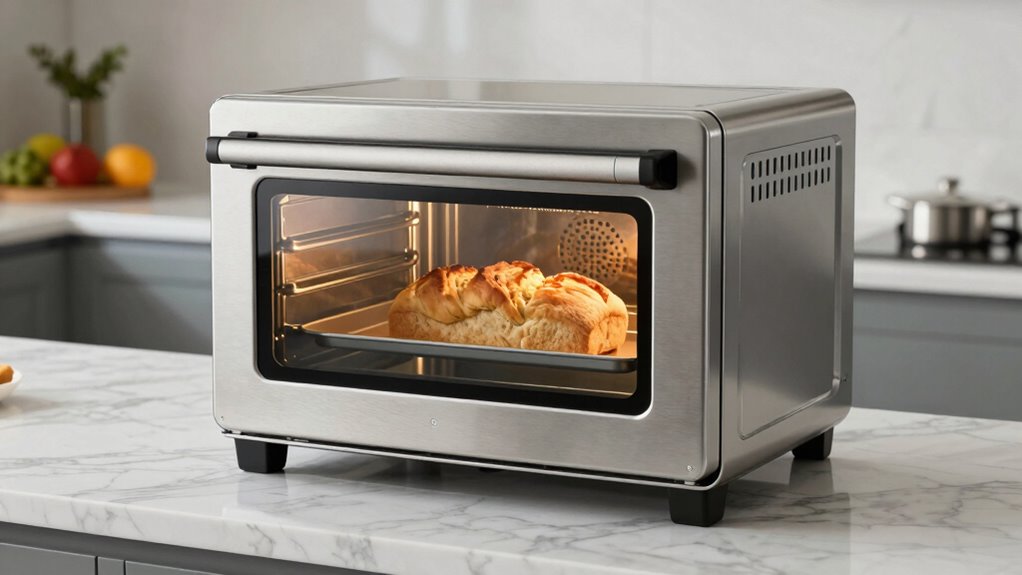
The key change to help your countertop oven bake more evenly is to calibrate its temperature. Over time, the oven’s internal temperature can drift, causing uneven results. By using an oven thermometer and adjusting the settings accordingly, you guarantee the oven heats to the correct temperature every time. This simple step improves bake quality, reduces hot spots, and guarantees consistent results. Keep going to discover how to easily perform this essential calibration at home.

Get baking supplies delivered free with Prime
- Fast, free delivery on millions of items
- Prime Video, Amazon Music and more included
- Member-only deals all year
Key Takeaways
- Use an oven thermometer to monitor and adjust the temperature for even baking.
- Preheat the oven thoroughly to ensure consistent heat distribution.
- Rotate baked goods halfway through cooking to promote even browning.
- Calibrate the oven regularly to match the set temperature with actual heat.
- Avoid overcrowding the oven, allowing proper air circulation for uniform baking.
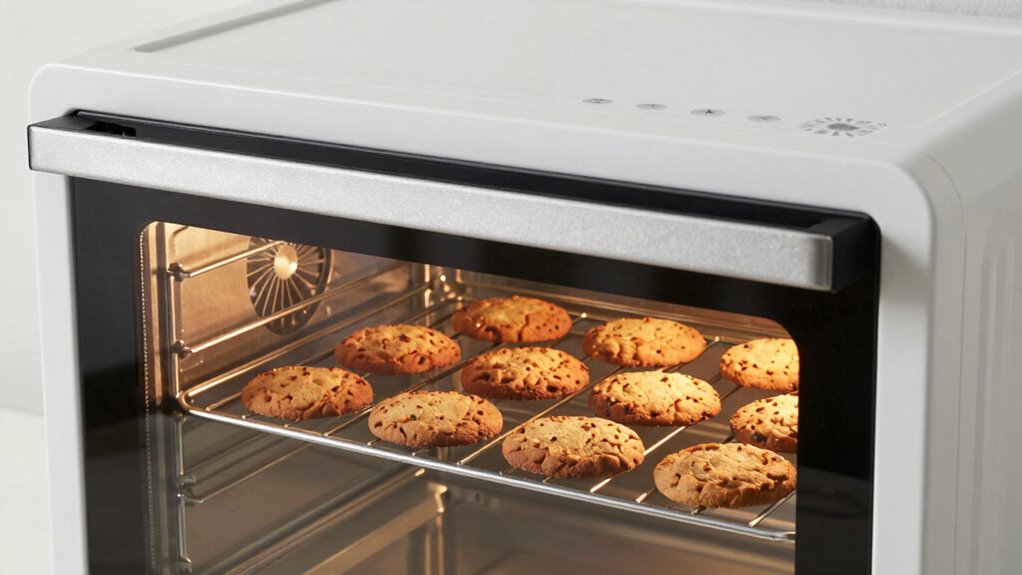
Have you ever wondered why some baked goods come out perfectly golden and evenly cooked while others turn out uneven? The answer often lies in a simple yet overlooked factor: your oven’s baking temperature and how well it’s calibrated. Many countertop ovens aren’t perfectly calibrated straight out of the box, which means the temperature you set might not match the actual temperature inside. This discrepancy can cause uneven baking, leaving some parts undercooked or overdone. The one change you need is to verify your oven’s temperature settings are accurate.
Ensuring your oven’s temperature is accurate is key to perfectly baked, evenly cooked treats.
First, consider that oven calibration plays an essential role in achieving consistent results. Over time, even the most reliable ovens can drift from their original calibration, especially with frequent use. A slight inaccuracy in baking temperature can considerably impact how evenly your baked goods cook. For example, if the oven runs cooler than the set temperature, your cookies might turn out pale and underbaked in the center. Conversely, if it runs hotter, you risk burning the edges while the middle remains raw. Regularly checking and calibrating your oven ensures that the temperature you input matches the actual environment inside. Calibration accuracy is crucial for consistent baking results, especially when precise temperature control is needed. Additionally, understanding how heat distribution varies within your oven can help you optimize your baking techniques for more even results. You can also improve baking consistency by making small adjustments based on your thermometer readings.
To do this effectively, you should use an oven thermometer—preferably one that’s oven-safe and accurate. Place it in the center of your countertop oven and preheat to a temperature you frequently use for baking. Once the oven indicates it’s reached that temperature, check the thermometer’s reading. If it’s off by more than a few degrees, consult your oven’s manual on how to recalibrate or adjust the thermostat. Some models have calibration settings built in, while others may require professional servicing. Correcting any discrepancies allows you to set more precise baking temperatures, leading to more evenly baked results. Proper oven temperature calibration ensures your baked goods turn out just right every time.
oven thermometer for countertop oven
As an affiliate, we earn on qualifying purchases.
As an affiliate, we earn on qualifying purchases.
Frequently Asked Questions
Do Different Brands of Countertop Ovens Require Different Adjustments?
Yes, different brands of countertop ovens may require different adjustments. You should check the temperature calibration regularly because some ovens tend to run hotter or cooler. Also, consider the oven insulation—better insulation can lead to more consistent baking. Adjusting the temperature settings accordingly helps guarantee even results. Familiarize yourself with your specific oven’s quirks, and make small adjustments to achieve more uniform baking outcomes.
How Does the Placement of Food Affect Baking Evenness?
Food placement and rack positioning directly impact baking evenness. You should place food in the center of the rack to guarantee consistent heat distribution. Avoid overcrowding the oven, as it can block airflow and cause uneven baking. Adjust the rack height depending on what you’re cooking; higher for broiling, middle for most baking. Proper food placement and rack positioning help your oven bake more evenly and improve your overall results.
Can Using a Baking Stone Improve Baking Consistency?
Using a baking stone can greatly improve baking consistency by enhancing heat distribution. When you place a baking stone inside your countertop oven, it absorbs and evenly radiates heat, reducing hot spots. This results in a more uniform bake, especially for bread and pizzas. By maintaining steady, consistent heat, a baking stone helps your baked goods cook more evenly, giving you better results every time you use your oven.
What Role Does Oven Preheating Play in Even Baking?
Getting your oven preheated properly is key to even baking because it guarantees the temperature calibration is accurate and the heat is evenly distributed. You want to give your oven time to reach the right temperature, which helps prevent hot spots. Good insulation maintains consistent heat, so your baked goods turn out perfectly. Remember, a well-preheated oven is the foundation for baking success—don’t cut corners on this step.
Are There Specific Settings or Modes That Promote Uniform Baking?
Yes, using specific settings like convection mode can promote uniform baking. Make sure your oven’s temperature calibration is accurate, as incorrect calibration can lead to uneven results. Adjust baking duration if needed, since some modes may bake faster or slower. By selecting the right mode, verifying calibration, and monitoring baking time, you’ll achieve more consistent, evenly baked results every time.
As an affiliate, we earn on qualifying purchases.
Conclusion
By making this simple switch, you’ll notice your countertop oven baking more evenly—no more undercooked centers or burnt edges. It’s like having a secret recipe from a wise old baker, guiding you to perfect results every time. Just remember, even in a world of high-tech gadgets, sometimes the tiniest tweak makes all the difference. So go ahead, give it a try, and enjoy consistently delicious baked goods, no matter what era you’re in!
As an affiliate, we earn on qualifying purchases.
oven temperature calibration tool
As an affiliate, we earn on qualifying purchases.
As an affiliate, we earn on qualifying purchases.
Fall Picks
fall essentials
As an affiliate, we earn on qualifying purchases.