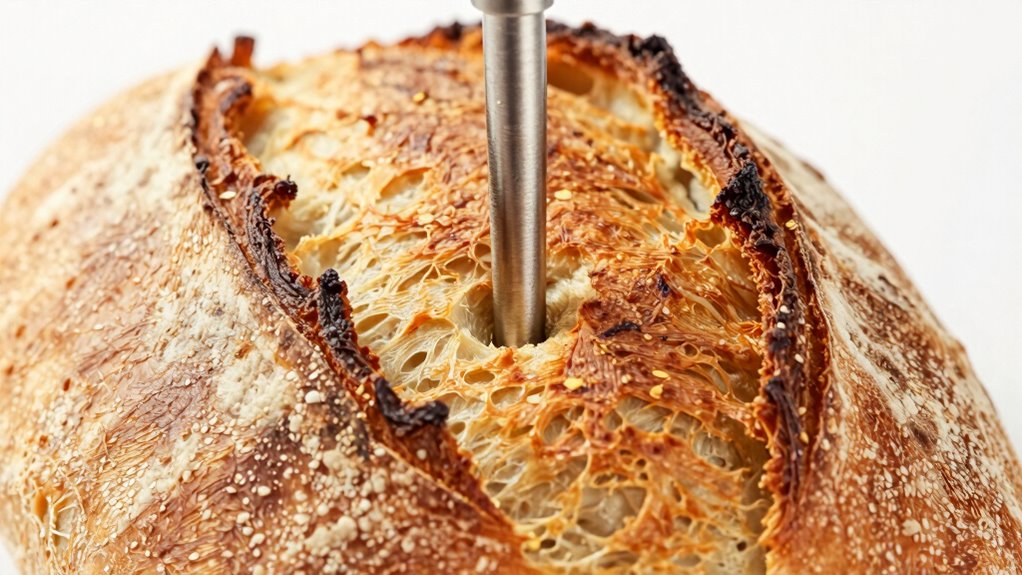
To get accurate internal temperatures in bread, insert your thermometer into the center of the loaf, avoiding crusts and edges. Push it straight into the thickest part, ensuring the probe reaches the core without touching the pan or crust. Keep it steady and wait for the temperature to stabilize before noting it down. Proper placement is key to results you can trust, and you’ll find more tips if you keep exploring.

Get baking supplies delivered free — and shop member deals
- Fast, free delivery on millions of items
- Access to Prime Big Deal Days deals on October 6–7
- Prime Video, Amazon Music and more included
Key Takeaways
- Insert the probe into the bread’s center, at least halfway in, avoiding crust and edges for an accurate reading.
- Choose the thickest part of the loaf to ensure the temperature reflects the core doneness.
- Insert the probe straight and steady, ensuring it reaches the internal center without contacting crust or pan surfaces.
- Avoid contact with hot spots or crust edges that can skew the internal temperature measurement.
- Wait for the reading to stabilize before recording to ensure an accurate internal temperature.
As an affiliate, we earn on qualifying purchases.
Why Accurate Temperature Checks Matter for Perfect Bread

Accurate temperature checks are essential because they guarantee your bread is baked to perfection. When your thermometer is properly calibrated, it provides reliable readings, preventing under- or over-baking. This accuracy directly impacts the bread’s crust color—an indicator of doneness and visual appeal. A well-calibrated thermometer ensures you don’t rely solely on visual cues, which can be misleading, especially with different oven types or loaf shapes. By checking internal temperatures precisely, you can confirm when your bread reaches the ideal doneness point, typically around 190-210°F, depending on the type. Proper thermometer calibration and monitoring internal temps help you achieve consistent results, ensuring your bread has the perfect crust, crumb, and overall quality every time. Proper thermometer calibration is crucial for reliable readings and consistent baking success. Additionally, understanding temperature accuracy can help you troubleshoot issues and refine your baking process for optimal results. Regularly verifying your thermometer’s accuracy with calibration techniques ensures continued precision over time. Furthermore, using a high-quality thermometer can significantly improve the reliability of your temperature readings.
As an affiliate, we earn on qualifying purchases.
How to Pick the Best Thermometer for Bread Baking
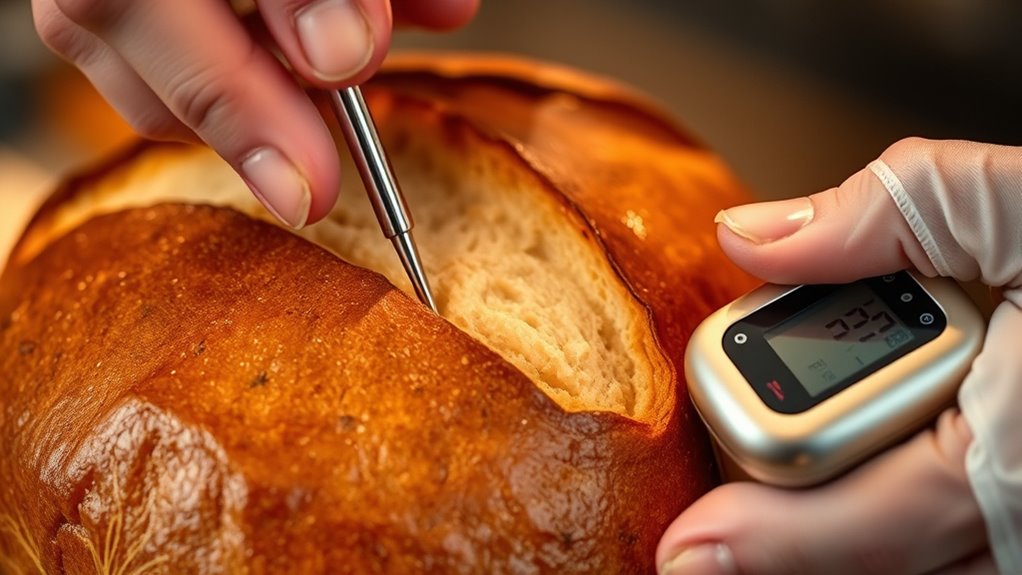
Choosing the right thermometer depends on understanding the different types and how they suit your baking needs. You’ll want one that offers quick, accurate readings and is easy to clean and maintain. Considering these factors helps you pick a tool that guarantees your bread turns out perfect every time. Additionally, selecting a thermometer with proper calibration ensures the consistency and reliability of your measurements. Regular calibration can prevent measurement inaccuracies and improve your baking results. A durable construction can also extend the lifespan of your thermometer, making it a worthwhile investment. Investing in a high-quality digital probe thermometer can further improve your baking precision. Incorporating connected kitchen tools can help you monitor temperatures more accurately and integrate with your smart home setup.
Thermometer Types and Uses
Selecting the right thermometer for bread baking depends on understanding the different types available and their specific uses. Digital thermometers are popular for quick, accurate readings and easy-to-read displays. Analog thermometers, on the other hand, offer durability and simplicity without batteries. When choosing, consider:
- Speed of response
- Ease of reading
- Durability
- Cost
Digital thermometers often provide instant results and are ideal for precise internal temperature checks. Analog thermometers are more straightforward, with no digital components that can fail. Both types can be effective, but your choice depends on your baking style and preferences. Keep in mind that the best thermometer for bread baking offers accuracy, reliability, and ease of use to ensure perfect results every time.
Accuracy and Response Time
When selecting a thermometer for bread baking, it’s crucial to take into account how quickly it responds to temperature changes and how precise its readings are. A fast response time ensures you catch the exact moment the bread reaches the right internal temp, preventing over or under-baking. Proper thermometer calibration guarantees accuracy over time, maintaining reliable readings. Consider these factors: Network-building and how it can help you connect with other baking enthusiasts or professionals to improve your skills. Maintaining thermometer calibration regularly is essential to uphold measurement accuracy, especially with frequent use. Additionally, understanding measurement accuracy is vital for consistent baking results. To ensure your thermometer continues to provide reliable readings, regular temperature calibration is recommended.
Ease of Use and Maintenance
To make certain your thermometer remains easy to use and maintain, look for models with intuitive controls and straightforward calibration procedures. This simplifies daily use and ensures accuracy over time. When considering cleaning tips, choose thermometers with removable probes or protective covers that are easy to sanitize. Regular calibration procedures help maintain precision; look for devices that offer simple calibration steps. Additionally, select models with clear display readings and minimal buttons for effortless operation. Home charging options can also influence how often you need to calibrate or clean your equipment, so choosing versatile tools can be beneficial. Ensuring the ergonomic design of your thermometer can also improve handling and reduce user fatigue during frequent use. Incorporating reliable temperature sensors can further enhance measurement accuracy and longevity of the device. Moreover, selecting thermometers with digital interfaces can facilitate quicker readings and easier adjustments, enhancing overall usability.
kitchen probe thermometer for baking
As an affiliate, we earn on qualifying purchases.
As an affiliate, we earn on qualifying purchases.
Where to Insert Your Thermometer for Accurate Results
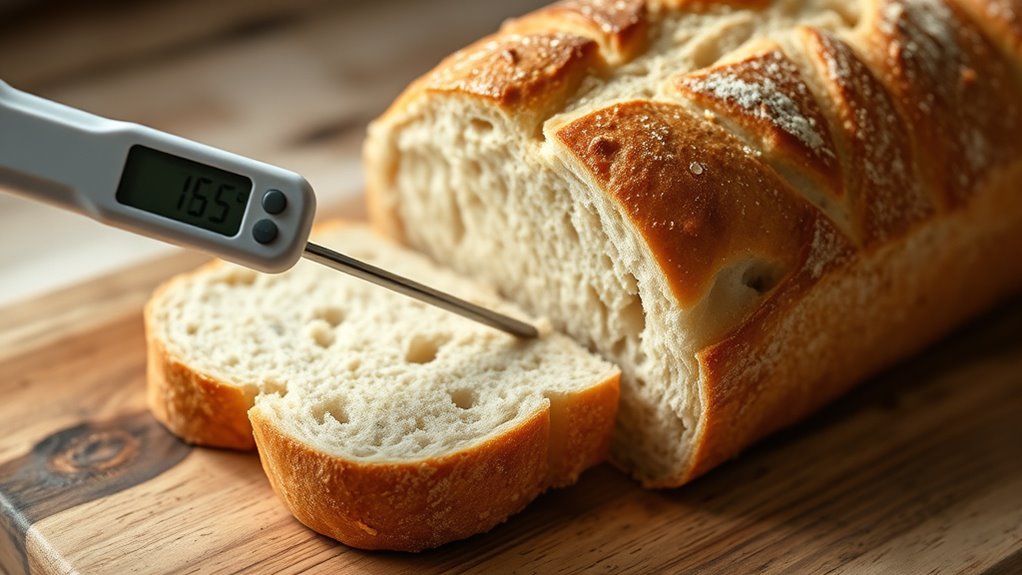
For the most accurate temperature readings, it’s vital to insert your thermometer in the right spot. During dough fermentation, measuring the internal temperature helps confirm the yeast activity is on track. When baking, inserting the probe into the center of the loaf provides the best indication of doneness, especially when checking the oven temperature’s impact on internal heat. Avoid poking the thermometer into the crust or edges, as these areas may be cooler or hotter than the core. Instead, aim for the middle of the bread, where heat is most evenly distributed. Proper placement guarantees you’re getting an accurate read of the dough’s fermentation progress or the bread’s doneness, helping you achieve perfect results every time. Consistent temperature checking can help ensure reliable results by making temperature checking part of your routine, especially when monitoring the precision of modern kitchen technology. Regularly calibrating your thermometer and understanding temperature distribution in baked goods further enhances your baking accuracy. Additionally, being aware of heat flow within your baked items can improve your overall results.
As an affiliate, we earn on qualifying purchases.
How to Properly Insert the Probe to Get Reliable Readings
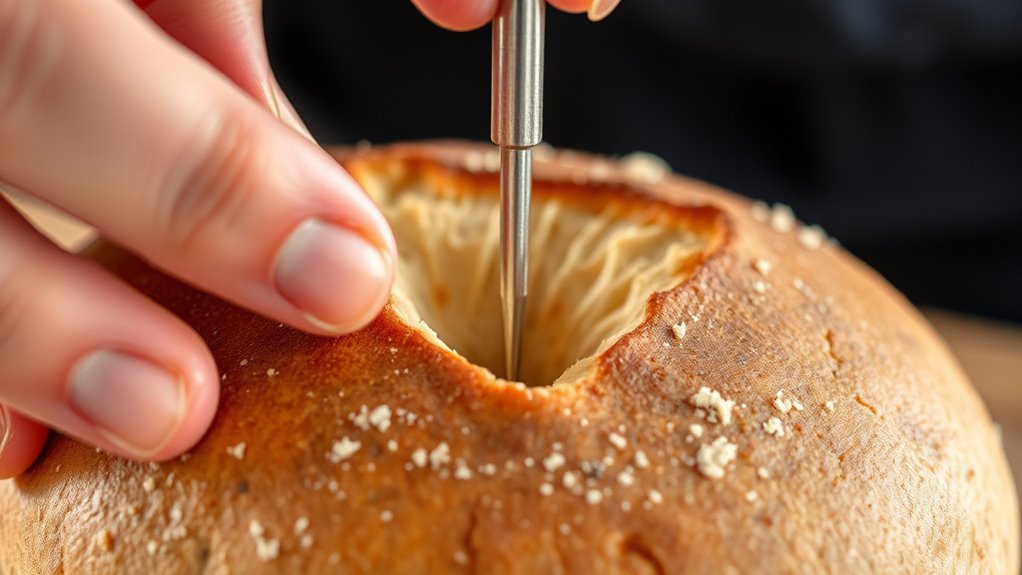
To guarantee accurate readings, you need to choose the correct probe placement and avoid contact with hot spots that can skew results. Make sure you insert the probe to the proper depth, so it accurately measures the area of interest. Proper technique is essential for reliable and consistent temperature readings. Additionally, understanding trusted resources can help ensure you follow best practices for probe placement. Being aware of proper insertion depth is crucial for obtaining meaningful internal temperature measurements. Consulting professional guidance can further improve your technique and ensure safe cooking results.
Choose Correct Probe Placement
Have you ever wondered why your readings seem inconsistent? Proper probe placement is essential for accurate internal temperature checks. To get reliable results, insert the probe into the center of the loaf, avoiding contact with the pan or crust. Remember, dough hydration affects how heat distributes, so placing the probe too close to the surface can give misleading readings. Also, consider the oven temperature, as hot spots may skew measurements if the probe isn’t centered. Keep these tips in mind:
- Insert the probe into the thickest part of the bread
- Avoid touching the baking pan or crust
- Ensure the probe isn’t near the surface or edges
- Wait for the reading to stabilize before recording
Correct placement ensures you gauge the true internal temperature, leading to perfect bake consistency.
Avoid Contact With Hot Spots
When inserting the probe, make sure it’s placed away from hot spots that can cause skewed readings. Hot spots are areas with higher temperatures that don’t represent the overall internal temperature of the bread. Contact avoidance is key; if the probe touches a hot spot, it’ll give an artificially high reading. To prevent this, gently position the probe in a spot where the heat is evenly distributed, avoiding edges or points that may be hotter. Keep the probe steady and ensure it’s not pressing against the crust or other uneven surfaces. This careful placement helps you get a true internal temperature, reflecting the bread’s actual doneness rather than a localized hot spot. Proper contact avoidance ensures reliable, consistent temperature readings every time.
Insert to Proper Depth
How deep should you insert the probe to guarantee accurate readings? You want the probe inserted into the center of the loaf, at least mid-depth or slightly deeper. This ensures you’re measuring the core temperature, not surface heat influenced by oven calibration or ambient conditions. To do this effectively:
- Insert the probe at least halfway into the bread’s thickness
- Avoid touching the bottom or sides of the pan
- Ensure the probe doesn’t hit the baking surface
- Check that the probe stays steady during measurement
Proper depth helps you get consistent, reliable readings that reflect true internal temperature. This minimizes errors caused by uneven oven calibration or ambient conditions, giving you confidence your bread is baked perfectly. Accurate probe placement is key to perfect results every time.
How Deep Should You Insert the Thermometer?
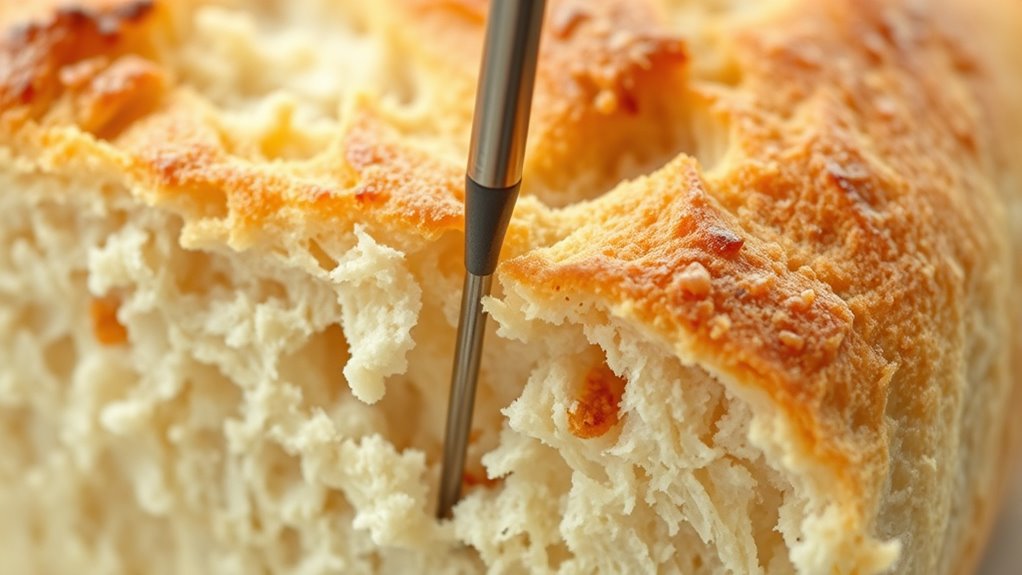
Determining the correct depth for thermometer insertion is essential for obtaining an accurate reading. If you insert the internal probe too shallowly, you’ll get a surface measurement that doesn’t reflect the bread’s true internal temperature. Aim to insert the probe at least halfway into the thickest part of the loaf, avoiding the edges or crust. This ensures you’re measuring the core temperature, which is critical for doneness. For smaller loaves, insert the probe about 1 to 2 inches deep, while larger loaves may require 3 inches or more. Use a steady hand to push the thermometer straight in, keeping it centered. Proper depth prevents false readings and helps you determine exactly when your bread has reached the perfect internal temperature.
Keep the Thermometer Away From Pan or Surfaces

To get an accurate temperature reading, it’s important to keep the thermometer away from the pan or any surfaces that could influence the measurement. Surface contact or proximity to the pan can cause false readings, so avoid letting the probe touch or rest against the pan walls. Proper placement ensures you’re measuring the bread’s internal temperature accurately. To prevent interference, keep these points in mind:
- Avoid resting the probe directly on the pan or baking surface
- Hold the thermometer in the middle of the bread, away from the sides
- Do not let the thermometer touch the bottom or the sides of the pan
- Keep the probe stable and free from surface contact during measurement
This approach guarantees you get a true reading of the bread’s internal temperature.
How to Read Your Bread’s Temperature and Know When It’s Done
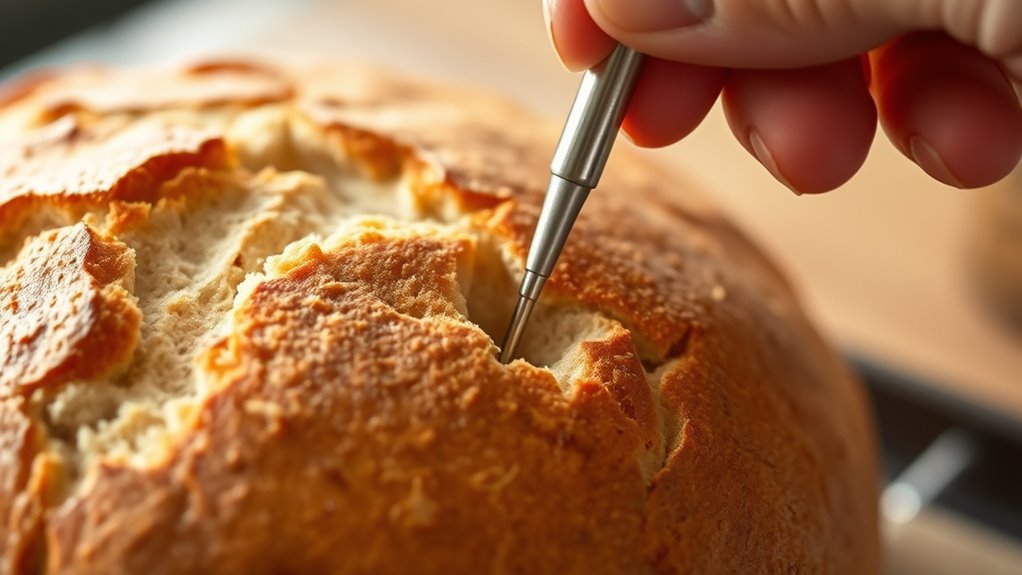
Knowing when your bread is perfectly baked depends on accurately reading its internal temperature. To do this, verify your thermometer is properly calibrated for precise readings. Insert the probe into the center of the loaf, avoiding the sides or bottom, which can give misleading results. A properly calibrated thermometer will give you consistent bread internal temperature readings, helping you determine doneness. Typically, bread is done when it reaches about 190°F to 210°F, depending on the type. Keep in mind that the temperature can rise slightly as the bread cools. Regularly check the thermometer’s calibration to maintain accuracy. By paying close attention to the bread’s internal temperature, you’ll achieve consistently perfect baked bread every time.
Common Mistakes When Measuring Bread Temperature (and How to Avoid Them)
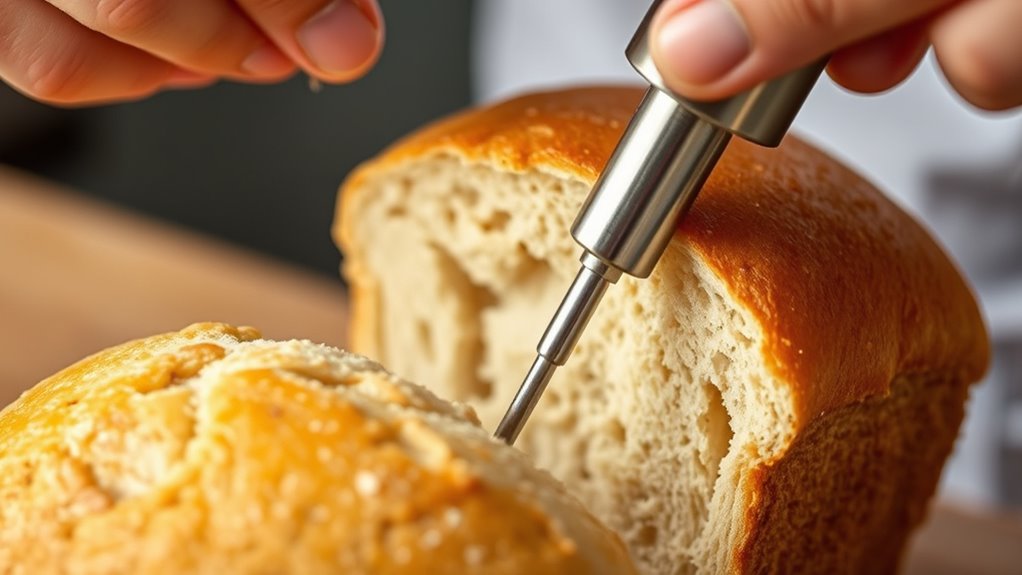
One common mistake when measuring bread temperature is inserting the thermometer into the wrong spot, which can lead to inaccurate readings. To prevent this, make sure you’re targeting the bread’s center or the thickest part for the most reliable results. Additionally, improper thermometer calibration can skew your readings, so always check your device before use. Be cautious not to mistake the bread crust temperature for the internal temperature, as the crust heats faster.
Remember:
- Insert the thermometer at the proper depth
- Calibrate your thermometer regularly
- Focus on the bread’s center, not the crust
- Avoid measuring only the crust temperature
Tips for Consistent, Reliable Temperature Readings Every Time
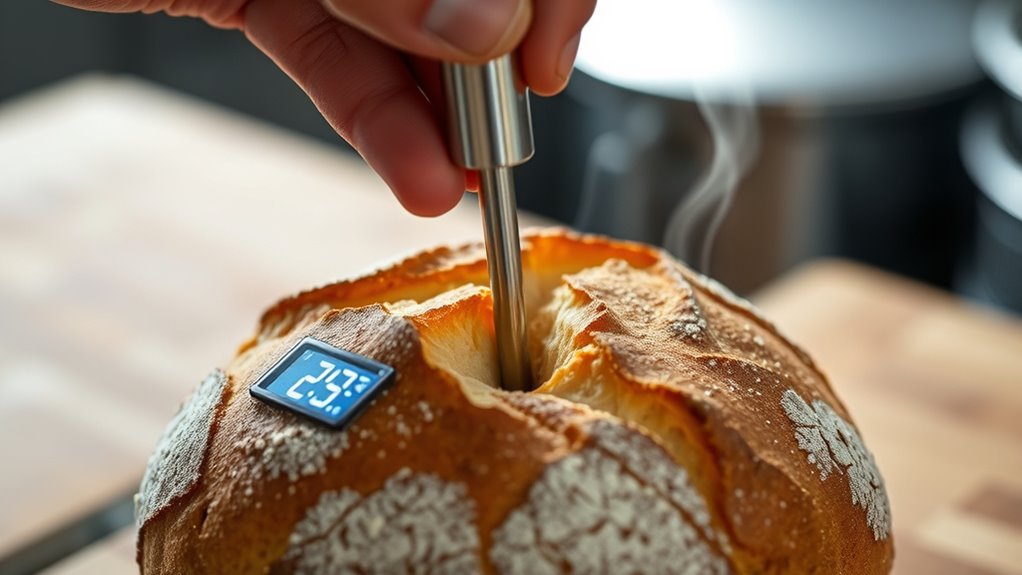
Achieving consistent, reliable temperature readings requires careful attention to technique and equipment. Always calibrate your thermometer regularly to prevent inaccuracies caused by temperature fluctuation. Use the same probe placement each time to ensure consistency, and insert it deeply for an accurate reading. Avoid quick measurements, as they can lead to inconsistent results. Keep your thermometer clean and well-maintained. Remember, ambient temperature changes can affect readings, so measure in a stable environment. Regular calibration minimizes errors, ensuring your readings reflect true internal bread temperature.
| Calibration | Placement | Environment |
|---|---|---|
| Ensures accuracy | Consistency | Stability |
| Prevents fluctuation | Deep insertion | Minimize drafts |
| Regular checks | Same spot | Controlled temp |
| Accurate results | Repeatability | Reliable data |
| Essential for precision | Key for success | Critical step |
Frequently Asked Questions
Can I Use a Digital or Analog Thermometer for Bread?
You can definitely use either a digital or analog thermometer for bread, but digital thermometers often provide better accuracy and faster readings. To guarantee thermometer accuracy, choose one with a probe designed for high temperatures and calibrate it regularly. Use proper measurement techniques by inserting the probe into the thickest part of the bread, avoiding the crust, to get an accurate internal temperature. Both types can work if used correctly.
How Does Bread Shape Affect Probe Placement?
Your bread shape directly influences probe placement because you want the thermometer to reach the center or thickest part. For round loaves, insert the probe into the middle, avoiding the crust. For loaves with a specific shape, find the thickest section and place the probe there. Proper probe placement guarantees you get an accurate internal temperature, helping you bake bread perfectly every time.
Is It Necessary to Calibrate My Thermometer Regularly?
Don’t you want your bread to turn out perfect every time? Regularly calibrate your thermometer to guarantee accuracy, especially if you notice inconsistent readings. Calibration frequency depends on how often you use it and if it has been dropped or mishandled. By maintaining your thermometer’s accuracy, you’ll confidently monitor internal temps and bake bread with the right texture and doneness, avoiding under- or over-baking.
Can Temperature Readings Vary Between Different Types of Bread?
Yes, temperature readings can vary between different types of bread due to factors like bread crust and dough density. A denser dough or thicker crust may retain heat differently, causing your thermometer to register slightly different internal temperatures. To guarantee accuracy, always consider these factors and adjust your probe placement accordingly, especially when baking various bread types. This way, you’ll get consistent, reliable readings and perfect baked results every time.
How Do Ambient Temperature and Oven Humidity Impact Readings?
Think of your bread’s internal temp as a swimmer’s pace—affected by surrounding water. Ambient temperature and oven humidity influence readings like water temperature affects a swimmer’s speed. Warmer ambient temps can make the bread seem cooked faster, while high humidity can slow moisture loss, skewing internal temp readings. Understanding these ambient effects helps you adjust baking time and probe placement, ensuring your bread is perfectly baked every time.
Conclusion
Remember, getting the perfect loaf starts with accurate temperature checks. Use the right thermometer, insert it correctly, and avoid common mistakes. With practice, you’ll trust your readings and bake bread that’s consistently delicious. As the saying goes, “A stitch in time saves nine”—taking that quick moment to verify your bread’s temperature guarantees you don’t over or underbake. Happy baking and enjoy every slice!
Fall Picks
fall essentials
As an affiliate, we earn on qualifying purchases.