
TL;DR

Get baking supplies delivered free with Prime
- Fast, free delivery on millions of items
- Prime Video, Amazon Music and more included
- Member-only deals all year
Silicone baking mats are reusable fiberglass-mesh sheets coated in food-grade silicone that replace parchment paper for 2,000–3,000+ uses. They’re safe up to roughly 480–500°F, excel at even browning and sugar work, but insulate heat so cookies spread more and roasted vegetables won’t crisp. Never cut them, never broil on them, and look for LFGB-certified platinum silicone for the best quality. [1]
You pull a batch of chocolate chip cookies from the oven, slide the spatula under the first one, and it lifts off the pan in one clean piece. No sticking. No shredded parchment. No greasy spray coating your counter. That’s the everyday magic of a silicone baking mat — a tool that costs about the same as two rolls of parchment paper but lasts for years.
But these mats have a quirk most reviewers gloss over: they’re heat insulators. That means some foods come out better on them, and some come out noticeably worse. Knowing the difference is the line between loving your mat and shoving it in a drawer.
In this article, you’ll learn what these mats actually are, which ones are safest to buy, the five situations where they beat parchment, the three where they fail, and how to clean one that’s gone sticky or stained. Let’s get into it.
Silicone baking mats are fiberglass mesh coated in food-grade silicone — the fiberglass delivers even heat, but it’s also why you must never cut or tear them.
Look for LFGB certification and platinum-cured silicone; they’re stricter and more stable than FDA-only, peroxide-cured alternatives.
Mats excel at sticky batters, candy work, and oil-free baking, but insulate heat — so skip them for crispy cookies and roasted vegetables.
Most mats are safe from -40°F to 480–500°F; never use them under a broiler or over direct flame.
Deep-clean grease buildup with a baking soda paste and store flat or rolled — never folded — to reach the full 2,000–3,000-use lifespan.
What Silicone Baking Mats Actually Are (It’s Not Just Silicone)
Silicone baking mats are food-grade silicone sheets, usually fiberglass mesh coated with silicone, that sit on your baking sheet as a reusable nonstick surface. The best-known brand is Silpat, invented in France in the 1960s by a French baker who wanted a reusable surface for his patisserie work. Today, dozens of affordable alternatives exist, from Amazon Basics to Kitzini. [1]
That fiberglass core matters more than most people realize. It’s the reason your mat spreads heat evenly instead of letting hot spots scorche one corner of your cookie sheet while the other corner stays pale. It’s also the reason you can never, ever cut the mat — but more on that in a minute.
Quality varies, and the label tells you a lot. Look for platinum-cured silicone — it’s more stable and higher quality than peroxide-cured silicone, which is what cheap no-name mats often use. For certification, LFGB (the German standard) is considered stricter than FDA approval, so if you see it on the packaging, that’s a good sign. [1]
Key insight: A mat is essentially a fiberglass screen wrapped in silicone. Treat it like a coated pan — damage the coating, and the whole thing is done.
5 Jobs Where a Silicone Mat Beats Parchment Every Time
Silicone baking mats outperform parchment in five specific situations: anything sticky or sugary, low-fat baking, candy work, repeated batch baking, and dough handling. Here’s where each one shines. [1]
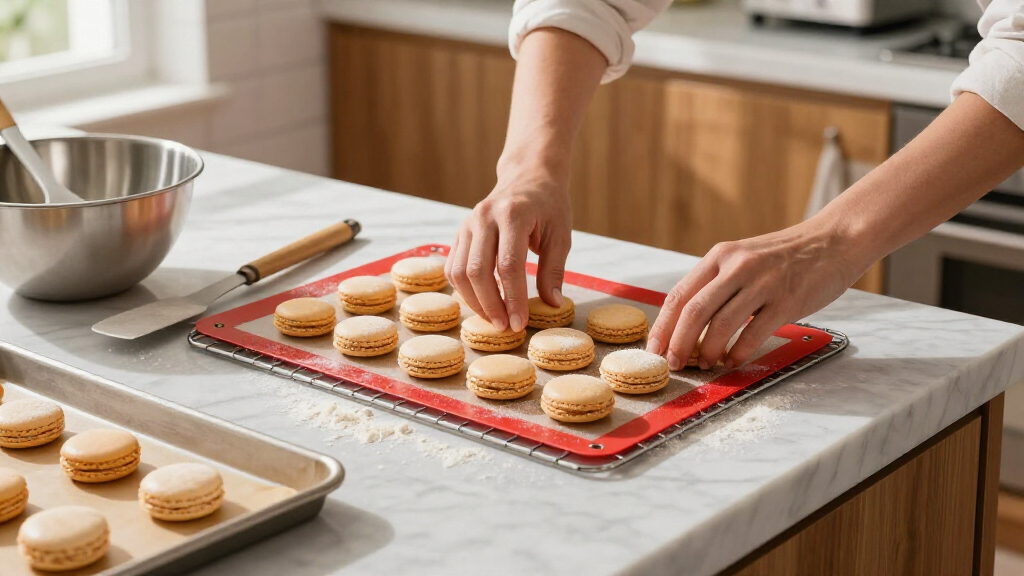
- Sticky and sugary batters. Macarons, meringues, and tuile cookies release from silicone like they were never there. Parchment can tear and take half your macaron shell with it.
- Candy and sugar work. Hot caramel and brittle peel straight off silicone once cooled — parchment can fuse to hot sugar and turn into a disaster.
- Oil-free baking. The surface is naturally nonstick, so you can skip the cooking spray entirely. If you’re cutting fat for health reasons, this is your tool.
- Marathon baking sessions. Baking three dozen cookies for a school event? One mat handles batch after batch with zero waste. No more running out of parchment halfway through.
- Dough prep and freezing. Knead bread dough on a mat instead of a floured counter, or freeze individual portions of cookie dough without them welding to the tray.
My neighbor bakes macarons every December — roughly 200 shells a season — and says switching from parchment to silicone template mats cut her broken-shell rate from about one in four to nearly zero. That’s not a coincidence: the even heat distribution from the fiberglass layer helps macarons bake uniformly.
Silicone Mat vs. Parchment vs. Bare Pan: The Honest Comparison
Silicone mats win on reusability and nonstick performance, parchment wins on crisping, and bare pans win on browning. None of them is best at everything — here’s the honest breakdown. [1]
| What you’re baking | Silicone mat | Parchment paper | Bare pan |
|---|---|---|---|
| Cookies (chewy) | Excellent — more spread | Good | Good, may burn bottoms |
| Cookies (crispy edges) | Weak — soft bottoms | Better | Best browning |
| Macarons & meringues | Best — perfect release | Good, can tear | Poor |
| Roasted vegetables | Soft, steamed texture | Crispier | Crispiest |
| Hot candy / brittle | Best — sugar releases clean | Can fuse to sugar | Sticks badly |
| Cost over 5 years | Lowest (reusable) | Highest | Low |
The pattern is simple: silicone insulates, so it slows browning on the bottom of whatever you’re baking. If you want crispy-edged chocolate chip cookies or deeply caramelized roasted broccoli, put those on parchment or a bare pan. If you want even, gentle baking and effortless release, silicone is your answer.
The 3 Mistakes That Ruin a Silicone Mat Fast
The three fastest ways to destroy a silicone baking mat are cutting it, broiling on it, and scraping it with metal utensils. Each one causes permanent damage that no amount of care can undo. [1]
- Cutting on it or cutting it to size. Slicing through the silicone exposes the fiberglass mesh inside. Those fibers can end up in your food, and the mat is finished. If your mat is too big for your pan, buy the right size — don’t trim it.
- Broiling or direct flame. Most mats are rated for -40°F to 480–500°F (-40°C to 250–260°C). Broilers and open flames blow past that ceiling in seconds and can damage the coating. [1]
- Metal spatulas and abrasive scrubbers. Both scratch the surface and give residue places to build up. Use silicone or plastic utensils and a soft sponge, and your mat stays slick for years.
Safety note: A torn or cut mat should be thrown away, not babied along. Exposed fiberglass isn’t something you want anywhere near food.
One more thing worth knowing: quality mats are BPA-free and contain no PFOA or PTFE — the chemicals that have made some nonstick pans controversial. Staining and discoloration over time are cosmetic, not a safety problem. [1]
How to Clean and Store a Mat So It Lasts 2,000+ Uses
To keep a silicone baking mat performing for its full 2,000–3,000-use lifespan, wash it gently, deep-clean grease with baking soda, and store it flat or rolled — never folded. [1]
Start with the basics: wash before first use with warm soapy water, then wipe or rinse after each bake. Most mats are dishwasher safe, top rack, though hand-washing is gentler on the surface coating.
Grease stains are inevitable if you bake cookies with butter. They look bad but clean up well: make a paste of baking soda and a little water, spread it over the stained areas, let it sit for 15–20 minutes, then scrub gently with a soft sponge. The paste lifts the residue that makes mats sticky and slick-looking.
Storage is where most people slip up. Fold or crease a mat repeatedly and you create permanent weak points in the silicone. Instead:
- Lay it flat in your baking sheet, stored inside the sheet itself
- Or roll it loosely and secure it with a rubber band
And if your mat starts smelling faintly of old cookies or plastic? That’s usually residue, not a safety issue. A baking soda treatment usually fixes it. If the smell comes back immediately on a brand-new cheap mat, that’s a sign of lower-grade silicone — worth returning and upgrading to an LFGB-certified mat. [1]
What’s New: Air Fryer Mats, Perforated Mats, and Macaron Templates
Silicone baking mats have expanded beyond the flat sheet — the category now includes air-fryer-sized mats, perforated crisper mats, and textured template mats for macarons and pastries. [1]
The perforated mat is the cleverest recent innovation. Those tiny holes let hot air reach the bottom of your food, which partially solves the crispness problem. If you’ve avoided silicone because you like crispy pizza crusts or roasted potatoes, the perforated version is worth a look.
Textured mats — with quilted, waffle, or macaron template circles printed on them — help beginners pipe uniform macarons without eyeballing every shell. And air-fryer-sized mats bring the nonstick benefits to a machine where parchment is genuinely risky (it can fly up against the heating element).
The bigger trend behind all of it is sustainability. According to market reporting, consumers are actively reducing single-use parchment and foil waste, and a mat that replaces thousands of disposable sheets fits that shift perfectly. [1]
Frequently Asked Questions
Are silicone baking mats safe? Do they leach chemicals?
Yes — quality mats made from food-grade platinum silicone are BPA-free and contain no PFOA or PTFE, unlike some nonstick pans. Look for LFGB certification (the stricter German standard) or FDA approval on the packaging. Cheap, uncertified mats may impart odor or taste, so brand and certification matter. [1]
Can I cut a silicone mat to fit my pan?
No. Cutting exposes the fiberglass mesh core, which can get into your food and permanently ruins the mat. If the size is wrong, buy the correct size — most mats come standardized to half-sheet pans, and air-fryer-sized versions exist. [1]
Why are my cookies flat or soft-bottomed on a silicone mat?
Silicone insulates the bottom of your dough, slowing browning and letting cookies spread more than they would on parchment or a bare pan. For chewy, evenly baked cookies this is a feature; for crispy-edged cookies, switch to parchment or a bare pan. Perforated silicone mats partially solve this by letting hot air through. [1]
How long do silicone baking mats last?
A well-cared-for mat lasts roughly 2,000–3,000 uses — several years of regular baking for most home cooks. Lifespan drops fast if you cut on it, use metal utensils, scrub abrasively, or expose it to broiler-level heat. Stains and discoloration are cosmetic and don’t mean the mat is done. [1]
My mat is sticky and smells — is it still safe to use?
Usually yes. Stickiness and odor come from baked-on grease residue, not degradation. Scrub with a paste of baking soda and water, let it sit 15–20 minutes, then rinse. If a brand-new cheap mat smells strongly out of the box, return it — that suggests lower-grade silicone. [1]
Conclusion
If you take one thing from this article, let it be this: buy the mat, but match it to the job. Sticky, sugary, delicate — silicone. Crispy, browned, caramelized — parchment or a bare pan. The mat that releases your macarons flawlessly will leave your roast potatoes disappointingly soft, and that’s not a defect. It’s physics.
Treat it right — no cutting, no broiling, no metal spatulas — and one $20–$25 sheet will quietly replace a small forest’s worth of parchment. That’s the rare kitchen upgrade that actually pays for itself.
Halloween Picks
halloween
As an affiliate, we earn on qualifying purchases.