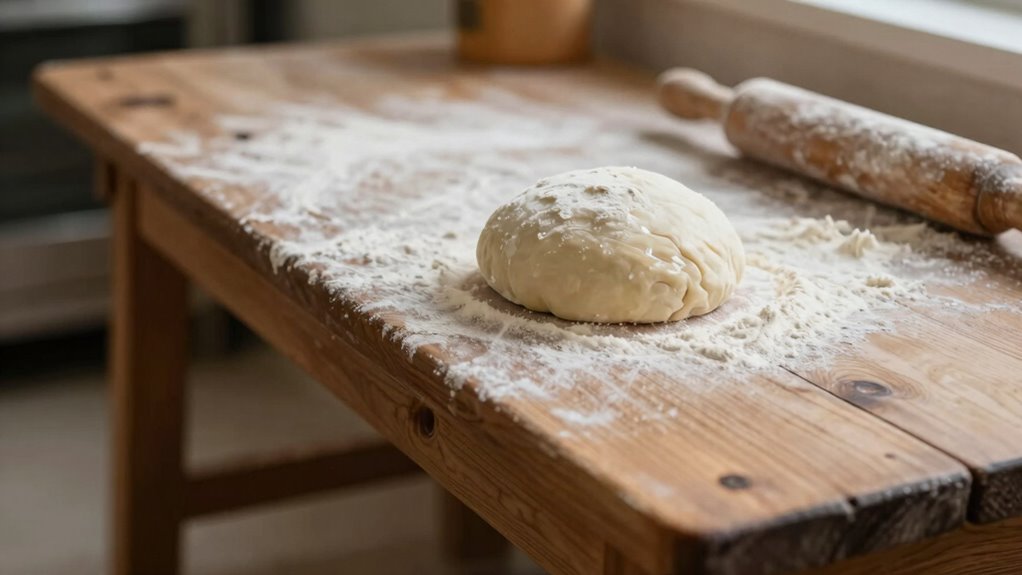

Bench rest is a vital yet often overlooked step in bread baking that can greatly improve your loaf’s texture, crumb, and appearance. It relaxes gluten, making final shaping easier and reducing tearing, while allowing gases to stabilize for better fermentation and flavor. Proper handling during this rest guarantees an open, even crumb and a professional look. Skip this step, and your bread may not reach its full potential—discover how to master it for perfect results.
Key Takeaways
- Bench rest relaxes gluten, making shaping easier and preventing tearing, resulting in a smoother, more professional loaf.
- It improves crumb structure by allowing gases to stabilize and distribute evenly during fermentation.
- Incorporating bench rest enhances flavor development by providing a pause that balances fermentation progress.
- Proper handling during bench rest maintains dough elasticity and tension, leading to better oven spring and rise.
- Using bench rest reduces the risk of uneven holes and overproofing, producing a more uniform and appealing loaf.

Bench resting is a crucial step in bread baking that often goes overlooked, yet it can markedly improve your loaf’s texture and crumb. When you finish shaping your dough, a proper bench rest allows gluten to relax, making the final shaping easier and more precise. This resting period also influences fermentation timing, giving your dough a chance to develop flavor and structure without overproofing. If you rush this step, you risk tearing the dough or creating uneven holes in your crumb, which can compromise both appearance and texture. By incorporating a bench rest into your process, you give your dough the necessary time to settle, leading to a more uniform and open crumb after baking.
Understanding how fermentation timing interacts with bench resting is essential. During bulk fermentation, yeast produces gases and flavor compounds, but the dough remains somewhat elastic and tight. A bench rest helps these gases stabilize and distribute evenly, preventing the dough from becoming overly tight or underdeveloped. It’s a delicate balance: too little fermentation and your dough lacks flavor, too much and it can collapse or become overly sour. The bench rest acts as a bridge, giving your dough a moment to relax and the fermentation process to reach an ideal point. This ensures your dough is at its peak before final shaping and proofing.
Dough handling techniques also come into play during bench resting. Properly handling your dough before and after this step can make a noticeable difference. When you shape your dough initially, you develop tension that helps it hold its shape during baking. After shaping, a bench rest allows that tension to relax slightly, making final shaping easier and more effective. This step minimizes tearing and creates a smooth surface, which is essential for a professional-looking loaf. During the bench rest, avoid excessive touching or pressing; instead, handle the dough gently to maintain the structure you’ve built. This careful approach ensures that your dough’s gluten network remains intact, resulting in a better rise and a more desirable crumb structure.
Top picks for "bench rest underus"
Open Amazon search results for this keyword.
As an affiliate, we earn on qualifying purchases.
Frequently Asked Questions
How Does Bench Resting Affect Bread Crust Color?
Bench resting helps improve your bread crust color by allowing the dough to relax and develop better oven spring. With proper dough hydration, the crust forms a richer, more appealing color as moisture redistributes evenly. During bench rest, gluten relaxes, enabling a more uniform rise and crust development. Skipping this step can lead to uneven crusts and less desirable coloration, so make sure to include it for a beautifully baked loaf.
Can Bench Resting Be Skipped Without Affecting Dough Quality?
You can skip bench resting, but it may impact dough elasticity and gluten development. Without this step, your dough might be less extensible, making shaping harder, and the gluten network might not fully develop, affecting bread texture. Bench resting allows the gluten to relax and strengthen, resulting in a better rise and crumb. Skipping it could lead to denser bread with a less tender crumb, so it’s best not to omit this step.
What Variations Exist in Bench Resting Techniques Worldwide?
You’ll find that worldwide, bench resting techniques vary based on dough type and tradition. Some bakers focus on gentle dough relaxation, allowing gluten to relax and making shaping easier, while others emphasize longer rests to enhance gluten development for a chewier texture. In certain regions, cold bench rests are common for flavor development, whereas others prefer quick, warm rests to speed up fermentation. These variations optimize dough handling and final bread quality.
How Does Bench Resting Influence Bread Dough Fermentation?
Bench resting boosts fermentation enhancement by permitting the dough to rest and develop flavor naturally. It also promotes better gluten development, making your dough more elastic and easier to shape. During this step, yeast activity continues at a controlled pace, resulting in improved rise and texture. By incorporating bench resting into your routine, you guarantee a more consistent, flavorful loaf with ideal fermentation and structure.
What Is the Ideal Bench Rest Duration for Different Bread Types?
Did you know that a bench rest of 20 to 30 minutes can substantially improve dough elasticity? For lean breads like baguettes, aim for 15-30 minutes, while enriched doughs like brioche benefit from 30-60 minutes. This rest period allows fermentation slowdown, resulting in better gluten development without overproofing. Adjust the time based on dough type and ambient conditions to optimize texture and flavor.
Conclusion
Next time you bake, don’t skip the bench rest—it’s your secret weapon for perfect bread. Studies show that allowing dough to rest improves gluten development by up to 30%, resulting in better rise and texture. This simple step can transform your loaf from good to bakery-quality. So, give your dough that extra few minutes on the bench; your taste buds will thank you for the tender, airy bread that follows. Happy baking!