Choosing a professional stand mixer is less about the word “professional” than about what you make, how much you make at once, and how often you want to use the machine. The KitchenAid 7-Quart Bowl-Lift Stand Mixer and Ankarsrum Assistent Original both offer large capacities and strong motors, but their mixing systems suit different routines. KitchenAid follows the familiar planetary approach: the attachment moves around a stationary bowl. Ankarsrum rotates the bowl beneath a roller and scraper, a design that gives bread dough room to develop in larger batches.

Get baking supplies delivered free with Prime
- Fast, free delivery on millions of items
- Prime Video, Amazon Music and more included
- Member-only deals all year

8.4QT Commercial Stand Mixer 800W with Aluminum Die Casting, NSF/ANSI 8-2023 Certified, Stainless Steel 8L Bowl, Dough Hook, Whis…
- ✔ Capacity: 8.4 qt (8 L)
- ✔ Motor: 800 W DC
- ✔ Speed settings: 11

ZACME 8.4qt Commercial Stand Mixer with 800W Motor, Aluminum Die Casting, NSF/ANSI 8-2023 Certified, Stainless Steel Bowl and Acc…
- ✔ Capacity: 8.4 qt (8 L)
- ✔ Maximum dough weight: 3 kg (6.6 lb)
- ✔ Motor: 800 W
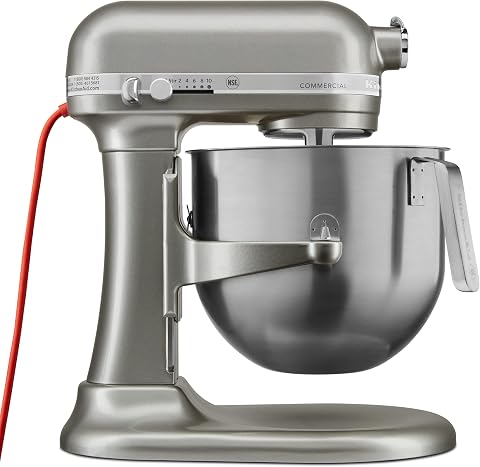
KitchenAid KSM8990CU 8-Quart Commercial Countertop Mixer, 10-Speed, Gear-Driven, Contour Silver
- ✔ Capacity: 8 qt
- ✔ Motor information: 500 W listed; description states 1.3 HP DC motor
- ✔ Speed settings: 10
That difference drives the decision. KitchenAid is the more approachable all-purpose choice for a household that bakes cakes, cookies, frostings, and occasional bread, especially if it already owns compatible attachments. Ankarsrum makes more sense for frequent bread bakers and cooks who regularly prepare large quantities and are willing to learn a less conventional machine. The comparison below focuses on practical capacity, dough handling, everyday versatility, operation, cleanup, and value.
At a Glance
| Criteria | KitchenAid 7-Quart Bowl-Lift Stand Mixer | Ankarsrum Assistent Original | Winner |
|---|---|---|---|
| Mixing system and learning curve | Planetary mixing with familiar controls and a conventional setup. | Rotating bowl with roller and scraper; technique and attachment setup take practice. | A |
| Bread dough and large batches | Capable of substantial dough batches, but the fixed bowl and planetary action are less specialized for them. | A strong fit for frequent bread making and larger dough batches, subject to recipe and ingredient limits. | B |
| Cakes, cookies, and everyday mixing | Strong all-purpose performance with familiar beater, whisk, and dough hook workflow. | Can handle general mixing, but the roller setup may feel less direct for some cake and cookie recipes. | A |
| Capacity and batch flexibility | 7-quart bowl suits family-size recipes and many large batches. | 7-liter bowl supports large quantities, though usable capacity depends on the recipe and dough. | Depends |
| Attachments and versatility | Broad KitchenAid attachment ecosystem, with many compatible accessories sold separately. | Useful range of accessories, but the ecosystem is smaller and some tools require a different setup. | A |
| Handling, cleanup, and storage | Bowl-lift frame is sturdy but takes counter space; bowl and attachments need routine washing. | Large footprint and a distinctive bowl setup; the bowl and attachments require cleanup after use. | Depends |
| Value for typical home use | Usually the more practical buy for mixed baking and for owners of compatible attachments. | Higher cost is easier to justify when bread dough and large batches are regular work. | Depends |
8.4QT Commercial Stand Mixer 800W with Aluminum Die Casting, NSF/ANSI 8-2023 Certified, Stainless Steel 8L Bowl, Dough Hook, Whis…
For buyers who want one large-capacity mixer to cover demanding home baking or a commercial-style workflow, the ZACME ZM-KM76A05 is the most balanced choice in this group. Its 8.4-quart stainless steel bowl and stated ability to handle batches up to 3 kg of dough give us room for substantial recipes, while 11 speeds provide more adjustment than the KitchenAid’s 10. The LED display adds a practical timing aid during recipes that need a controlled mixing interval.Compared with the other ZACME, this model is described with a digital LED display and a tilt-head design that helps us reach the bowl and change accessories. The second ZACME shares the same capacity and 800 W motor class, so we should not assume this one mixes more effectively; its advantage is the clearly documented display and access arrangement. Against the KitchenAid bowl-lift mixer, it offers a slightly larger stated capacity and tilt-head access, but buyers who prefer a bowl supported by a lift mechanism may find the KitchenAid’s design more reassuring for heavy mixing.The tradeoff is scale. An 8.4-quart bowl and die-cast body take up real counter space, and the tilt-head format still requires room to raise the head. Its listed low-gear noise figure is quiet, but the high-gear figure reaches 68 dBA, so we should not expect the machine to stay whisper-quiet at every speed. This is our strongest all-around recommendation when capacity, speed choice, and timing controls matter more than a compact footprint.
Pros:
- 8.4-quart stainless steel bowl supports large batches.
- 800 W DC motor and 11 speeds provide a broad mixing range.
- Digital LED display makes timing easier to manage.
- NSF/ANSI 8-2023 certification is listed for commercial-oriented use.
Cons:
- Bulky size can be difficult to fit on a small countertop.
- Listed noise rises to 68 dBA at high gear.
Best for: Bakers who regularly make large dough batches and want 11 speeds, a digital timing display, and tilt-head access.
Not ideal for: Small-kitchen owners, people who need to store a mixer after each use, or buyers who prefer a bowl-lift base.
Bottom line: We recommend the ZM-KM76A05 for large-batch bakers who value capacity and visible timing controls more than a small footprint.
“We recommend the ZM-KM76A05 for large-batch bakers who value capacity and visible timing controls more than a small footprint.”
ZACME 8.4qt Commercial Stand Mixer with 800W Motor, Aluminum Die Casting, NSF/ANSI 8-2023 Certified, Stainless Steel Bowl and Acc…
This ZACME makes the clearest case for buyers whose main question is whether a mixer can accommodate a substantial dough batch. It specifies a maximum dough weight of 3 kg (6.6 lb), giving us a useful boundary for planning recipes. The 8.4-quart stainless steel bowl matches the capacity of our top pick, and its 800 W motor with 11 speeds puts it in the same broad class for mixing control.Compared with the ZM-KM76A05, this model’s most concrete distinction is not a larger bowl or a different motor rating; those are essentially shared. Instead, this listing identifies the bowl as dishwasher-safe and explicitly states the dough-weight limit. That makes it easier to assess batch fit and cleanup expectations. The first ZACME highlights a digital display, so buyers who want a visible timer may prefer that model. The KitchenAid KSM8990CU has a smaller 8-quart bowl but a bowl-lift design, which may better suit a buyer who values supported bowl positioning over maximizing capacity.Its commercial-oriented certification and metal construction make it relevant for frequent use, but the provided details do not establish that it is more durable or more powerful in practice than its ZACME sibling. The low-gear noise figure is listed at 48 dBA or less; high gear can reach 68 dBA. We also need room for its large footprint. Choose it when batch limits and a dishwasher-safe bowl are more useful to our routine than the first model’s specifically advertised LED display.
Pros:
- Stated maximum dough weight of 3 kg (6.6 lb) helps set batch expectations.
- 8.4-quart bowl and 800 W motor suit large-batch mixing.
- Dishwasher-safe stainless steel bowl simplifies cleanup.
- NSF/ANSI 8-2023 certification is listed.
Cons:
- Large footprint needs substantial counter space.
- High-gear noise is listed at up to 68 dBA.
Best for: Frequent bakers who want a stated 3 kg dough limit, a large bowl, and a dishwasher-safe bowl.
Not ideal for: Buyers who need a compact mixer, want a specifically documented digital timing display, or prefer bowl-lift construction.
Bottom line: We would choose this ZACME when a clearly stated dough limit and dishwasher-safe bowl are more useful than a digital display.
“We would choose this ZACME when a clearly stated dough limit and dishwasher-safe bowl are more useful than a digital display.”
KitchenAid KSM8990CU 8-Quart Commercial Countertop Mixer, 10-Speed, Gear-Driven, Contour Silver
The KitchenAid KSM8990CU takes a different route from the two tilt-head ZACME models: its bowl-lift design supports the bowl against the mixer as we work, a useful arrangement to consider for heavy doughs and repeated mixing. The listed 8-quart stainless steel bowl is still substantial, though it is slightly smaller than the ZACME bowls. Its 10 speeds offer one fewer setting than either ZACME, so this pick is about its support style and commercial-series positioning rather than maximum capacity or the most speed choices.Compared with the ZACME ZM-KM76A05, the KitchenAid gives up 0.4 quart of stated capacity and the listed digital display, while adding a bowl-lift format and a gear-driven design. Compared with the other ZACME, it likewise has a smaller bowl, but the supplied description emphasizes a high-efficiency DC motor intended to run cooler during heavy work. The specifications list 500 watts, while the description gives a 1.3 HP motor; because those figures are presented differently, we should avoid making a direct power comparison from them alone.The machine is listed at 25 pounds and measures 14.63 by 13.31 by 16.44 inches, so it is not a convenient pick for frequent storage. Its 120-volt specification and NSF commercial-use certification are useful context for placement and intended setting. The included flat beater, spiral dough hook, and elliptical whip cover common mixing tasks, but this option does not win on bowl size or speed count. Choose it when bowl-lift support and the KitchenAid commercial format are more important than a larger bowl or tilt-head access.
Pros:
- Bowl-lift design supports the bowl during mixing.
- 8-quart stainless steel bowl accommodates large recipes.
- Includes flat beater, spiral dough hook, and elliptical whip.
- NSF certified for commercial use according to the supplied description.
Cons:
- At 25 pounds, it is cumbersome to move frequently.
- Its 8-quart capacity is smaller than the ZACME mixers’ 8.4 quarts.
- The listed 500-watt figure and 1.3 HP motor description do not provide a directly comparable power measure.
Best for: Bakers who prefer a bowl-lift mixer for heavy mixing and have a permanent counter location.
Not ideal for: Those seeking the largest listed bowl, a digital display, or a lightweight mixer they can put away after use.
Bottom line: We would pick the KSM8990CU when bowl-lift support is our priority and we can give this heavy mixer a permanent place.
“We would pick the KSM8990CU when bowl-lift support is our priority and we can give this heavy mixer a permanent place.”
As an Amazon Associate we earn from qualifying purchases.
Key Differences
The clearest divide is dough work. Ankarsrum’s rotating bowl and roller are designed to work dough through the bowl, and that arrangement appeals to bakers who make bread repeatedly or in large batches. KitchenAid’s planetary action is more familiar and versatile across common home baking tasks. It can make bread, but its strongest case is not specialization in dough; it is doing many jobs with one straightforward setup.
Capacity figures do not settle the choice by themselves. Both machines have large bowls, but the right batch size depends on the recipe, dough hydration, and manufacturer guidance. Ankarsrum’s larger-batch appeal matters if the user will actually use that room. For ordinary cakes, cookies, and smaller household quantities, KitchenAid’s conventional workflow and broad attachment support can matter more than extra headroom.
Value follows use frequency. KitchenAid is generally the more sensible investment for varied baking, occasional bread, or someone already invested in its attachments. Ankarsrum’s premium is easier to defend for a committed bread baker who wants to make substantial dough batches routinely and accepts a learning curve. Paying more for a capacity or dough-focused design that sits unused is poor value; paying for a machine that fits a demanding weekly routine can be worthwhile.
Detailed Comparison
Mixing system and learning curve (KitchenAid 7-Quart Bowl-Lift Stand Mixer wins — moderate)
KitchenAid wins for ease of adoption. Its planetary mixer layout, bowl-lift mechanism, and familiar attachment workflow will make sense to many home bakers. Ankarsrum’s rotating bowl and roller work differently, so users may need practice with setup and technique. The gap is moderate: experienced bakers can adapt, but a beginner who wants to start mixing immediately is likely to find KitchenAid more intuitive.
Bread dough and large batches (Ankarsrum Assistent Original wins — major)
Ankarsrum wins for frequent bread making and substantial dough batches. Its bowl-and-roller system is built around that kind of work and gives the dough room to move as it is mixed. KitchenAid can handle bread dough, but the planetary setup is less tailored to a baker whose main priority is making bread repeatedly. The gap is major for regular large-batch bread production and much smaller for occasional loaves.
KitchenAid has the edge for routine cakes, cookies, and frostings because its familiar beater and whisk attachments suit those tasks directly. Ankarsrum can perform general mixing, but the roller-centered setup may not feel as convenient for every conventional baking recipe. The difference is moderate for someone who bakes a broad assortment and minor for someone whose regular recipes are mostly bread.
Capacity and batch flexibility (moderate difference)
This depends on the recipes and quantities. Both have large bowls, and Ankarsrum is particularly compelling when that capacity is used for frequent dough production. KitchenAid’s 7-quart bowl is already ample for many family and entertaining recipes. A larger nominal capacity has little practical value if typical recipes are small; check the manufacturer’s limits for the specific ingredients and batch before choosing on capacity alone.
Attachments and versatility (KitchenAid 7-Quart Bowl-Lift Stand Mixer wins — moderate)
KitchenAid wins on breadth and convenience of its accessory ecosystem. Its many compatible attachments can extend the mixer beyond baking, and existing owners may avoid replacing tools they already use. Ankarsrum offers useful accessories too, but its ecosystem is smaller and the operating setup differs. The advantage is moderate if accessories are central to the purchase, minor if the mixer will mainly handle mixing and dough.
Handling, cleanup, and storage (minor difference)
Neither machine is compact, so both need a permanent or planned storage spot. KitchenAid’s conventional bowl and attachment arrangement may be easier to manage for users accustomed to stand mixers. Ankarsrum’s bowl, roller, and scraper setup has its own cleanup routine, which becomes familiar with use. There is no universal winner here: compare the actual counter footprint, lifting needs, and parts used for your recipes.
Value for typical home use (major difference)
KitchenAid is better value for most households that bake a mix of sweets, savory recipes, and occasional bread. It costs less in many configurations and gains usefulness from its familiar design and accessory range. Ankarsrum can be better value for a dedicated bread baker who will use its dough handling and batch capacity often. The premium is justified by that routine, not by the machine’s professional label alone.
KitchenAid 7-Quart Bowl-Lift Stand Mixer: Pros and Cons
Pros:
- Familiar planetary mixing is easy to learn.
- Well suited to cakes, cookies, frosting, and varied household baking.
- Broad ecosystem of compatible attachments.
- Large 7-quart bowl for many family-size recipes.
- Often the more accessible value for all-purpose use.
Cons:
- Less specialized for frequent, substantial bread-dough batches.
- Large bowl-lift design needs counter or storage space.
- Accessory benefits depend on which tools the buyer will actually use.
Ankarsrum Assistent Original: Pros and Cons
Pros:
- Rotating bowl and roller design suits frequent bread making.
- Strong fit for larger dough batches and committed bread routines.
- Distinctive mixing approach offers an alternative to planetary action.
- Large 7-liter bowl for substantial recipes, within recipe limits.
Cons:
- Different setup and technique can require a learning period.
- Premium price makes less sense for occasional bread baking.
- Smaller accessory ecosystem than KitchenAid’s.
- Large footprint and parts to clean after use.
Who Should Choose What
Choose KitchenAid 7-Quart Bowl-Lift Stand Mixer if:
- You bake a varied mix of cakes, cookies, frostings, and occasional bread.
- You want familiar planetary mixing and a straightforward learning curve.
- You already own compatible KitchenAid attachments or plan to use its broad accessory range.
- You want a capable large mixer without paying extra for a bread-focused workflow.
Choose Ankarsrum Assistent Original if:
- You make bread or enriched dough frequently and in substantial batches.
- Dough handling is a higher priority than the most familiar cake-and-cookie setup.
- You are willing to learn a different mixing method for a machine that fits your baking routine.
- You will use the larger-batch capability often enough to justify the premium.
Skip both if: You usually mix small quantities, have limited counter or storage space, or bake too infrequently to benefit from a large stand mixer. A smaller mixer or hand mixer may be better value.
Value for Money
Pay more for the Ankarsrum when bread dough is a regular part of your week and large batches are genuinely useful. In that case, its distinctive mixing system can match the work better than a general-purpose machine. For mixed home baking, KitchenAid usually offers stronger value: it is familiar, versatile, and supported by a wider attachment ecosystem. A premium only pays off when its specific strengths save effort or enable batches you will actually make.
Final Verdict
For most home bakers seeking one capable, large stand mixer, choose the KitchenAid 7-Quart Bowl-Lift. It is the safer all-purpose recommendation for cakes, cookies, frosting, and occasional bread, with a familiar workflow and broad accessory support. Choose the Ankarsrum Assistent Original if you bake bread often, make substantial dough batches, and want a mixer whose design centers on that work. The deciding factor is not which machine sounds more professional: it is whether your routine is varied baking or frequent, large-scale dough making.
Frequently Asked Questions
Which mixer is better for bread dough?
Ankarsrum is the stronger fit for someone who makes bread frequently or in large batches, thanks to its rotating bowl and roller. KitchenAid remains capable for occasional bread; the difference matters most when dough is a regular priority.
Is the Ankarsrum worth the higher price?
It can be worth the premium for a committed bread baker who will use its dough handling and batch capacity often. For varied baking or occasional bread, KitchenAid is usually the better value.
Is KitchenAid’s 7-quart bowl large enough for family baking?
For many family-size recipes, yes. Actual batch limits vary by recipe and ingredients, so check the manufacturer’s guidance rather than assuming the full bowl volume is usable for every mix.
Which one should a first-time stand mixer buyer choose?
KitchenAid is the easier default for most first-time buyers because its planetary setup and common attachments are familiar. Choose Ankarsrum first if bread dough is already a central, frequent part of your baking.