TL;DR

Get baking supplies delivered free with Prime
- Fast, free delivery on millions of items
- Prime Video, Amazon Music and more included
- Member-only deals all year
Good Housekeeping Institute reviews analyst Noah Pinsonnault recommends washing wooden spoons by hand because dishwasher heat, prolonged moisture and detergent can dry and damage wood over time. A single dishwasher cycle is unlikely to ruin a spoon, but repeated cycles can contribute to warping, cracks or splits; check the manufacturer’s care instructions for exceptions.
Wooden spoons are best washed by hand, according to Noah Pinsonnault, a reviews analyst in the Good Housekeeping Institute’s Home Care & Cleaning Lab, who says repeated dishwasher cycles can expose the utensils to conditions that damage wood. The advice matters for everyday kitchen care: heat, prolonged moisture and dishwasher detergent can contribute over time to warping, cracks or splits.
Pinsonnault told Good Housekeeping that a dishwasher’s combination of extended water exposure, high temperatures and strong detergents can dry out wood and gradually strip protective finishes. The effects build over time, rather than necessarily appearing after one wash. The report says repeated cycles can leave utensils warped, cracked or split.
Cracking can also affect how well an item can be cleaned. “These cracks can also trap food residue and make the utensils more difficult to clean thoroughly,” Pinsonnault said. That makes damage more than a cosmetic concern for tools used to prepare or serve food.
The report says a single dishwasher cycle is unlikely to ruin a wooden spoon immediately, so using one in a pinch does not mean it must be discarded. Still, Pinsonnault advises against making dishwasher cleaning routine. Some wooden utensils are labeled dishwasher-safe; owners should follow the maker’s instructions when that guidance is available. If the item has no care label or its status is uncertain, the report recommends hand-washing.
How Dishwasher Damage Builds
For households that rely on wooden utensils, the guidance offers a practical way to reduce wear without requiring special products or equipment. Repeated exposure is the concern: a spoon may appear fine after one wash, while regular cycles can gradually dry and weaken the wood. Hand-washing also helps avoid cracks that may hold food residue and become harder to clean thoroughly.
The distinction between one-time use and repeated cleaning is useful for readers facing a full sink or hosting a large group. The report does not say that every dishwasher cycle makes a spoon unsafe or unusable. It does explain why hand-washing is the recommended default, with product-specific care instructions taking precedence when the manufacturer says an item can go in the dishwasher.
As an affiliate, we earn on qualifying purchases.
A Simple Hand-Washing Routine
Wooden spoons are commonly used because they are gentle on nonstick cookware and do not heat up as quickly as metal while stirring. The Good Housekeeping report applies its care advice to other wooden kitchen tools as well, including spatulas, salad servers and cutting boards. It does not provide separate dishwasher rules for different wood species or finishes.
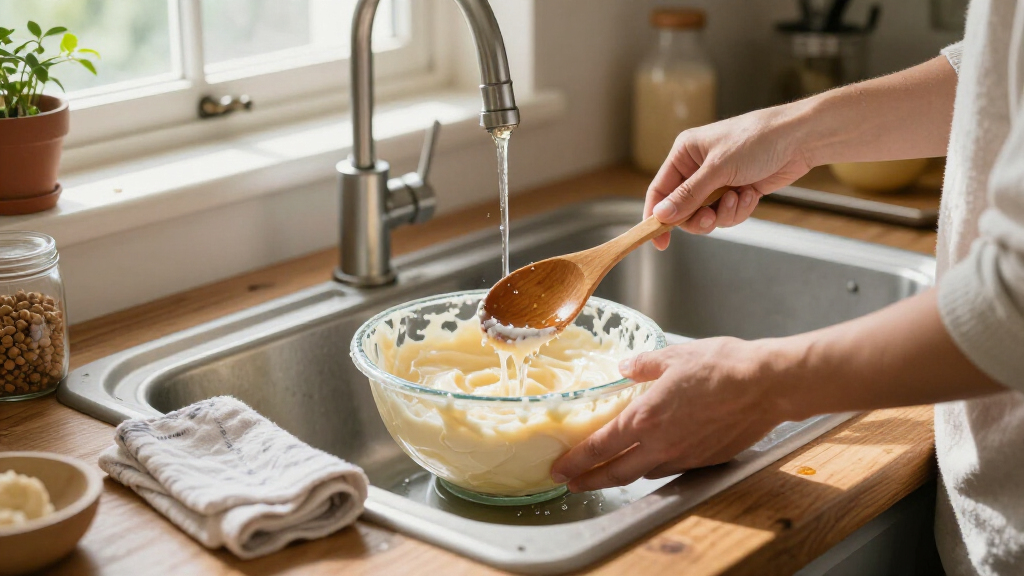
Pinsonnault’s suggested routine is straightforward: wash the utensil with warm water and a little dish soap, using a soft sponge rather than an abrasive scrubber. Do not leave it soaking in the sink, since submerging wood for an extended time adds moisture exposure. After washing, dry it promptly with a towel instead of leaving it wet to air-dry on the counter.
The report presents these steps as a way to limit the conditions associated with gradual wood damage. It does not specify a required water temperature beyond recommending warm water, or give a schedule for oiling or replacing wooden utensils.
wooden kitchen utensil set with care instructions
As an affiliate, we earn on qualifying purchases.
As an affiliate, we earn on qualifying purchases.
Care Labels and Wood Differences
The supplied report does not identify a publication date, test results, or a specific dishwasher cycle used to evaluate wooden spoons. It also does not say how quickly damage develops, since that can depend on the utensil and how often it is washed. The risk is described as gradual, not as a guaranteed result of any single cycle.
Some wooden utensils may be labeled dishwasher-safe, but the report does not list brands, models or the materials and finishes covered by those labels. For an individual item, the manufacturer’s care instructions are the relevant guide; where those instructions are missing or unclear, the report advises hand-washing.
wooden spatula and salad server set
As an affiliate, we earn on qualifying purchases.
As an affiliate, we earn on qualifying purchases.
Check Instructions Before Washing
Before putting a wooden utensil in a dishwasher, check its packaging or care label and follow the manufacturer’s directions. If no dishwasher-safe instruction is available, use the hand-washing routine described in the report: warm soapy water, a soft sponge, no soaking and prompt towel-drying.
Readers should also inspect utensils for cracks, splits or warping, although the report does not set out a formal inspection schedule or replacement threshold. It gives no new product guidance beyond the care recommendation, so the next step for owners is to use the instructions for their own utensil where available.
As an affiliate, we earn on qualifying purchases.
Key Questions
Can a wooden spoon go in the dishwasher once?
The Good Housekeeping report says one cycle is unlikely to ruin a spoon immediately. It advises avoiding repeated dishwasher cycles because damage can build gradually.
Why can dishwashers damage wooden spoons?
According to analyst Noah Pinsonnault, prolonged moisture, high temperatures and dishwasher detergents can dry out wood and wear down protective finishes, potentially contributing to warping, cracks or splits.
How should I wash a wooden spoon?
Wash it with warm water and a little dish soap using a soft sponge. Avoid soaking it, then dry it promptly with a towel.
Are any wooden utensils dishwasher-safe?
The report says some are labeled dishwasher-safe. Check the item’s packaging or care instructions and follow the manufacturer’s directions; if you cannot confirm it is dishwasher-safe, hand-wash it.
Source: rss
Halloween Picks
halloween
As an affiliate, we earn on qualifying purchases.